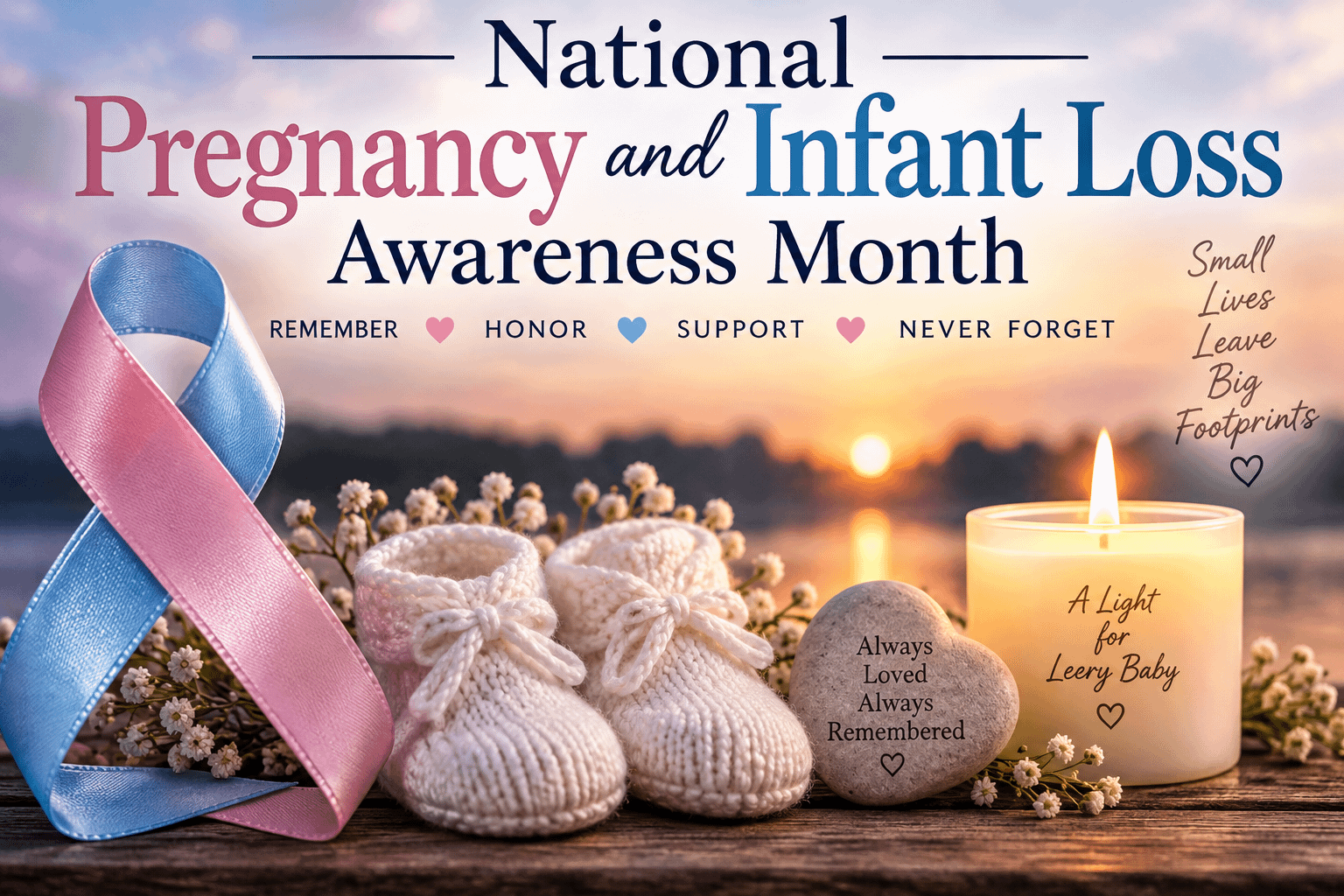
October is National Pregnancy and Infant Loss Awareness Month, a time dedicated to remembering babies who died during pregnancy or infancy and recognizing the parents and families who carry their love—and their grief—forward.
For many families, pregnancy begins with dreams.
There are imagined birthdays, first steps, first words, Christmas mornings, family photographs, school days, graduations, and countless ordinary moments that suddenly feel extraordinary because a new life is expected.
Then, sometimes, everything changes.
A miscarriage occurs.
A baby is stillborn.
A newborn dies shortly after birth.
An infant dies unexpectedly.
And a future that once seemed so real disappears.
Yet the love does not disappear with it.
That is one of the most important messages of National Pregnancy and Infant Loss Awareness Month:
A short life can leave a lifelong impact.
Pregnancy and Infant Loss Is More Than a Medical Event
Pregnancy and infant loss is sometimes described clinically.
Words such as miscarriage, stillbirth, neonatal death, and infant death are necessary medical terms, but they cannot fully describe what a grieving parent experiences.
Behind those words is a child.
Behind the statistics is a family.
Behind every loss are dreams that will never unfold in the way they were imagined.
A parent may have already chosen a name. They may have decorated a nursery, purchased clothes, heard a heartbeat, felt their baby move, imagined holding them, or pictured the person their child might someday become.
Even during an early pregnancy, an emotional relationship with the baby can begin almost immediately.
That is why telling someone, “At least it happened early,” can be incredibly painful.
There is no minimum amount of time someone must know or hold their child before they are allowed to grieve.
Love is not measured by days, weeks, months, or years.
And neither is grief.
The Invisible Grief Many Parents Carry
One of the hardest aspects of pregnancy loss is that much of the grief can be invisible.
When someone loses an older child or another close family member, people often recognize the magnitude of the loss. There are photographs, memories, stories, friendships, and a visible history of the person who died.
Pregnancy loss can be different.
Sometimes very few people even knew about the pregnancy.
The parents may have been waiting to announce it.
Suddenly, they are grieving someone the rest of the world never had the opportunity to know.
That can create profound loneliness.
A mother may remember exactly how it felt to carry her baby.
A father or partner may remember the moment they first heard about the pregnancy and the dreams that immediately began forming.
The outside world may move forward quickly.
The parents often do not.
There may be due dates that never arrive as expected.
Birthdays that exist only in imagination.
Anniversaries of the loss.
Mother’s Day.
Father’s Day.
Christmas.
Family gatherings.
Pregnancy announcements from friends.
Each can unexpectedly reopen grief.
Fathers Grieve Pregnancy and Infant Loss Too
Fathers are sometimes unintentionally overlooked after pregnancy or infant loss.
People understandably focus on the mother, particularly because she has experienced the physical aspects of pregnancy and loss.
But fathers can be grieving deeply as well.
A father may feel that he has to remain strong.
He may believe his responsibility is to support his partner while hiding his own pain.
People may ask him:
“How is she doing?”
Far fewer may ask:
“How are you doing?”
That question matters.
A father lost his baby too.
He may have imagined teaching his child to ride a bicycle, taking them fishing, watching sports together, celebrating birthdays, giving advice, or simply hearing someone call him “Dad.”
Those dreams were real.
Their disappearance can hurt deeply.
Men may express grief differently. Some become quiet. Some work more. Some withdraw. Some focus on taking care of everyone else. Some cry privately because they believe they are supposed to remain strong publicly.
There is no single correct way for a father—or anyone—to grieve.
The Dreams That Were Lost Matter Too
When a baby dies, parents are grieving more than the physical presence of their child.
They are also grieving the future.
They may grieve the first smile they never saw.
The first steps they never witnessed.
The bedtime stories they never read.
The birthday cakes they never baked.
The school pictures that were never taken.
The teenage years that never arrived.
The graduation they never attended.
The adult their child never had the opportunity to become.
Grief contains thousands of moments that were supposed to happen.
That is one reason child loss can remain present throughout a parent’s life.
Parents do not simply remember the child who died.
They may also wonder about the person their child would have become.
Please Don’t Tell Parents to “Move On”
Grieving parents sometimes hear well-intentioned statements that can cause more pain than comfort.
“You can try again.”
“Everything happens for a reason.”
“At least you already have children.”
“It was probably for the best.”
“You need to move on.”
These statements may be intended to provide hope, but grief rarely needs explanations.
It needs compassion.
Having another child does not replace the child who died.
A future pregnancy does not erase the previous one.
Another baby can bring enormous joy while the parents still carry love for the baby they lost.
Human hearts are capable of holding joy and grief simultaneously.
Instead of trying to explain the loss, sometimes the most powerful words are simply:
“I am so sorry. I am here for you.”
Say Their Baby’s Name
If the parents named their baby, do not be afraid to say the child’s name.
Many people avoid mentioning someone who died because they fear reminding the grieving person of their loss.
But grieving parents have not forgotten.
They remember every day.
Hearing their baby’s name can sometimes be comforting because it acknowledges that their child existed.
It tells them:
Your baby mattered.
Your love mattered.
Your grief matters.
Your child has not been forgotten.
Pregnancy After Loss Can Be Complicated
Pregnancy after loss can bring happiness, hope, anxiety, and fear at the same time.
A positive pregnancy test may bring excitement followed almost immediately by worry.
Every appointment can feel frightening.
Every ultrasound can bring memories.
Every unfamiliar sensation can cause concern.
Parents who once believed pregnancy naturally ended with bringing a baby home may no longer have that sense of certainty.
They have learned something they never wanted to learn:
Sometimes terrible things happen even when you desperately want everything to be okay.
Supporting someone through pregnancy after loss means understanding that joy and fear can coexist.
Allow them to feel both.
Remembering a Baby Who Died
Parents may choose many different ways to remember their child.
Some keep ultrasound photographs.
Some save hospital bracelets, blankets, footprints, or other keepsakes.
Some create memory boxes.
Some plant trees or flowers.
Some wear jewelry containing their child’s name, birthstone, initials, or another meaningful symbol.
Some donate to charities.
Some participate in remembrance walks.
Some light candles.
Some write letters to their child.
Some create traditions that continue year after year.
And some choose to remember privately.
There is no correct way to honor a child.
The important thing is that parents are allowed to remember in whatever way brings meaning to them.
October 15: Pregnancy and Infant Loss Remembrance Day
An especially meaningful date during October is October 15, Pregnancy and Infant Loss Remembrance Day.
Many families around the world participate in candle-lighting remembrance events that evening, creating a symbolic wave of light in memory of babies who died too soon.
A candle may seem like a small gesture.
But for grieving parents, it can represent something enormous.
It says:
You existed.
You were loved.
You are remembered.
Your life mattered.
For families who have experienced pregnancy or infant loss, knowing someone else remembers their child can mean more than people realize.
Supporting Someone After Pregnancy or Infant Loss
You do not need perfect words.
In fact, there may be no perfect words.
Simply being present can make a difference.
Check on them weeks and months later, not only immediately after the loss.
Remember important dates if they have shared them with you.
Listen when they want to talk.
Sit quietly when they do not.
Bring dinner.
Send a message.
Offer practical help.
Say their baby’s name when appropriate.
Most importantly, allow them to grieve without placing a deadline on their grief.
The funeral, memorial, hospital discharge, or first few weeks are not the end of grief.
Sometimes they are only the beginning.
To the Parents Who Have Lost a Baby
If you are a parent reading this because you have experienced miscarriage, stillbirth, neonatal death, or infant loss, your child’s life mattered.
Your relationship with your baby was real.
Your dreams were real.
Your love was real.
And therefore, your grief is real.
You do not have to justify why certain days hurt.
You do not have to explain why you still think about your baby years later.
You do not have to erase your child’s memory to prove that you are healing.
Healing does not require forgetting.
You can continue living while continuing to remember.
You can smile again while still missing your baby.
You can experience happiness while carrying grief.
You can love the people who are here while still loving the child who is not.
Love does not have to choose.
Remembering Every Baby
National Pregnancy and Infant Loss Awareness Month gives us an opportunity to speak about losses that were once frequently hidden behind closed doors.
It allows parents to tell their stories.
It allows families to say their babies’ names.
It gives communities an opportunity to listen.
And perhaps most importantly, it reminds grieving parents that they do not have to carry their grief completely alone.
Some babies lived only inside their mother’s womb.
Some lived for minutes.
Some lived for hours.
Some lived for days, weeks, or months.
But the length of someone’s life does not determine the depth of the love surrounding that life.
A tiny heartbeat can change a family forever.
A tiny pair of footprints can leave an enormous mark on someone’s heart.
And a child who was here for only a short time can be remembered for an entire lifetime.
This October, remember the babies who could not stay.
Remember the mothers who carried them.
Remember the fathers who dreamed about their futures.
Remember the siblings and grandparents who loved them.
Remember the families quietly carrying memories the rest of the world may never see.
Light a candle.
Speak their names.
Listen to their stories.
Honor their lives.
Because no matter how briefly they were here, they were here.
And they will always be loved.
Who will you hold in your heart and remember this National Pregnancy and Infant Loss Awareness Month?
Leave a Reply