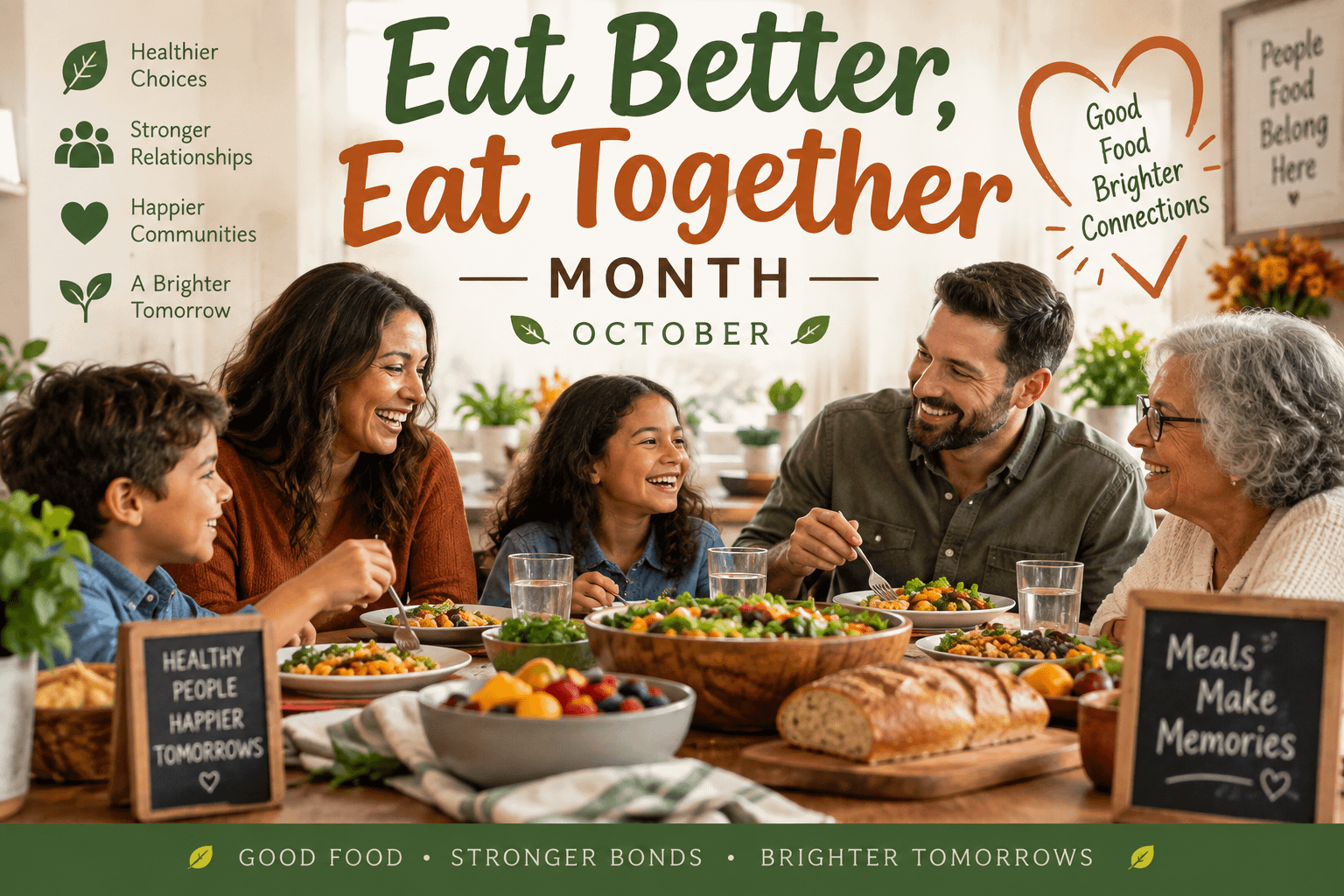
In a world where everyone seems to be moving in different directions, something as simple as sitting down together for a meal can become surprisingly rare. Work schedules, school activities, phones, television, errands, appointments, and everyday responsibilities can easily pull families and friends apart.
Eat Better, Eat Together Month, observed during October, encourages us to change that.
The idea is beautifully simple: make healthier food choices while making more time to enjoy meals together.
It isn’t about following a perfect diet. It isn’t about counting every calorie or completely eliminating the foods you love. And it certainly isn’t about creating elaborate meals every night.
Instead, Eat Better, Eat Together Month reminds us that food can nourish more than our bodies.
A shared meal can nourish relationships.
A dinner table can become a place for conversation, laughter, encouragement, storytelling, and connection.
Sometimes the healthiest thing about dinner isn’t what is on the plate.
It is who is sitting around the table.
Why Eating Together Matters
Think about some of your favorite memories involving food.
Maybe it was Sunday dinner at your grandparents’ house.
Maybe it was backyard barbecues during the summer.
Maybe it was pizza night with your children.
Perhaps it was Thanksgiving dinner surrounded by relatives, a birthday meal at someone’s favorite restaurant, or breakfast around the kitchen table before everyone started their day.
Food has always had a remarkable ability to bring people together.
For generations, meals have been one of the primary ways families communicate and connect. People gather around tables to celebrate accomplishments, discuss problems, tell stories, share traditions, and simply spend time together.
But modern life can make shared meals difficult.
One person eats before work. Another grabs something on the way home. Children may have sports practices or activities. Someone else eats while watching television or scrolling through a phone.
Before long, everyone may be eating separately.
Eat Better, Eat Together Month gives us a reason to intentionally bring people back together.
Even one additional shared meal each week can create another opportunity to reconnect.
Eating Better Doesn’t Mean Eating Perfectly
The phrase “eat better” can sometimes sound intimidating.
People may immediately imagine restrictive diets, expensive specialty foods, complicated recipes, or giving up everything they enjoy.
Healthy eating doesn’t have to work that way.
Eating better can begin with small choices.
Add vegetables to dinner.
Choose fruit for a snack.
Drink more water.
Cook at home more frequently.
Include whole grains.
Pay attention to portion sizes.
Try a new vegetable.
Reduce how often highly processed foods become the main part of a meal.
None of these changes require perfection.
The goal is simply to move in a healthier direction.
One better decision today can become another tomorrow.
Over time, those small choices can become habits.
Bring Back the Family Dinner
There is something special about gathering around a table.
Dinner gives everyone an opportunity to stop what they are doing and reconnect.
You can ask questions such as:
“What was the best part of your day?”
“What made you laugh today?”
“Did anything frustrate you?”
“What are you looking forward to tomorrow?”
Those conversations may seem ordinary, but ordinary conversations are often how relationships are built.
Children grow up.
Schedules change.
People move away.
Life rarely slows down on its own.
That is why making time for each other matters.
Years from now, someone may not remember exactly what you served for dinner.
But they might remember sitting around the table laughing with you.
Put the Phones Away
One of the easiest ways to improve a shared meal has nothing to do with food.
Put the phones away.
Technology allows us to communicate with people around the world, but it can sometimes distract us from the people sitting directly in front of us.
Consider making meals a phone-free time whenever possible.
Put devices somewhere away from the table.
Turn off the television.
Let messages wait.
For thirty minutes, give the people around you your attention.
Conversation may feel awkward at first if everyone is accustomed to looking at screens. Give it time.
Ask questions.
Tell stories.
Talk about upcoming plans.
Share something funny that happened during the day.
Connection grows when people feel heard.
Cook Together
Eating together can begin before anyone sits at the table.
Cooking can become part of the experience.
Give everyone something to do.
Someone can wash vegetables.
Another person can prepare a salad.
Someone can set the table.
Children can help with age-appropriate kitchen tasks.
Another family member might choose the music.
Cooking together transforms dinner from something one person has to prepare into something everyone helps create.
It can also teach valuable life skills.
Children who participate in cooking can learn how ingredients work, how meals are prepared, and how much effort goes into putting food on the table.
Most importantly, you’re spending time together.
Try New Foods Together
Eat Better, Eat Together Month can also become an opportunity for culinary adventures.
Choose one new food each week.
Try a vegetable you’ve never prepared.
Cook a dish from another culture.
Visit a farmers market and choose something unfamiliar.
Experiment with different herbs and spices.
Create homemade versions of restaurant favorites.
You can even let each family member choose a meal.
One person picks Monday’s dinner. Someone else chooses Friday’s.
Suddenly, healthy eating becomes less about restrictions and more about discovering new foods together.
Healthy Meals Don’t Have to Be Complicated
One reason people rely on takeout or convenience foods is time.
After a long day, spending two hours preparing dinner may not sound appealing.
Fortunately, nutritious meals don’t have to be complicated.
Simple dinners can include combinations such as grilled chicken, roasted vegetables, and rice; tacos with lean protein and plenty of vegetables; homemade soup and whole-grain bread; pasta with vegetables and protein; baked fish with potatoes and salad; or a stir-fry filled with colorful vegetables.
The formula can be simple:
Protein + vegetables + whole grains or another nutritious carbohydrate + something everyone enjoys.
Healthy eating becomes easier when it fits into real life.
Plan Ahead
Meal planning can make eating better much easier.
Before grocery shopping, decide what several meals will be for the upcoming week.
You don’t need to plan every bite.
Start with dinner.
Choose four or five meals and make a grocery list based on those meals.
Planning can reduce the nightly question:
“What are we going to eat?”
It can also reduce impulse purchases and last-minute trips for fast food.
Another helpful strategy is cooking extra.
If you’re making chicken, prepare enough for another meal.
If you’re making rice, cook extra.
Leftover ingredients can become tomorrow’s lunch or part of another dinner.
A little preparation today can save considerable time later.
Eat More Colors
One easy way to think about healthier eating is color.
Fruits and vegetables naturally come in an incredible variety of colors.
Red tomatoes.
Orange carrots.
Yellow peppers.
Green broccoli.
Blueberries.
Purple cabbage.
Instead of obsessing over complicated nutrition rules, challenge yourself to put more natural colors on your plate.
You could even turn it into a family challenge.
How many different fruits and vegetables can everyone try during October?
Children might enjoy keeping a list and seeing how many colors they can eat.
Healthy habits are often easier to maintain when they feel enjoyable rather than forced.
Don’t Forget Breakfast
Eating together doesn’t have to mean dinner.
If evenings are chaotic, breakfast might work better.
Wake up slightly earlier and eat together before work or school.
It doesn’t have to be elaborate.
Eggs and toast.
Oatmeal with fruit.
Yogurt and berries.
Whole-grain cereal.
A breakfast sandwich.
Even fifteen minutes around the kitchen table can create a positive beginning to the day.
Weekend Meals Count Too
If weekdays are simply too busy, make weekends your time to reconnect.
Saturday breakfast could become a tradition.
Sunday dinner could become something everyone looks forward to.
Invite grandparents, siblings, friends, neighbors, or extended family occasionally.
Shared meals don’t have to happen every night to be meaningful.
Consistency matters more than perfection.
A weekly tradition can become something people remember for years.
Food Connects Generations
Recipes often carry stories.
Maybe your grandmother made a particular soup.
Perhaps your father had a famous barbecue recipe.
Maybe your family always prepared a certain dish during holidays.
These recipes are more than instructions for preparing food.
They are pieces of family history.
Eat Better, Eat Together Month can be a wonderful opportunity to preserve those traditions.
Ask older relatives about meals they remember from childhood.
Cook one of their recipes.
Write it down.
Ask where it came from.
You might discover stories you’ve never heard before.
Someday, someone may prepare that same recipe and tell your story while making it.
That is how traditions survive.
Invite Someone Who Might Be Alone
Eating together doesn’t have to be limited to immediate family.
Think about someone in your life who may regularly eat alone.
A neighbor.
An older relative.
A friend going through a difficult season.
A coworker who recently moved to the area.
Someone who has experienced loss.
Invite them to dinner.
You don’t need to prepare anything extravagant.
Make spaghetti.
Order pizza.
Cook burgers.
Prepare sandwiches.
The menu doesn’t have to be impressive.
The invitation matters.
Sometimes sharing a meal is another way of saying:
You matter. You are welcome here. You don’t have to be alone tonight.
Sharing Meals After Loss
Food and grief can have a complicated relationship.
After losing someone you love, the dinner table can suddenly feel painfully different.
An empty chair can become impossible to ignore.
A favorite meal can bring back memories.
A recipe can remind you of holidays, birthdays, conversations, or ordinary evenings you once took for granted.
For someone grieving, eating together may sometimes hurt.
But shared meals can also become part of healing.
Cooking someone’s favorite recipe can become a way to honor them.
Telling stories around the table can keep memories alive.
You might say:
“Remember when they used to ask for this?”
Or:
“This was always their favorite.”
The person may no longer be sitting at the table, but the love they brought into your life can still have a place there.
Don’t Wait for the Perfect Moment
One of life’s hardest lessons is realizing how quickly ordinary moments become memories.
We often assume there will always be another dinner.
Another holiday.
Another birthday.
Another weekend.
Another chance to sit together.
But life can change unexpectedly.
That doesn’t mean we should live afraid of what might happen.
It means we should appreciate what we have while we have it.
Sit at the table.
Tell the stories.
Laugh loudly.
Ask questions.
Listen carefully.
Make someone’s favorite meal.
Stay a little longer.
Take the picture.
Enjoy the moment.
Because someday you may realize that the ordinary Tuesday dinner you barely thought about became one of the memories you treasure most.
A Simple Challenge for Eat Better, Eat Together Month
This October, try something simple.
Choose at least one meal each week when everyone who can participate sits together.
Put away the phones.
Turn off the television.
Prepare something reasonably nutritious.
Then talk.
You don’t need a perfectly decorated table.
You don’t need expensive ingredients.
You don’t need a gourmet recipe.
You simply need food, time, and people willing to be present with one another.
If you already eat together regularly, invite someone else to join you.
If your family lives far away, schedule a meal when you can visit.
If you live alone, invite a friend or neighbor.
Eating together isn’t only about families living under the same roof.
It’s about human connection.
More Than a Meal
Eat Better, Eat Together Month reminds us that healthy living involves more than nutrients.
Food nourishes our bodies.
Relationships nourish our lives.
When we combine the two, a simple meal can become something much greater.
It becomes conversation.
It becomes laughter.
It becomes tradition.
It becomes belonging.
It becomes memory.
So this October, make an effort to eat a little better.
Cook something fresh.
Try a new recipe.
Add more fruits and vegetables.
Drink more water.
Invite someone over.
And whenever possible, sit down and enjoy your meal with someone you care about.
Because sometimes the most important ingredient isn’t something you put into the recipe.
It’s the people you share it with.
Who would you love to sit down and share a meal with this month?
Leave a Reply