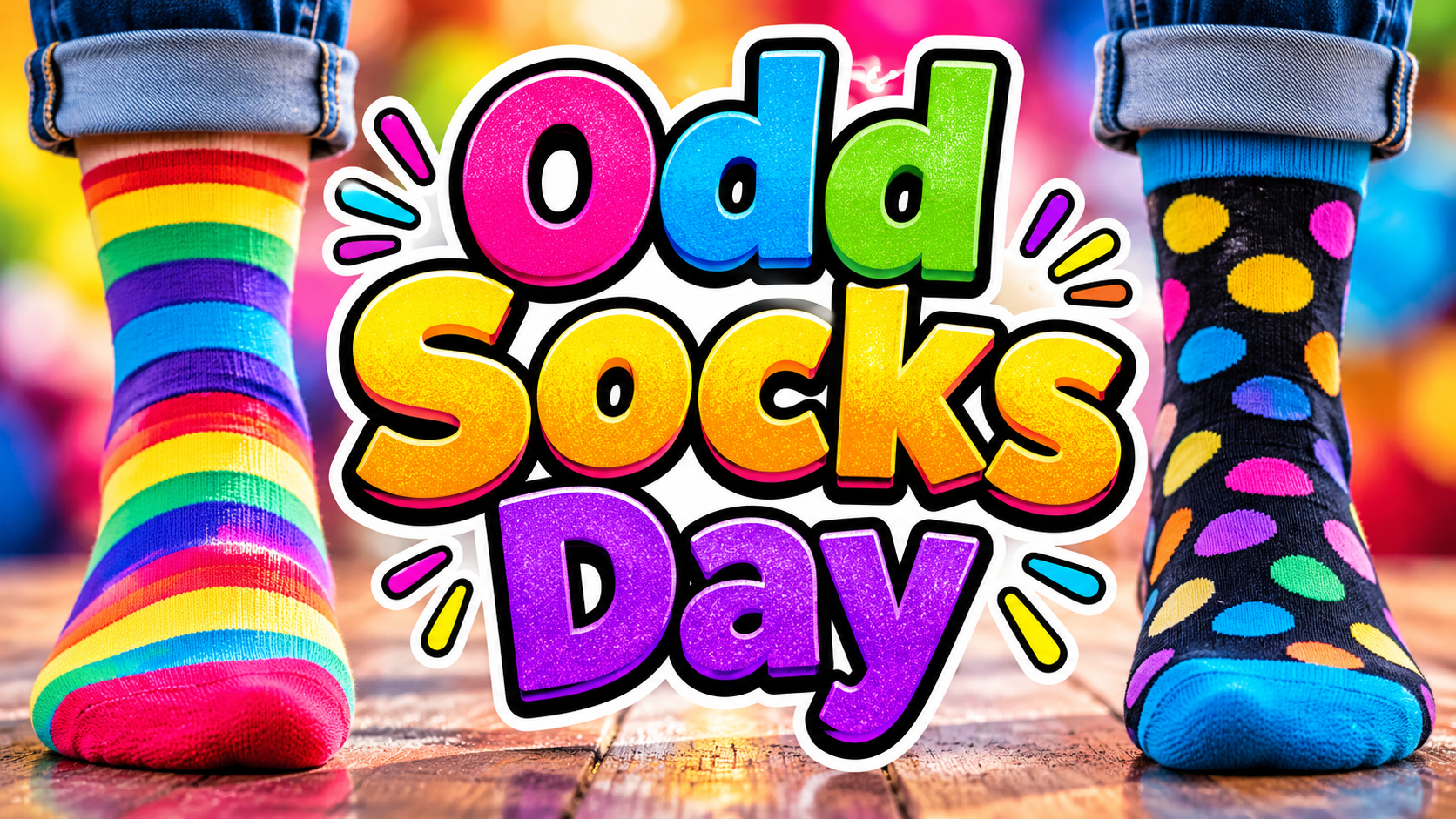
Every person in the world is different. We have different personalities, backgrounds, abilities, interests, and ways of seeing life. Yet sometimes, those differences become reasons for people to be judged, excluded, or bullied. Odd Socks Day reminds us that being different is not something to hide. It is something to celebrate.
Odd Socks Day is a fun, colorful, and meaningful occasion that encourages people of all ages to wear mismatched socks as a symbol of individuality, acceptance, and kindness. What may seem like a simple fashion choice carries a much bigger message: we do not have to look alike, think alike, or act alike to treat one another with respect.
From classrooms and workplaces to homes and communities, Odd Socks Day brings people together through something as simple as wearing two different socks.
But behind the colorful patterns and mismatched designs is an important conversation about bullying, diversity, inclusion, and the power of accepting people exactly as they are.
What Is Odd Socks Day?
Odd Socks Day is an awareness event that encourages people to wear two different socks to celebrate individuality and promote acceptance.
The event is particularly associated with Anti-Bullying Week in England, Wales, and Northern Ireland, where schools, organizations, and communities participate in activities that encourage kindness and respect.
Instead of requiring expensive costumes, special uniforms, or elaborate preparations, participants simply choose two socks that do not match.
One sock might have stripes while the other has polka dots. One might be bright yellow while the other is blue. Some people wear socks featuring different animals, cartoon characters, or colorful designs.
There are no strict fashion rules.
The idea is that everyone can participate regardless of their age, background, or financial situation.
The mismatched socks represent something important about humanity: no two people are exactly alike, and that is perfectly okay.
Odd Socks Day is not about who has the funniest socks or the most unusual designs. It is about recognizing that our differences help make the world interesting, meaningful, and diverse.
When Is Odd Socks Day Celebrated?
Odd Socks Day is commonly celebrated during Anti-Bullying Week in November.
In 2026, the UK Anti-Bullying Alliance’s Odd Socks Day falls on Monday, November 16, 2026, the opening day of Anti-Bullying Week.
The exact date can change from year to year because the observance is connected to the annual Anti-Bullying Week schedule.
Some schools, workplaces, and community organizations may choose different dates to accommodate their own calendars.
Although the event is especially recognized in the United Kingdom, its message has relevance worldwide.
Bullying, discrimination, and social exclusion are challenges that affect communities everywhere. Odd Socks Day provides an accessible opportunity to discuss these issues and encourage positive behavior.
The History of Odd Socks Day
Odd Socks Day became widely recognized through the work of the Anti-Bullying Alliance, a coalition of organizations and individuals working to prevent bullying and create safer environments for children and young people.
The initiative was developed as a fun and inclusive way to help launch Anti-Bullying Week.
The concept was intentionally simple.
Rather than asking participants to purchase special clothing or accessories, organizers encouraged people to wear socks they already owned.
This approach helped make participation accessible to families from different financial backgrounds.
The event also became associated with Andy Day, a British children’s television presenter, and his band Andy and the Odd Socks.
Through music, performances, and awareness campaigns, Andy and the Odd Socks have helped spread positive messages about friendship, acceptance, and standing up against bullying.
Over time, Odd Socks Day has become a recognizable part of Anti-Bullying Week activities.
Schools have embraced the event through classroom discussions, creative projects, assemblies, and activities focused on kindness.
What began as a lighthearted way to encourage participation has developed into a meaningful reminder that everyone deserves to feel accepted.
Why Do We Wear Mismatched Socks?
At first glance, wearing mismatched socks might seem silly.
After all, most people grow up learning that their socks should match.
But that expectation is exactly what makes Odd Socks Day meaningful.
When someone wears two different socks, they are deliberately stepping outside an ordinary social convention.
They are demonstrating that being different does not have to be embarrassing.
Think about how often people feel pressured to fit in.
Children may worry about wearing the wrong clothes, enjoying unpopular hobbies, or behaving differently from their classmates.
Teenagers may struggle with expectations surrounding appearance, popularity, and social acceptance.
Adults can experience similar pressures in workplaces, relationships, and social situations.
Odd Socks Day challenges those expectations through a simple act.
It reminds participants that differences do not make someone less valuable.
A striped sock and a spotted sock can belong together, just as people with different personalities, cultures, abilities, and experiences can belong in the same community.
The socks may not match, but they still serve their purpose.
And people do not have to be identical to respect, support, and appreciate one another.
Odd Socks Day and Anti-Bullying Awareness
One of the most important purposes of Odd Socks Day is to encourage conversations about bullying.
Bullying is more than an occasional disagreement or argument.
It generally involves repeated harmful behavior and an imbalance of power, whether that power comes from physical strength, social influence, access to information, or other circumstances.
Bullying can take several forms.
Physical bullying may involve hitting, pushing, damaging belongings, or other forms of physical intimidation.
Verbal bullying includes repeated insults, cruel remarks, threats, and name-calling.
Social bullying may involve deliberately excluding someone, spreading rumors, or attempting to damage their relationships.
Cyberbullying occurs through digital communication, including social media, messaging platforms, and online communities.
The emotional effects of bullying can be significant.
People who experience bullying may struggle with confidence, loneliness, anxiety, sadness, or fear of participating in everyday activities.
Some may begin to believe that the differences making them targets of bullying are personal flaws.
Odd Socks Day challenges that harmful idea.
Its message is that nobody should have to change who they are simply to avoid mistreatment.
However, wearing mismatched socks alone will not prevent bullying.
Meaningful prevention requires consistent action from schools, families, workplaces, and communities.
That includes listening to people who report bullying, addressing harmful behavior, establishing clear expectations, and creating environments where everyone feels safe.
Odd Socks Day can help start those conversations.
The responsibility to continue them belongs to all of us.
The Importance of Celebrating Individuality
Imagine a world where everyone dressed alike, thought alike, enjoyed the same activities, and had identical personalities.
There would be little room for creativity, discovery, or different perspectives.
Our differences contribute to the richness of everyday life.
Some people are outgoing and enjoy being surrounded by others.
Some are quiet and prefer meaningful conversations with a few close friends.
Some express themselves through art, music, writing, or sports.
Others enjoy science, technology, cooking, gardening, or helping their communities.
No single personality or interest is inherently more valuable than another.
Individuality also extends beyond hobbies and personal preferences.
People experience the world through different cultural traditions, physical abilities, family circumstances, and life experiences.
Those differences deserve understanding rather than judgment.
Odd Socks Day encourages us to recognize that people should not have to earn acceptance by becoming more like everyone else.
Everyone deserves basic dignity and respect.
Celebrating individuality does not mean ignoring the things we share.
It means understanding that people can have meaningful connections without being exactly alike.
How Schools Can Celebrate Odd Socks Day
Schools play an important role in helping children understand the meaning behind Odd Socks Day.
While wearing colorful socks creates excitement, the greatest value comes from the conversations and lessons surrounding the event.
Teachers can encourage students to discuss what makes each person unique and why those differences deserve respect.
Classrooms might create displays featuring drawings of mismatched socks, with each design representing a positive quality.
Students could write encouraging messages to classmates or share examples of times when someone showed them kindness.
Reading stories about friendship, acceptance, and inclusion can help younger children understand these concepts.
Older students may benefit from discussions about peer pressure, online behavior, exclusion, and the importance of speaking up when someone is mistreated.
Schools can also use the occasion to remind students how to report bullying and where to find support.
Participation should remain welcoming and voluntary.
A child who forgets to wear mismatched socks, prefers matching socks, or cannot participate for another reason should never feel excluded.
After all, an event promoting acceptance should practice the same values it teaches.
How Adults Can Participate in Odd Socks Day
Odd Socks Day is not just for children.
Adults can participate at work, at home, or in their communities.
Wearing mismatched socks to the office can create an opportunity to discuss respectful workplace behavior.
Coworkers may use the occasion to reflect on how they welcome new employees, respond to differences, and support colleagues who feel excluded.
Families can participate together by choosing mismatched socks and talking about the importance of treating others kindly.
Parents and caregivers can encourage children to share their experiences with friendship, teasing, and social pressure.
Community groups can organize awareness activities that promote inclusion.
Even someone spending the day at home can participate by wearing mismatched socks and reflecting on the event’s message.
The most important part is not where someone celebrates.
It is what they take away from the experience.
10 Simple Ways to Celebrate Odd Socks Day
There are many creative ways to recognize this meaningful occasion without spending much money.
1. Wear two different socks. Choose colors, patterns, or designs that would not normally go together.
2. Encourage family participation. Invite household members to wear their favorite mismatched combinations.
3. Start a conversation about kindness. Ask someone what acceptance means to them.
4. Compliment someone sincerely. Recognize a positive quality that makes another person special.
5. Teach children about bullying. Explain why repeated teasing, exclusion, and intimidation can be harmful.
6. Share a positive message. Encourage others to embrace their individuality and respect differences.
7. Create an odd socks art project. Draw or decorate paper socks with encouraging words.
8. Reach out to someone who feels left out. A friendly invitation or thoughtful conversation can make a difference.
9. Celebrate different talents. Recognize the unique abilities and interests of people around you.
10. Practice kindness beyond the occasion. Carry the day’s message into everyday interactions.
These activities may appear small, but meaningful change often begins with ordinary decisions.
Why Kindness Matters More Than We Realize
Kindness is sometimes mistaken for weakness.
In reality, treating others with compassion often requires patience, courage, and emotional maturity.
It is easy to be kind to people who agree with us, share our interests, or belong to our social circles.
The greater challenge comes when we encounter someone whose experiences, beliefs, or personality differ from our own.
Kindness asks us to recognize another person’s humanity even when we do not fully understand their perspective.
It means choosing not to participate in cruel jokes.
It means refusing to spread rumors.
It means including someone who has been repeatedly left out.
And sometimes, it means having the courage to tell another person that their behavior is hurtful.
Odd Socks Day reminds us that kindness should not depend on how closely someone resembles us.
Every person has a story that others may not fully understand.
A classmate who appears withdrawn may be experiencing difficulties at home.
A coworker who seems unusually quiet may be facing personal challenges.
A stranger who behaves differently may simply experience the world in another way.
We cannot know everything another person is carrying.
But we can choose to treat them with dignity.
Teaching Children That Being Different Is Okay
Children begin noticing differences at an early age.
They recognize variations in appearance, language, behavior, interests, and abilities.
Those observations are natural.
What matters is how adults help children interpret them.
When differences are treated with curiosity and respect, children can learn that diversity is a normal part of life.
When differences are mocked or used to exclude others, harmful attitudes may develop.
Parents, teachers, and caregivers can help by modeling respectful behavior.
Children notice how adults speak about people who are different from them.
They also notice whether adults intervene when someone is being mistreated.
Encouraging children to develop empathy can help them understand how their words and actions affect others.
It is equally important to teach children that they deserve respect themselves.
Being kind does not mean accepting bullying or allowing others to violate personal boundaries.
Children should know that they can seek help, speak up, and expect adults to take their concerns seriously.
Odd Socks Day offers a memorable opportunity to reinforce those lessons.
The Deeper Meaning Behind Two Different Socks
The beauty of Odd Socks Day is that its message is easy to understand but powerful enough to influence how we treat one another.
Two socks can be completely different and still belong together.
One may be bright and colorful.
The other may be plain and simple.
One may feature bold patterns.
The other may have a quiet, understated design.
Neither has to become identical to the other.
That idea applies to friendships, families, schools, workplaces, and communities.
We do not have to share every opinion, interest, or life experience to show one another compassion.
We can disagree respectfully.
We can appreciate different perspectives.
We can recognize that everyone brings something valuable to the world.
And we can stop expecting people to hide the qualities that make them unique.
The goal is not to create a world where everyone is the same.
It is to create one where differences do not become excuses for cruelty.
Making Every Day an Odd Socks Day
An awareness event can inspire people for a day, but its greatest success comes when the message continues afterward.
The socks eventually go into the laundry.
The classroom decorations come down.
The photographs and social media posts become memories.
But the need for kindness and acceptance remains.
Every day provides opportunities to make someone feel welcome.
Every day gives us chances to challenge bullying, encourage individuality, and support people who feel overlooked.
We can make room for someone new at the table.
We can listen without immediately judging.
We can recognize when a joke has crossed the line.
We can apologize when our own words cause harm.
And we can remind people that they do not need to change everything about themselves to deserve friendship, respect, or belonging.
Those choices matter far more than any particular pair of socks.
Final Thoughts: Different Socks, Equal Worth
Odd Socks Day may be one of the simplest awareness events to participate in, but its message deserves serious attention.
It celebrates individuality, encourages kindness, and reminds us that differences should never be used as reasons to bully or exclude someone.
We live in a world where people often feel pressure to fit in, meet expectations, and hide the parts of themselves that others may not understand.
Odd Socks Day offers a different perspective.
You do not have to match everyone else to belong.
You do not have to share someone else’s personality, appearance, interests, or experiences to deserve respect.
And you do not have to become someone else to have value.
So when Odd Socks Day arrives, reach into your sock drawer and choose two that do not match.
Wear them proudly.
Let them remind you that individuality is worth celebrating and kindness is always worth practicing.
Most importantly, remember that the true meaning of Odd Socks Day is not found in what we wear on our feet.
It is found in how we treat the people walking beside us.
If you could share one message with someone who feels different, excluded, or afraid to be themselves, what would you want them to know?

Leave a Reply