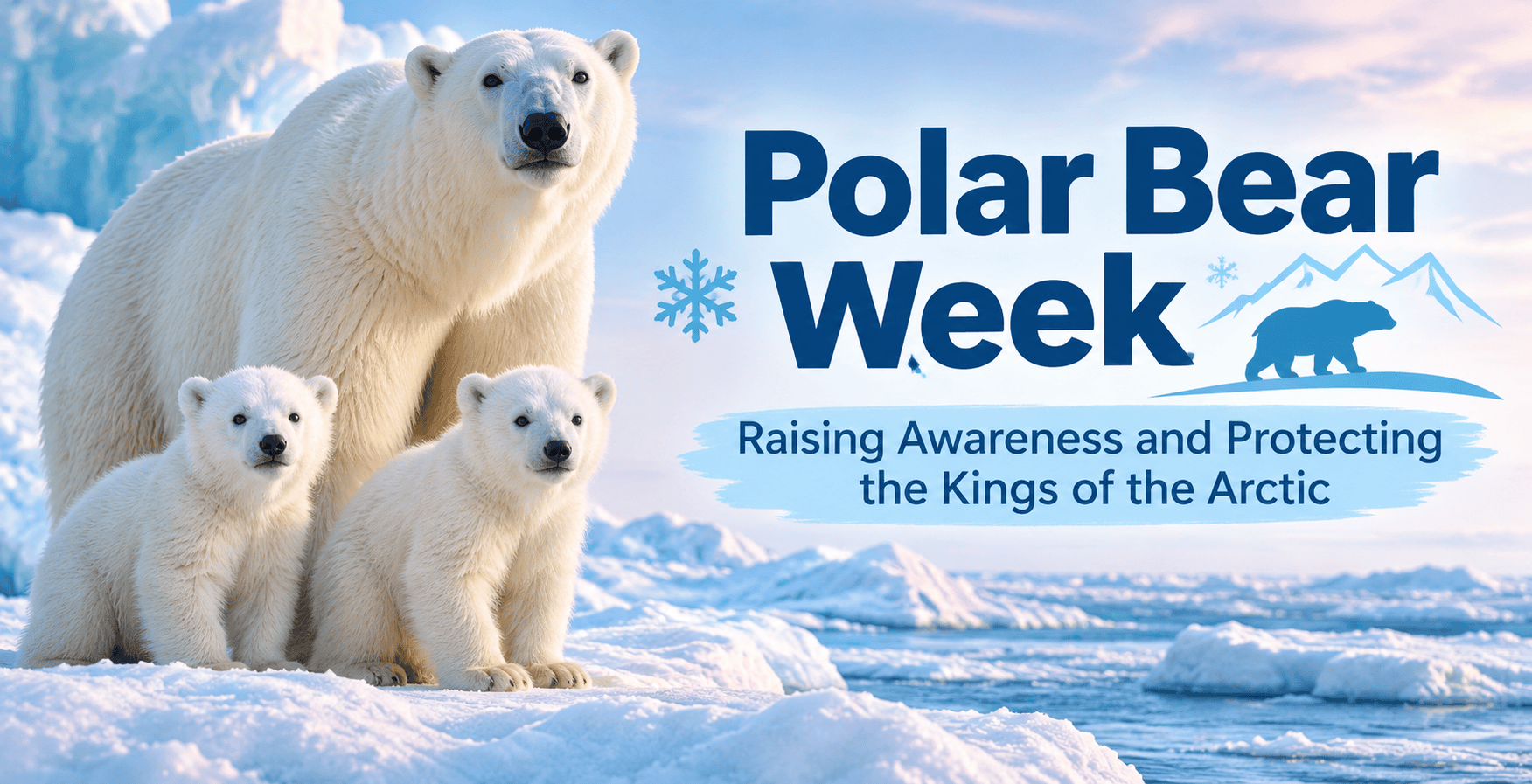
Every year, Polar Bear Week brings attention to one of the world’s most recognizable and extraordinary animals—the polar bear. These powerful Arctic predators symbolize strength, survival, and the beauty of the natural world. Yet despite their remarkable ability to thrive in one of Earth’s harshest environments, polar bears face growing challenges as their icy habitat continues to change.
Polar Bear Week is more than a celebration of these magnificent creatures. It is an opportunity to learn about their lives, understand the importance of Arctic sea ice, and recognize the conservation efforts needed to protect their future.
From their incredible hunting abilities to their essential role in the Arctic ecosystem, polar bears remind us how closely wildlife and the environment are connected.
What Is Polar Bear Week?
Polar Bear Week is an annual wildlife awareness and conservation observance organized by Polar Bears International. It traditionally takes place in early November, coinciding with the seasonal gathering of polar bears near Churchill, Manitoba, Canada, as they wait for Hudson Bay to freeze.
During this time, conservation organizations, researchers, educators, and wildlife enthusiasts work together to raise awareness about polar bears and the environmental challenges affecting their survival.
The observance emphasizes the importance of protecting Arctic sea ice, which polar bears depend on for hunting, traveling, and accessing food.
Polar Bear Week also encourages individuals and communities to learn more about climate change, wildlife conservation, and the actions that can help protect Arctic ecosystems.
Although polar bears live far from most human communities, the environmental changes affecting their habitat are connected to broader changes taking place across the planet.
When Is Polar Bear Week Celebrated?
Polar Bear Week is observed annually in early November, although the exact dates can vary from year to year.
The timing is especially significant because it corresponds with an important period in the lives of polar bears living around western Hudson Bay.
During the warmer months, sea ice melts, forcing many polar bears onto land. As autumn progresses and temperatures begin to fall, the bears gather near the coast, waiting for the water to freeze.
Once the ice returns, they can resume hunting seals, their primary food source.
This seasonal gathering provides researchers and conservationists with opportunities to observe polar bears, study their behavior, and educate the public about their dependence on sea ice.
The History of Polar Bear Week
Polar Bear Week was established by Polar Bears International, a nonprofit conservation organization dedicated to protecting polar bears and the sea ice they depend on.
The organization works with scientists, educators, conservation professionals, and communities to promote research and public understanding of polar bear conservation.
Churchill, Manitoba, often called the Polar Bear Capital of the World, plays a central role in the observance.
Each autumn, polar bears gather along the western shores of Hudson Bay as they wait for the sea ice to form.
This remarkable natural event has attracted researchers, photographers, wildlife enthusiasts, and conservation organizations for decades.
Polar Bear Week uses this seasonal gathering to highlight the challenges polar bears face and the importance of protecting their Arctic environment.
Over time, the observance has become an international opportunity for people to learn about polar bears, follow conservation research, and participate in educational activities.
Why Are Polar Bears Important?
Polar bears are among the Arctic’s most important predators.
As apex predators, they occupy the top of their food chain and play an important role in the marine ecosystem.
Their primary prey consists of seals, particularly ringed seals and bearded seals.
By hunting seals, polar bears participate in the complex relationships that help shape Arctic marine ecosystems.
Polar bears are also considered an important indicator species.
Because they depend heavily on sea ice, changes in their health, distribution, and survival can provide scientists with valuable information about environmental conditions in the Arctic.
Studying polar bears helps researchers better understand the effects of changing temperatures, sea ice loss, and shifting ecological relationships.
Protecting polar bears is therefore about more than preserving a single species. It is also about maintaining the health and stability of Arctic ecosystems.
10 Fascinating Facts About Polar Bears
Polar bears are extraordinary animals with adaptations that allow them to survive in freezing Arctic conditions.
1. Polar Bears Are the Largest Living Bear Species
Polar bears are among the largest living land carnivores.
Adult males commonly weigh between 770 and 1,500 pounds, although individual bears can be larger or smaller.
Females are generally much smaller than males.
Their enormous size helps them survive the Arctic’s demanding environment.
2. Their Fur Is Not Actually White
Although polar bears appear white, their fur is made of largely transparent, pigment-free hairs that scatter and reflect light.
Beneath their thick fur, polar bears have black skin.
Their appearance provides camouflage in snowy and icy surroundings.
3. Polar Bears Are Excellent Swimmers
Polar bears are powerful swimmers capable of traveling long distances through Arctic waters.
Their large front paws help propel them through the water, while their hind legs assist with steering.
Swimming allows them to move between ice floes and reach different parts of their habitat.
However, long-distance swimming can require substantial energy, particularly for young bears.
4. Polar Bears Depend on Sea Ice
Unlike many other bear species, polar bears spend much of their lives on Arctic sea ice.
They use the ice as a platform for hunting seals, traveling, and accessing important feeding areas.
Without sufficient sea ice, many polar bears have greater difficulty obtaining the food they need.
5. Polar Bears Have an Incredible Sense of Smell
Polar bears possess an exceptionally developed sense of smell.
They can detect seals and other potential food sources from considerable distances, depending on wind and environmental conditions.
This ability is essential for locating prey across the vast Arctic landscape.
6. Polar Bear Cubs Are Born Extremely Small
Despite growing into enormous predators, polar bear cubs are tiny at birth.
Newborn cubs typically weigh around one to two pounds.
They are born in sheltered maternity dens, where their mothers provide warmth, protection, and nourishment.
7. Polar Bears Have Thick Layers of Insulation
Polar bears survive extreme cold through a combination of dense fur and thick body fat.
These adaptations help retain body heat in freezing temperatures.
Their relatively small ears and short tails also help reduce heat loss.
8. Polar Bears Are Mostly Solitary
Adult polar bears generally live alone, except during mating periods and when mothers are raising cubs.
They travel across extensive areas in search of food.
Their solitary lifestyle reflects the challenges of finding prey in the Arctic.
9. Polar Bears Can Travel Great Distances
Polar bears may travel hundreds or even thousands of miles over time while following sea ice and searching for suitable hunting conditions.
Their movements are closely connected to seasonal changes in the Arctic.
10. Polar Bears Are Classified as Vulnerable
The International Union for Conservation of Nature classifies polar bears as Vulnerable.
The primary long-term threat to the species is the loss of sea ice habitat associated with climate change.
Scientists continue monitoring different polar bear populations to understand how changing Arctic conditions affect their survival.
Why Are Polar Bears Threatened?
Although polar bears are powerful predators, they face environmental challenges that physical strength alone cannot overcome.
The most significant threat is the ongoing loss of Arctic sea ice.
Polar bears rely on sea ice to hunt seals, which provide the high-fat nutrition necessary for their survival.
As Arctic temperatures rise, sea ice forms later in some regions and melts earlier in the year.
This can shorten the amount of time polar bears have access to productive hunting grounds.
When bears spend longer periods on land, they may be forced to rely on stored body fat or search for alternative food sources.
For some populations, these changes can affect body condition, reproduction, and cub survival.
Additional concerns include pollution, industrial development, increased shipping activity, and human-wildlife conflicts.
The severity of these threats varies across different Arctic regions.
How Climate Change Affects Polar Bears
Climate change is one of the most serious long-term challenges facing polar bears.
The Arctic is warming much faster than the global average, resulting in significant changes to sea ice conditions.
These changes affect polar bears in several ways.
Reduced hunting opportunities: Less sea ice can make it more difficult for bears to reach seals.
Longer fasting periods: Some populations must spend more time without reliable access to food.
Greater energy demands: Bears may need to travel farther or swim longer distances to reach suitable habitat.
Lower reproductive success: In some populations, reduced food availability can affect mothers’ ability to raise healthy cubs.
Increased encounters with humans: As bears spend more time on land in certain regions, encounters with nearby communities may become more frequent.
Scientists emphasize that the effects are not identical across every polar bear population. Some populations are experiencing more severe changes than others.
Nevertheless, long-term sea ice loss remains a major conservation concern.
The Importance of Churchill, Manitoba
Churchill, Manitoba, is one of the world’s most famous destinations for observing polar bears in their natural habitat.
Located along the western coast of Hudson Bay, the community experiences a remarkable seasonal gathering of polar bears each autumn.
The bears arrive near the coastline while waiting for the bay to freeze.
Once sea ice forms, they can return to hunting seals.
This annual gathering has made Churchill an important location for polar bear research, conservation education, and responsible wildlife tourism.
Researchers use the region to study polar bear behavior, movement, health, and responses to changing environmental conditions.
The community also provides an important example of how people and wildlife can coexist through education, careful planning, and safety measures.
How to Celebrate Polar Bear Week
Polar Bear Week offers opportunities for individuals, families, schools, and communities to participate in wildlife education and conservation.
Learn About Polar Bears
Spend time researching polar bear behavior, habitat, diet, and survival adaptations.
Understanding these animals is an important first step toward appreciating their role in the Arctic.
Watch Polar Bears in Their Natural Habitat
Wildlife documentaries and educational livestreams can provide fascinating views of polar bears.
Observing their behavior helps people develop a greater appreciation for these remarkable animals.
Support Conservation Organizations
Consider supporting reputable organizations dedicated to polar bear research, Arctic conservation, and environmental education.
Contributions can help fund scientific studies, community programs, and conservation initiatives.
Teach Children About Arctic Wildlife
Polar Bear Week is an excellent opportunity to introduce children to Arctic ecosystems.
Educational activities might include reading books about polar bears, creating Arctic-themed artwork, or learning about the differences between polar bears and other bear species.
Reduce Your Environmental Impact
Individual actions can contribute to broader efforts to address climate change.
Improving energy efficiency, reducing unnecessary energy consumption, and supporting cleaner energy systems are examples of practical steps.
Share Polar Bear Facts
Use social media or conversations with friends and family to share interesting information about polar bears.
Accurate educational information can help raise awareness about wildlife conservation.
Participate in Community Activities
Schools, libraries, wildlife centers, and environmental organizations may organize educational activities during Polar Bear Week.
Participating in these events can help encourage greater interest in conservation.
Why Protecting Arctic Sea Ice Matters
Arctic sea ice is essential to polar bears, but its importance extends far beyond one species.
Sea ice provides habitat and influences food webs involving seals, fish, plankton, and other Arctic organisms.
It also plays an important role in Earth’s climate system.
Bright ice reflects much of the sunlight reaching its surface, helping regulate temperatures.
When sea ice melts, darker ocean water becomes exposed and absorbs more solar energy.
This contributes to additional warming.
Changes in sea ice also affect Indigenous communities whose cultures, livelihoods, travel routes, and food systems are closely connected to Arctic environments.
Protecting Arctic ecosystems therefore involves ecological, environmental, and human considerations.
The Role of Scientists in Polar Bear Conservation
Scientific research is essential for understanding the challenges polar bears face.
Researchers study population trends, movement patterns, reproductive success, body condition, and habitat changes.
Modern research methods include satellite tracking, aerial surveys, genetic analysis, and field observations.
These tools help scientists understand how polar bears respond to changing environmental conditions.
Researchers also work with Indigenous communities, whose traditional knowledge and observations contribute valuable insights into Arctic wildlife and ecosystems.
By combining scientific research with local knowledge, conservation efforts can better address the needs of polar bears and the communities that share their environment.
Can Polar Bears Survive in a Changing Arctic?
The future of polar bears depends heavily on what happens to their sea ice habitat.
Polar bears have evolved remarkable adaptations for surviving Arctic conditions, but those adaptations are closely tied to a frozen marine environment.
Although some bears can consume alternative foods on land, these sources generally cannot replace the nutritional benefits of hunting seals across sea ice.
Conservation scientists emphasize the importance of reducing greenhouse gas emissions to limit long-term habitat loss.
Protecting important habitats, managing human-bear interactions, reducing pollution, and supporting scientific research are also valuable conservation measures.
The challenges are significant, but actions taken today can influence the conditions polar bears experience in the future.
Why Polar Bear Week Matters
Polar Bear Week serves as an important reminder that wildlife conservation requires awareness, education, and long-term commitment.
Polar bears are more than symbols of the Arctic.
They are living animals with complex behaviors, important ecological roles, and an extraordinary ability to survive in challenging conditions.
Their future is closely connected to the health of the Arctic environment.
By learning about polar bears and understanding the threats they face, people can make more informed decisions about conservation and environmental protection.
Polar Bear Week also provides an opportunity to inspire younger generations to appreciate wildlife and recognize the importance of protecting natural habitats.
The more people understand the Arctic, the better equipped society becomes to make decisions that affect its future.
Final Thoughts: Protecting Polar Bears for Future Generations
Polar Bear Week celebrates one of nature’s most remarkable animals while drawing attention to the environmental challenges threatening its future.
From their powerful swimming abilities to their extraordinary adaptations for surviving freezing temperatures, polar bears represent the resilience and beauty of Arctic wildlife.
However, their survival depends on something they cannot control: the continued availability of the sea ice that supports their way of life.
Protecting polar bears requires scientific research, conservation efforts, environmental responsibility, and greater public awareness.
Polar Bear Week reminds us that even animals living in the most remote regions of the planet are connected to the choices people make around the world.
By appreciating these magnificent creatures and supporting meaningful conservation efforts, we can help protect the Arctic environment for generations to come.
What fascinates you most about polar bears, and what do you think people can do to help protect their Arctic home?



Leave a Reply