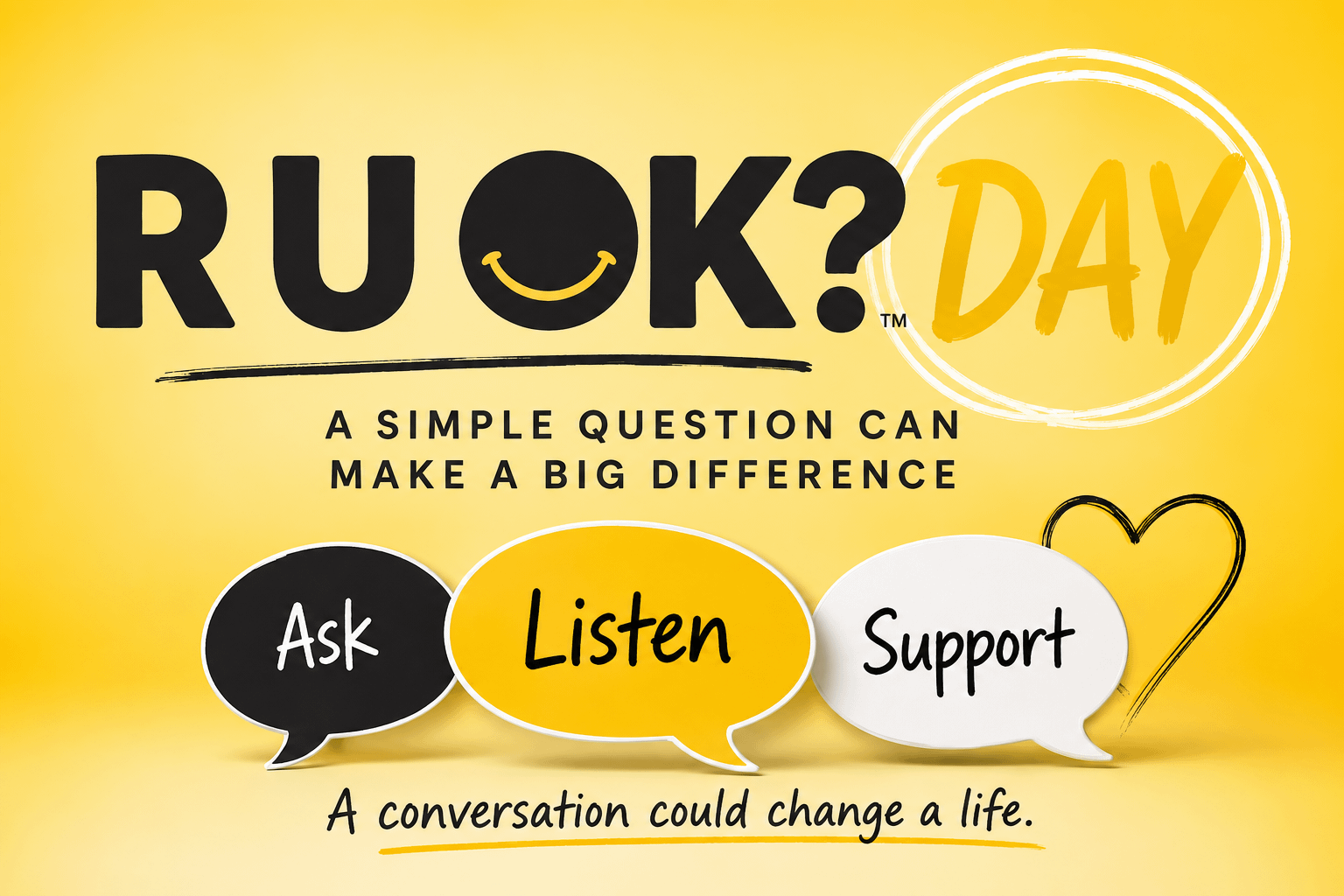
Sometimes the most important conversations begin with three simple words:
“Are you okay?”
R U OK? Day is a reminder that checking in with someone can make a meaningful difference. Behind a smile, a busy schedule, a social media post, or the familiar response of “I’m fine,” someone may be dealing with grief, loneliness, anxiety, stress, heartbreak, depression, financial pressure, family problems, or another struggle they have not shared.
We cannot always see what another person is carrying.
That is why R U OK? Day matters.
It encourages us to pay attention to the people around us, start genuine conversations, listen without immediately trying to fix everything, and remind people that they do not have to face difficult moments completely alone.
But perhaps the greatest lesson of R U OK? Day is that we should not wait for a designated day to ask someone how they are doing.
We can ask today.
We can ask tomorrow.
And we can keep asking.
What Is R U OK? Day?
R U OK? Day is an Australian mental health and suicide-prevention initiative centered on encouraging people to have meaningful conversations with those who may be struggling.
The idea is beautifully simple: regularly checking in with the people in our lives can help create connection and encourage someone to talk about what they are experiencing.
It is not about becoming a therapist.
It is not about having perfect advice.
It is not about knowing exactly what to say.
Sometimes it is simply about noticing that someone seems different and caring enough to ask.
A conversation may begin with:
“You haven’t seemed like yourself lately. Are you okay?”
Those few words can open a door someone has been waiting for.
People Become Very Good at Saying “I’m Fine”
One of the difficult realities about emotional pain is that it is often invisible.
People can go to work while grieving.
They can laugh while feeling lonely.
They can take care of their families while emotionally exhausted.
They can post happy pictures while struggling privately.
They can encourage everyone around them while feeling as though they are falling apart themselves.
And when someone asks how they are doing, the automatic response is often:
“I’m fine.”
Sometimes “I’m fine” really does mean everything is okay.
Other times it means:
“I don’t know how to explain what I’m feeling.”
“I don’t want to burden you.”
“I don’t think anyone will understand.”
“I’m afraid of being judged.”
“I don’t know where to begin.”
Or simply:
“I don’t want anyone to know how badly I’m hurting.”
That is why checking in requires more than asking a question out of politeness.
It requires being willing to hear the real answer.
Look Beyond the Smile
We often assume that someone who looks happy must be doing well.
Life does not always work that way.
Some of the strongest-looking people are carrying enormous emotional burdens.
The friend who is always making everyone laugh may go home to an empty house and struggle with loneliness.
The coworker who never misses a shift may be overwhelmed financially or emotionally.
The parent who takes care of everyone else may have forgotten how to take care of themselves.
The person constantly encouraging others may desperately need encouragement.
The grieving person who appears to be “doing better” may still have nights when the loss feels as painful as ever.
People learn how to function while hurting.
They learn how to smile.
They learn how to answer questions.
They learn how to complete responsibilities.
None of that necessarily means the pain has disappeared.
Notice When Something Changes
You do not need to analyze every person’s behavior, but meaningful changes can sometimes tell us that someone may need support.
Perhaps someone who normally calls regularly suddenly becomes distant.
Maybe they stop participating in activities they once enjoyed.
Perhaps they seem unusually exhausted, irritable, withdrawn, overwhelmed, hopeless, or distracted.
Sometimes the change is subtle.
You might simply have a feeling that something isn’t right.
That is enough reason to check in.
You do not need proof that someone is struggling before showing them kindness.
Try saying:
“I’ve noticed you’ve been a little quiet lately. How are you doing?”
“You’ve had a lot going on. How are you holding up?”
“I just wanted to check on you. Are you okay?”
Then give them the opportunity to answer.
Listening Can Be More Powerful Than Advice
When someone finally opens up, our instinct may be to immediately solve the problem.
We offer advice.
We tell them what we would do.
We try to find the positive side.
We remind them that things could be worse.
Usually, those responses come from a good place.
But sometimes the person does not need a solution.
They need someone to listen.
Really listen.
Allow them to speak without constantly interrupting.
Do not immediately compare their experience to yours.
Do not minimize their feelings.
Do not rush them toward positivity.
You do not have to understand everything they are experiencing to acknowledge that their pain is real.
Sometimes one of the most comforting things you can say is:
“I may not completely understand what you’re going through, but I’m here and I’m listening.”
That can mean more than a long speech filled with advice.
Don’t Be Afraid of Silence
Difficult conversations can include uncomfortable moments of silence.
That is okay.
If someone is talking about grief, depression, fear, loneliness, trauma, or another deeply personal struggle, they may need time to gather their thoughts.
They may become emotional.
They may cry.
They may struggle to find the words.
You do not have to fill every second of silence.
Your presence can speak for you.
Stay.
Listen.
Give them time.
Sometimes simply knowing that another person is willing to sit beside us during a difficult moment reminds us that we are not completely alone.
Grief Is One Reason We Need to Keep Checking In
Grief deserves special attention because support often disappears long before grief does.
When someone dies, friends and relatives frequently gather around the grieving person.
There are phone calls.
Messages.
Meals.
Flowers.
Visits.
Then life gradually returns to normal for everyone else.
But for the person grieving, there may never be a return to the life they once knew.
Weeks become months.
Months become years.
People stop asking.
The grieving person may feel pressure to appear stronger because they worry others think they should have “moved on.”
That is when a simple check-in can become incredibly meaningful.
“I know it’s been a while, but I wanted to see how you’re doing.”
“I was thinking about you today.”
“You don’t have to pretend you’re okay with me.”
Those messages remind someone that their grief has not made them invisible.
Check on the Strong Ones Too
We often check on people who openly show that they are struggling.
But what about the person everyone describes as strong?
The person who always handles everything.
The one everyone calls when something goes wrong.
The person who supports everyone else.
Strong people need somewhere to put their pain too.
Being dependable does not make someone immune to exhaustion.
Being encouraging does not mean they never feel discouraged.
Being strong does not mean they never need someone to ask:
“But how are YOU doing?”
Sometimes the people who seem to need the least support are the ones who have gone the longest without receiving it.
Men Need These Conversations Too
Many men have been taught—directly or indirectly—to keep emotional struggles private.
Be strong.
Handle it yourself.
Don’t complain.
Don’t cry.
Keep going.
Those messages can make it difficult for men to admit when they are struggling.
A man may be dealing with grief, depression, loneliness, divorce, financial pressure, family problems, or overwhelming stress while telling everyone around him that everything is fine.
That is why checking on the men in our lives matters.
Your father.
Your brother.
Your son.
Your husband.
Your boyfriend.
Your friend.
Your coworker.
Ask them how they are doing—and create enough space for an honest answer.
Emotional honesty is not weakness.
Sometimes admitting that life has become difficult requires tremendous courage.
Don’t Ask Unless You’re Willing to Listen
“How are you?”
We say it constantly.
Often it has become more of a greeting than an actual question.
R U OK? Day challenges us to make the question meaningful again.
When you ask someone if they are okay, try not to immediately look at your phone, change the subject, or rush away.
Give them your attention.
Make eye contact when appropriate.
Listen.
Let the conversation go somewhere deeper if they want it to.
You may discover that someone has been waiting for an opportunity to talk.
What If They Say They’re Not Okay?
You do not need to panic.
You also do not need to have all the answers.
Listen to what they are experiencing and acknowledge it.
You might say:
“I’m glad you told me.”
“That sounds incredibly difficult.”
“I’m here with you.”
“What would help you most right now?”
Depending on what they are experiencing, encouraging appropriate professional support may also be helpful.
The goal is not to take responsibility for solving another person’s life.
The goal is to help them feel heard, supported, and connected to appropriate help when necessary.
If someone indicates they may be in immediate danger or thinking about suicide, take it seriously and seek urgent professional or emergency support rather than trying to handle the situation alone.
Follow Up After the Conversation
One of the most important parts of checking in happens afterward.
Suppose someone tells you they are struggling.
You listen.
You talk for an hour.
Then several weeks pass without another conversation.
They may begin wondering whether you really wanted to know or whether they burdened you by opening up.
Follow up.
Send a message.
Call them.
Invite them for coffee.
Ask them to take a walk.
Say:
“I’ve been thinking about our conversation. How are you doing today?”
Following up communicates something powerful:
I didn’t forget about you.
For someone going through a difficult season, that reminder can matter enormously.
Small Acts of Connection Matter
Supporting someone does not always require a long emotional conversation.
Sometimes connection happens through ordinary moments.
Send a text.
Share a meal.
Sit together.
Take a walk.
Call someone you have not spoken with recently.
Invite someone who has become isolated to join you.
Tell someone you appreciate them.
Let a grieving friend talk about the person they miss.
Check on the friend who suddenly disappeared from social media.
Ask the coworker who seems overwhelmed whether they need someone to listen.
Small actions can remind people that they still matter.
You Don’t Need the Perfect Words
People sometimes avoid difficult conversations because they are afraid of saying the wrong thing.
That fear is understandable.
But perfection is not required.
Compassion matters more.
You might stumble over your words.
You might not know what to say next.
You may sit quietly for a while.
That is okay.
A sincere:
“I don’t know exactly what to say, but I care about you.”
can be far more meaningful than saying nothing.
People usually remember whether you showed up more than whether every sentence was perfect.
R U OK? Day Should Be More Than One Day
Awareness days are valuable because they bring attention to important issues.
But emotional struggles do not follow calendars.
Grief does not disappear after an awareness day.
Depression does not take the rest of the year off.
Loneliness does not only happen during a campaign.
People need connection throughout the year.
Make checking in part of your relationships.
Ask again next week.
Remember difficult anniversaries.
Reach out during holidays.
Check on people after major life changes.
Pay attention when someone suddenly becomes quiet.
And when someone tells you they are struggling, remember that conversation later.
It’s Also Okay to Admit When You Aren’t Okay
R U OK? Day is not only about checking on others.
It can also be an opportunity to check in with yourself.
Ask yourself:
How am I really doing?
What have I been carrying privately?
Am I exhausted?
Am I lonely?
Am I grieving?
Am I overwhelmed?
Have I been pretending everything is okay because I do not want anyone to worry?
Do I need someone to talk to?
There is no prize for silently carrying everything by yourself.
Sometimes the person who needs to answer “Are you okay?” is the person looking back at us in the mirror.
If you are struggling, consider reaching out to someone you trust.
You do not have to explain everything immediately.
Sometimes the first step is simply saying:
“I’m having a difficult time and I could use someone to talk to.”
Three Words Can Open a Door
We may never fully know what another person is carrying.
That is why compassion matters.
Ask the friend who has gone quiet.
Check on the person who recently experienced a loss.
Call the family member you have been thinking about.
Reach out to the person who always seems strong.
Check on the man who never talks about his feelings.
Sit beside the person who does not know how to ask for help.
And do not assume that because someone smiled today, they are okay.
Sometimes people are waiting for someone to notice.
Sometimes they are waiting for permission to talk.
Sometimes they simply need to know that somebody cares enough to listen.
R U OK? Day reminds us that we do not need extraordinary words to begin an important conversation.
Sometimes we only need three:
Are you okay?
And when we ask, we should be prepared to stay long enough to hear the answer.
Who is someone in your life you haven’t checked on lately—and could today be the day you ask them, “Are you okay?”
Leave a Reply