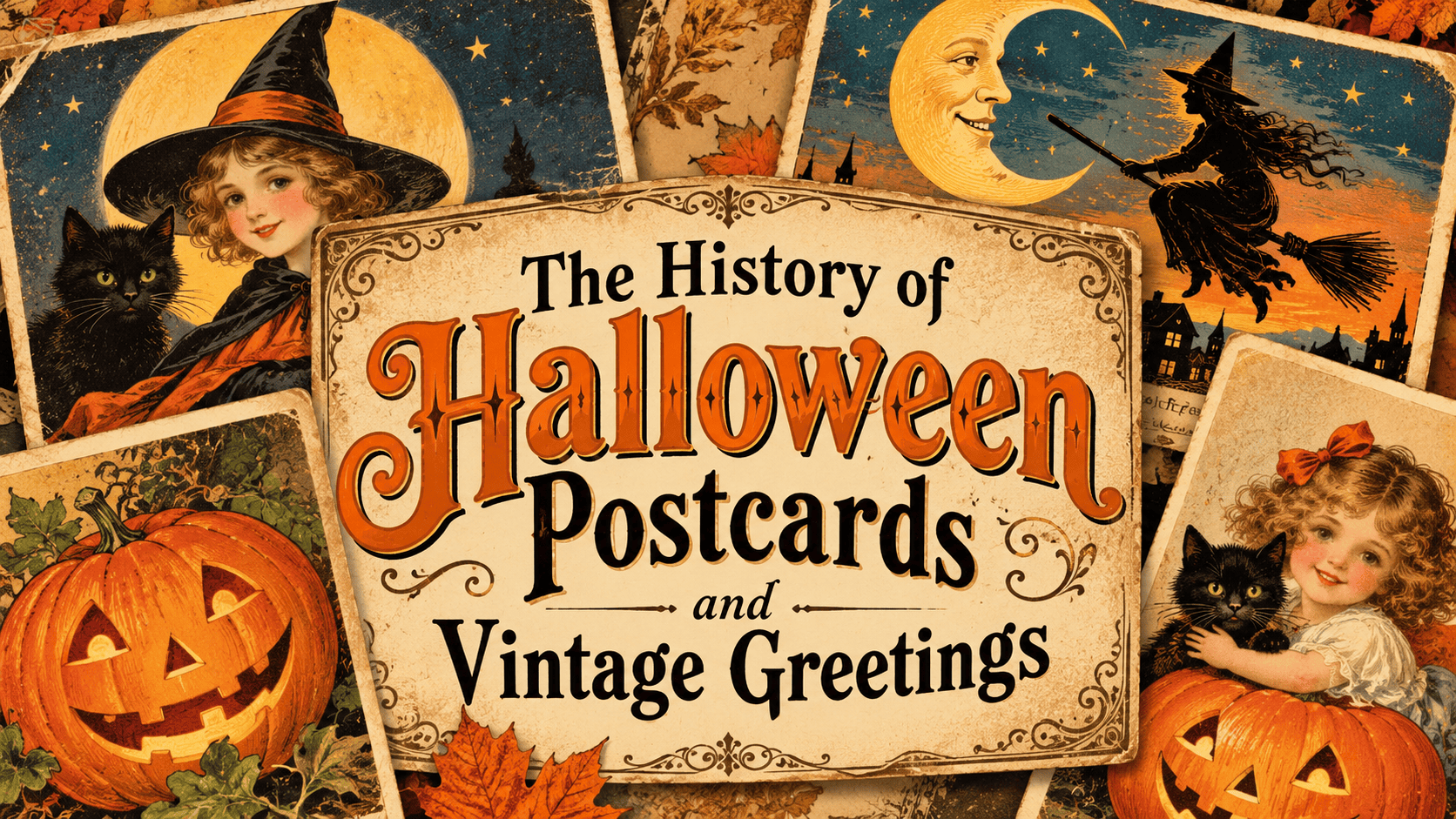
Long before Halloween was celebrated with elaborate decorations, neighborhood trick-or-treating, costume parties, and social media greetings, Americans had a charming way of sharing the holiday with friends and loved ones: Halloween postcards.
These colorful pieces of paper captured the imagination of an earlier generation. Decorated with smiling jack-o’-lanterns, mysterious black cats, witches riding broomsticks, glowing moons, and romantic messages, vintage Halloween postcards were more than simple holiday greetings. They reflected the traditions, superstitions, humor, and social customs of their time.
During the late 19th and early 20th centuries, Halloween postcards became part of a growing American greeting-card culture. Families, friends, and sweethearts exchanged beautifully illustrated cards to celebrate October 31, wish one another good fortune, and sometimes deliver playful messages about love and marriage.
Today, these vintage greetings offer a fascinating glimpse into a Halloween that looked quite different from the holiday we know.
The Origins of Halloween Greeting Cards
The history of Halloween postcards begins with the development of affordable postal services and the growing popularity of illustrated greeting cards.
During the Victorian era, sending cards became an important social custom. People exchanged greetings for Christmas, Easter, Valentine’s Day, birthdays, and other special occasions.
As printing technology improved during the 1800s, colorful illustrations became easier and less expensive to reproduce. Publishers recognized that Americans enjoyed sending attractive cards to mark holidays and maintain friendships.
Halloween, with its unusual mixture of ancient traditions, supernatural folklore, and autumn celebrations, offered artists an especially imaginative subject.
Although Halloween greetings existed in various forms before the postcard craze, illustrated Halloween postcards became particularly popular around the beginning of the 20th century.
Unlike modern Halloween cards, which often emphasize horror, monsters, and frightening imagery, early Halloween postcards frequently combined gentle humor, romantic symbolism, and traditional beliefs about luck and the future.
Many were designed to be whimsical rather than terrifying.
The Golden Age of Halloween Postcards
The period from approximately 1905 through the 1910s is often considered the golden age of American Halloween postcards.
During these years, postcards were an extremely popular and inexpensive means of communication.
Before telephones became common in every household, sending a postcard was a convenient way to share news, arrange visits, or simply let someone know they were being remembered.
Halloween publishers took advantage of this popularity by producing countless seasonal designs.
Some postcards featured children carving pumpkins or playing traditional Halloween games. Others displayed witches flying across moonlit skies, black cats sitting beside glowing jack-o’-lanterns, or young women participating in mysterious fortune-telling rituals.
Many cards included short poems, humorous sayings, or cheerful holiday wishes.
The illustrations were often richly colored, with deep oranges, golden yellows, midnight blues, and dramatic black silhouettes.
These designs helped establish the orange-and-black color combination that remains closely associated with Halloween.
For many Americans, receiving a Halloween postcard became a small but enjoyable seasonal tradition.
Why Halloween Postcards Became So Popular
Several important developments helped Halloween postcards become a nationwide phenomenon.
First, the United States experienced major improvements in its postal system. The expansion of mail delivery made communication more convenient for Americans living in both cities and rural communities.
Second, postcards were affordable. A person could purchase an attractive illustrated card and send it through the mail for a relatively small amount of money.
Third, postcard collecting became a fashionable hobby.
People saved cards in decorative albums, exchanged them with friends, and displayed their favorite illustrations.
In 1907, American postal regulations began allowing divided-back postcards, with space for both an address and a message on the reverse side.
This gave publishers more freedom to fill the entire front with artwork.
The result was a flourishing market for illustrated postcards, including Halloween greetings.
The Meaning Behind Vintage Halloween Postcard Symbols
One of the most fascinating aspects of vintage Halloween postcards is the symbolism hidden within their illustrations.
Many familiar Halloween decorations carried meanings that were more important to earlier generations than they are today.
Jack-o’-Lanterns: Protection, Mischief, and Autumn
Pumpkins were among the most recognizable images on early Halloween postcards.
Artists frequently illustrated jack-o’-lanterns with exaggerated faces, enormous smiles, glowing eyes, and playful expressions.
Some pumpkins appeared to dance, laugh, drive automobiles, or interact with children.
The jack-o’-lantern tradition was influenced by Irish folklore and older customs of carving lanterns from root vegetables.
In America, pumpkins became the preferred material because they were abundant during autumn and easier to carve.
By the early 1900s, jack-o’-lanterns had become one of the defining symbols of American Halloween.
Black Cats: Mystery and Superstition
Black cats appeared on countless vintage Halloween postcards.
They were frequently shown sitting beside pumpkins, following witches, or staring into the night with bright eyes.
Their association with Halloween developed from European folklore connecting cats with witchcraft, supernatural powers, and mysterious nighttime activities.
However, vintage postcards did not always portray black cats as frightening.
Some showed them as playful companions or symbols of good fortune.
Their popularity helped establish the black cat as a permanent part of Halloween imagery.
Witches: Magic and Imagination
Witches were another favorite subject of postcard illustrators.
They appeared flying across full moons, stirring bubbling cauldrons, riding broomsticks, and traveling with black cats.
Some were depicted as elderly women with pointed hats and exaggerated features.
Others appeared as fashionable young women dressed in elaborate Halloween costumes.
These illustrations reflected the combination of folklore, humor, and imagination that characterized early American Halloween celebrations.
Full Moons, Owls, and Ghosts
Full moons provided dramatic backgrounds for many Halloween postcard designs.
Owls represented nighttime mystery, while ghosts reflected the holiday’s longstanding connection with spirits and the supernatural.
Interestingly, many early ghost illustrations were surprisingly gentle.
Rather than terrifying viewers, they often appeared as playful figures participating in humorous Halloween scenes.
Halloween Postcards Were Often About Love and Marriage
One of the biggest differences between vintage Halloween greetings and modern Halloween cards is their emphasis on romance.
During the late Victorian and Edwardian periods, Halloween was closely associated with fortune-telling traditions, especially those involving marriage and future relationships.
Young people participated in games believed to reveal the identity of a future husband or wife.
These customs became popular subjects for Halloween postcards.
Illustrations frequently featured young women looking into mirrors, examining apples, holding candles, or attempting to discover their romantic futures.
Some postcards portrayed a woman’s future sweetheart appearing mysteriously in a mirror.
Others included playful poems about finding love before the next Halloween.
These romantic images reveal an almost forgotten side of the holiday.
For earlier generations, Halloween was not simply about ghosts and frightening costumes. It could also be an evening of courtship, curiosity, and romantic possibilities.
Fortune-Telling Traditions Featured on Vintage Greetings
Halloween fortune-telling games were particularly popular subjects for early postcard artists.
Several traditional activities appeared repeatedly in Halloween illustrations.
Apple Peeling
One custom involved peeling an apple in one long strip and tossing the peel over a shoulder.
According to folklore, the fallen peel might resemble the first initial of a future spouse.
Looking Into a Mirror
Another tradition involved looking into a mirror by candlelight on Halloween night.
Participants hoped to glimpse the face of someone they would eventually marry.
Although the practice was rooted in superstition, it became a memorable theme in vintage postcard illustrations.
Bobbing for Apples
Bobbing for apples was both a popular party activity and, in some traditions, a game associated with romance and fortune.
Postcards often depicted young people laughing as they attempted to retrieve apples from tubs of water.
Nuts and Marriage Predictions
Another old Halloween custom involved placing nuts near a fire and interpreting how they burned.
Different outcomes supposedly predicted whether a romantic relationship would succeed.
These activities demonstrate how Halloween once blended harvest celebrations, social gatherings, folklore, and romantic curiosity.
Famous Artists Who Created Vintage Halloween Postcards
The popularity of Halloween postcards created opportunities for talented commercial illustrators.
Several artists became especially associated with beautifully designed holiday greetings.
Ellen Hattie Clapsaddle
Ellen Hattie Clapsaddle was one of the best-known American postcard illustrators of the early 20th century.
Her work frequently featured charming children, expressive pumpkins, playful animals, and colorful seasonal scenes.
Her Halloween illustrations combined warmth, humor, and imaginative details.
Many of her designs were published by the International Art Publishing Company.
Today, original Clapsaddle Halloween postcards are particularly appreciated by collectors.
John O. Winsch
John O. Winsch was an important postcard publisher whose cards featured elaborate artwork and decorative printing techniques.
Winsch Halloween postcards often included colorful illustrations, embossed details, and imaginative seasonal compositions.
Some designs featured unusual scenes combining witches, pumpkins, animals, and modern inventions.
These cards demonstrate how postcard publishers mixed traditional folklore with the changing world of the early 1900s.
Raphael Tuck & Sons
Raphael Tuck & Sons was a major international publisher of illustrated postcards.
The company produced holiday greetings for numerous occasions, including Halloween.
Its designs often reflected popular seasonal activities, rural celebrations, and carefully detailed illustrations.
The company’s Halloween postcards helped bring festive imagery to a broad audience.
Why So Many Vintage Halloween Postcards Were Printed in Germany
An interesting fact about early American Halloween postcards is that many were printed in Germany.
During the late 19th and early 20th centuries, German printers were internationally respected for their advanced color-printing techniques.
American publishers frequently commissioned German printing companies to reproduce illustrations.
These printing methods produced vibrant colors, fine details, embossed surfaces, and sometimes metallic accents.
The quality of German printing contributed significantly to the beauty of vintage Halloween postcards.
Although the artwork and messages were often designed for American consumers, the physical cards might have been manufactured overseas.
This international partnership became less practical during World War I, when trade disruptions changed the postcard industry.
What Did Vintage Halloween Greetings Actually Say?
Early Halloween postcards frequently included short seasonal messages.
Some were simple expressions of friendship, while others used playful rhymes and references to supernatural folklore.
Common greeting styles included:
-
A Merry Halloween
-
Halloween Greetings
-
A Jolly Halloween
-
Best Wishes for Halloween
-
A Happy Halloween to You
Other cards featured humorous poems about witches, pumpkins, ghosts, and fortune-telling.
Romantic postcards might refer to discovering a future sweetheart or receiving good luck in love.
The wording was often cheerful and lighthearted.
Rather than focusing entirely on frightening someone, these greetings celebrated the excitement and mystery of the holiday.
Halloween Postcards as Party Invitations
Halloween postcards were not always sent simply to wish someone a happy holiday.
They could also serve as invitations to seasonal gatherings.
During the early 1900s, Halloween parties became increasingly popular among American families and communities.
Hosts organized evenings featuring costumes, autumn decorations, fortune-telling games, refreshments, and traditional activities.
A postcard provided an attractive way to invite friends.
Its colorful illustration immediately established the holiday theme.
A handwritten message could include the date, time, location, and special instructions for attending.
These invitations remind us that Halloween was becoming an important social celebration long before modern neighborhood trick-or-treating became widespread.
How World War I Changed the Halloween Postcard Industry
The outbreak of World War I in 1914 significantly affected international postcard production.
Before the war, American publishers depended heavily on German printing companies.
As international trade became disrupted, importing German-printed postcards became increasingly difficult.
American printers gradually assumed a larger role in production.
At the same time, public tastes and communication habits continued changing.
The elaborate postcard craze that had dominated the early 1900s began to decline.
Halloween postcards did not disappear immediately, but the period of extraordinary artistic variety and widespread collecting was coming to an end.
Halloween Greeting Cards in the 1920s and 1930s
During the 1920s and 1930s, Halloween celebrations continued evolving.
Commercial decorations, costumes, party supplies, and greeting cards became more widely available.
Halloween imagery remained familiar, with pumpkins, witches, black cats, and ghosts appearing throughout seasonal merchandise.
However, postcards increasingly competed with folded greeting cards and other forms of communication.
The development of new printing styles also changed the appearance of holiday artwork.
Some designs became simpler and more modern, reflecting the visual tastes of the period.
The Great Depression affected consumer spending, but inexpensive holiday greetings continued to provide opportunities for people to share seasonal cheer.
By the middle of the 20th century, Halloween greeting cards were part of a much larger commercial holiday industry.
How Vintage Postcards Helped Shape Modern Halloween
Vintage Halloween postcards played an important role in popularizing the visual identity of the holiday.
Before mass-produced Halloween decorations became common, postcard illustrations helped circulate familiar seasonal symbols throughout the country.
A family in one state might receive a postcard showing the same witch, pumpkin, or black cat imagery enjoyed by someone hundreds of miles away.
These shared illustrations helped create a recognizable national Halloween aesthetic.
The influence remains visible today.
Modern Halloween decorations still feature many of the same elements that appeared on postcards more than a century ago.
Orange pumpkins, black cats, full moons, pointed witch hats, and flying broomsticks continue to define the holiday.
Although artistic styles have changed, the underlying imagery remains remarkably consistent.
Why Collectors Love Antique Halloween Postcards
Original Halloween postcards from the early 1900s have become desirable collectibles.
Collectors appreciate their historical significance, colorful artwork, unusual themes, and connection to an earlier era.
Several factors can influence a postcard’s collectible value.
Age: Cards produced during the golden age of postcards are especially interesting to many collectors.
Artist: Illustrations associated with recognized artists, including Ellen Clapsaddle, may attract greater attention.
Condition: Cards with minimal fading, creases, stains, or damage are generally more desirable.
Rarity: Unusual illustrations or difficult-to-find designs can command greater interest.
Publisher: Cards associated with well-known publishers may be particularly collectible.
Artwork: Elaborate scenes, distinctive characters, and unusual Halloween subjects can make a postcard stand out.
Some rare antique Halloween postcards sell for substantial amounts, although values vary considerably depending on condition, authenticity, and collector demand.
How to Identify an Authentic Vintage Halloween Postcard
For anyone interested in collecting Halloween postcards, learning to recognize older examples is an important first step.
One useful clue is the postcard’s reverse side.
Before 1907, many American postcards had undivided backs, meaning the address occupied the reverse side and messages were generally written on the illustrated front.
After divided backs became permitted in 1907, cards commonly included separate areas for messages and addresses.
Printing methods can also provide clues.
Many early postcards feature embossed details, rich lithographic colors, or textured surfaces.
Publisher names, artist signatures, and postal cancellation marks may help establish an approximate date.
However, collectors should remember that modern reproductions can closely resemble original cards.
An old-fashioned illustration alone does not prove that a postcard is genuinely antique.
Examining the paper, printing, markings, and overall construction is essential.
What Vintage Halloween Postcards Reveal About American Life
Beyond their decorative appeal, vintage Halloween postcards provide valuable insights into American social history.
They reveal how people celebrated holidays, communicated with friends, expressed romantic interests, and understood traditional folklore.
They also demonstrate how commercial printing helped spread cultural customs.
A single postcard might reveal several aspects of everyday life.
The illustration could show popular Halloween games.
The printed greeting might reflect contemporary humor.
The handwritten message could document a friendship, family relationship, or invitation.
A postmark might establish when and where the card traveled.
Together, these details transform an ordinary piece of paper into a small historical record.
The Lost Art of Sending Halloween Greetings
Today, Halloween greetings are often shared through text messages, social media posts, animated images, and digital cards.
These methods allow people to communicate instantly.
Yet there is something distinctive about the older tradition of choosing a postcard, writing a personal message, addressing it, and sending it through the mail.
A vintage Halloween postcard required thought and effort.
The sender selected an illustration that suited the recipient, added a few personal words, and trusted the postal service to deliver the greeting.
The recipient could display the card, save it in an album, or revisit the message years later.
That personal connection is one reason antique postcards remain meaningful.
They preserve not only the artwork of their time but also the relationships between the people who exchanged them.
Can You Still Send Vintage-Style Halloween Postcards Today?
Although the original postcard craze ended generations ago, the tradition can still be enjoyed.
Vintage-inspired Halloween postcards remain popular among collectors, artists, and people who appreciate nostalgic holiday customs.
Some enthusiasts reproduce public-domain artwork from the early 1900s.
Others create new illustrations inspired by Victorian and Edwardian designs.
Sending a Halloween postcard today can be a thoughtful alternative to a digital greeting.
A handwritten message accompanied by an old-fashioned pumpkin, witch, or black cat illustration brings a little history into the modern holiday.
It also offers a simple way to revive a tradition that once connected friends and families across America.
Why the History of Halloween Postcards Still Matters
The story of Halloween postcards is about more than holiday decorations or collectible paper.
It is part of the larger history of how Americans transformed Halloween into a widely recognized celebration.
These cards appeared during a period when the country was changing rapidly.
Communication was becoming easier, commercial printing was expanding, and regional traditions were reaching national audiences.
Halloween itself was evolving from a holiday associated with folklore, harvest customs, and fortune-telling into a community celebration filled with games, parties, and recognizable seasonal symbols.
Postcards helped document and spread that transformation.
Their illustrations captured a world where Halloween could be mysterious, romantic, humorous, and festive all at once.
Final Thoughts
The history of Halloween postcards and vintage greetings offers a charming window into America’s past.
Long before digital messages and modern Halloween merchandise, beautifully illustrated postcards carried seasonal wishes from one household to another.
They featured glowing jack-o’-lanterns, mischievous black cats, moonlit witches, romantic fortune-telling games, and cheerful holiday messages.
They also helped popularize the symbols that continue to define Halloween today.
Although more than a century has passed since their golden age, these postcards remain reminders of a time when even a small holiday greeting could become a treasured keepsake.
Perhaps that is their greatest appeal.
Behind every faded illustration and handwritten message is a reminder that people have always enjoyed finding simple ways to celebrate, connect, and let others know they are remembered.
If you could receive an original Halloween postcard from more than 100 years ago, would you prefer one featuring a mysterious witch, a smiling jack-o’-lantern, or an old-fashioned Halloween love greeting?
Leave a Reply