Halloween has always been a night filled with mystery, superstition, and unusual traditions. Long before trick-or-treating, haunted houses, and costume parties became popular, people celebrated Halloween with rituals meant to reveal secrets about the future.
One of the strangest Halloween traditions involved something found in almost every home: a mirror.
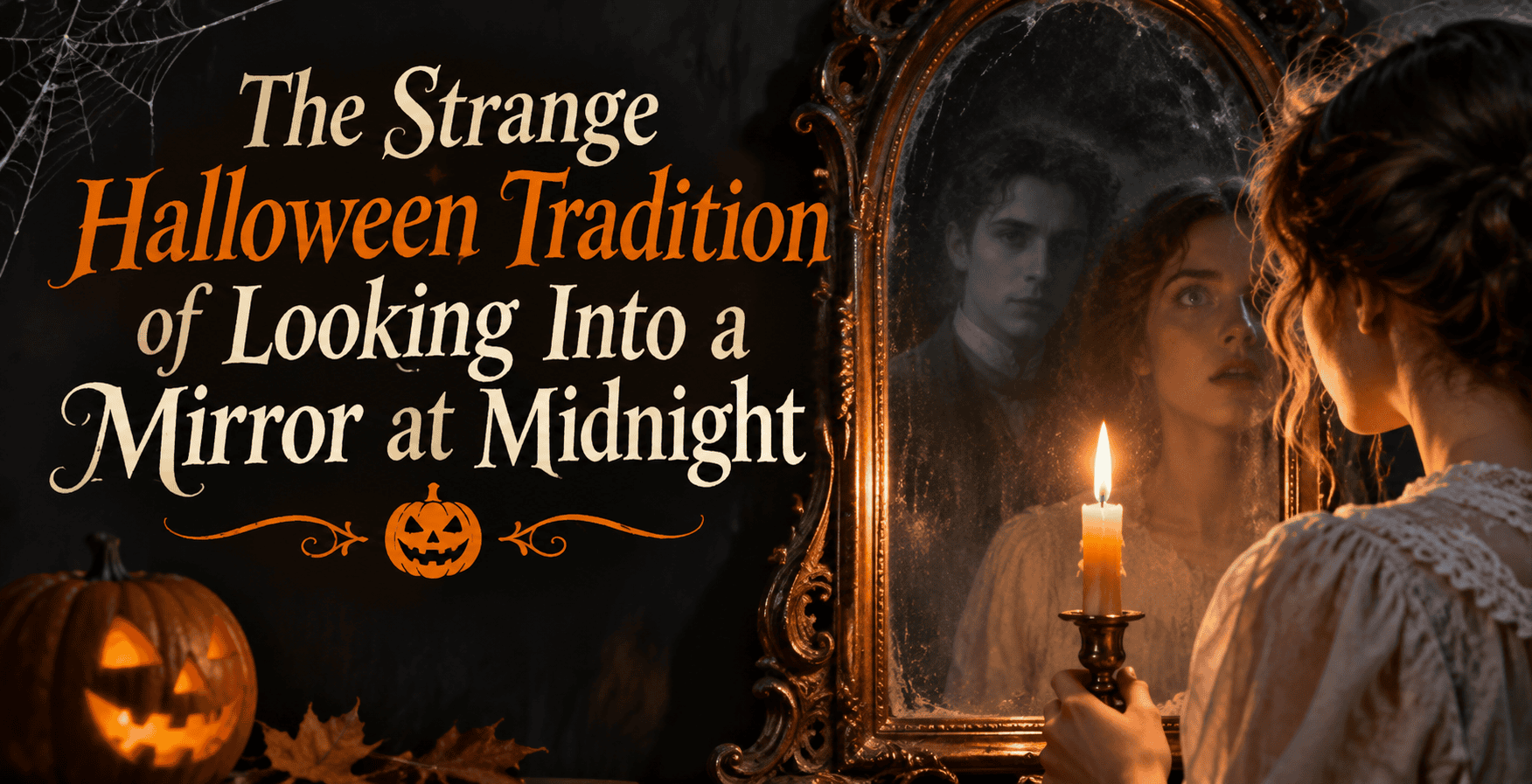
According to old folklore, a person who looked into a mirror at midnight on Halloween might see something extraordinary. Instead of their own reflection, they might glimpse the face of their future husband or wife, witness a mysterious figure, or receive a frightening warning about what was to come.
For generations, young people performed mirror rituals on Halloween, hoping to discover whom they would marry. Others feared that looking into a mirror at the wrong moment could reveal something much darker.
But where did this unusual tradition come from, and why did people believe that mirrors held supernatural powers on Halloween?
The answers reveal a fascinating chapter in the history of Halloween, when romance, superstition, and fear were closely connected.
The Origins of Halloween Mirror Superstitions
The tradition of looking into mirrors on Halloween developed from older European beliefs about divination, the practice of attempting to discover hidden knowledge or predict future events.
Halloween falls on October 31, the evening before All Saints’ Day. Its history includes influences from the ancient Celtic festival of Samhain, as well as later Christian observances and European folk customs.
Samhain marked an important seasonal transition as communities moved from the harvest season toward winter.
In later folklore, this period became associated with spirits, supernatural encounters, and the belief that the boundary between the living and the dead was unusually thin.
Over time, Halloween became a popular occasion for fortune-telling games, particularly those involving marriage and romance.
Mirrors were especially fascinating because they reflected the world while seemingly creating another world behind the glass.
Before modern scientific explanations of reflection became widely understood, mirrors inspired many supernatural interpretations.
People sometimes believed that mirrors could reveal hidden truths, expose spirits, or provide glimpses into the future.
These ideas helped create the Halloween mirror traditions that became popular in parts of Britain, Ireland, and eventually North America.
Why Midnight Was Considered the Most Powerful Hour
Midnight has long held a special place in supernatural folklore.
Often called the witching hour, midnight was traditionally associated with ghosts, witches, mysterious encounters, and supernatural activity.
In Halloween folklore, the hour carried additional significance because Halloween itself was believed to be a particularly mysterious night.
Some people believed that supernatural forces were strongest when one day changed into another.
Others thought that midnight provided the best opportunity to communicate with spirits or discover hidden information.
These beliefs made midnight a natural setting for Halloween fortune-telling rituals.
A person hoping to see their future spouse might wait until the clock struck twelve before approaching a mirror.
The room was often kept dark, with only a candle providing illumination.
The combination of darkness, silence, and flickering candlelight made the experience especially unsettling.
Although midnight was important in many versions of the tradition, not every historical mirror ritual required it. Some called only for performing the ritual on Halloween night.
The Halloween Mirror Ritual to See Your Future Husband or Wife
One of the best-known Halloween mirror traditions involved unmarried young women attempting to discover the identity of their future husbands.
In a commonly recorded version, a young woman would enter a dark room carrying a candle.
She would stand before a mirror and look carefully into the reflection.
Some versions instructed her to eat an apple or hold one while gazing into the glass.
If the ritual worked, according to the superstition, the face of her future husband would appear behind her shoulder.
The image might be faint, appearing only briefly before disappearing.
In other versions, the future spouse might appear directly in the mirror.
The ritual was intended to reveal someone the participant had not yet met or someone whose romantic importance had not yet become clear.
For young people living in societies where marriage strongly influenced their future security and social position, such fortune-telling customs could be particularly appealing.
The ritual offered a mixture of excitement, romance, and fear.
Participants hoped to see a handsome stranger or familiar sweetheart, but the possibility of seeing something frightening added to the suspense.
Why Apples Were Used in Halloween Mirror Rituals
Apples played an important role in many traditional Halloween fortune-telling games.
Because Halloween occurred near the end of the autumn harvest, apples were readily available in many communities.
They also became associated with romance, courtship, and marriage predictions.
In some mirror rituals, a young woman was instructed to eat an apple while looking into the reflection.
Other versions involved peeling an apple and tossing the peel over a shoulder.
The shape formed by the fallen peel was supposedly the first initial of a future spouse’s name.
Apple bobbing also developed associations with courtship and romantic fortune-telling, although it later became primarily a party game.
The apple-and-mirror ritual combined two familiar elements of Halloween divination.
The apple represented a traditional tool for romantic prediction, while the mirror supposedly provided a supernatural image of the future.
Together, they created one of Halloween’s most memorable old-fashioned customs.
The Frightening Possibility of Seeing a Skull in the Mirror
Not every Halloween mirror prediction promised romance.
Some versions of the superstition included a terrifying warning.
Instead of seeing the face of a future spouse, a participant might see a skull or skeletal figure.
According to the folklore, this could mean that the person would die before marrying.
Other versions suggested that the appearance of a skull predicted an unhappy future or an approaching death.
These frightening possibilities made the ritual more than a harmless romantic game.
For someone who genuinely believed in supernatural predictions, looking into a mirror could become a deeply unsettling experience.
The fear was intensified by the conditions in which the ritual took place.
A dark room, a single candle, and the expectation of seeing an unfamiliar face could make ordinary shadows seem extraordinary.
There is no evidence that mirrors can predict death or reveal future events.
However, the folklore surrounding these rituals demonstrates how closely love and mortality were connected in some historical Halloween traditions.
The Strange Tradition of Walking Backward Toward a Mirror
Another version of Halloween mirror divination involved walking backward toward a mirror.
According to certain traditional accounts, a young woman would enter a room backward while holding a candle.
She might also be instructed to eat an apple or perform the ritual without speaking.
Once she reached the mirror, she would turn or look into the reflection, hoping to see her future husband.
The backward movement made the ritual more unusual and symbolically different from everyday behavior.
In folklore, performing ordinary actions in reverse was sometimes associated with magic or attempts to obtain supernatural knowledge.
Walking backward also increased the suspense.
The participant could not easily see what was behind her, making the experience more frightening.
The exact instructions varied between regions and storytellers, but the central idea remained the same: an unusual action performed on Halloween might reveal a person’s romantic future.
The Role of Candlelight in Halloween Mirror Divination
Candlelight was an essential part of many Halloween mirror rituals.
Before electric lighting became common, candles were a practical source of illumination.
But in fortune-telling traditions, they also contributed to the atmosphere of mystery.
A single candle could cast moving shadows across a person’s face and the surrounding room.
When reflected in a mirror, those shadows might create unusual shapes and distorted appearances.
Someone staring into the glass for an extended period might begin to interpret these shifting patterns as unfamiliar faces.
The effect could become stronger when the participant already expected to see a ghostly figure.
Modern psychology offers explanations for why prolonged mirror-gazing in dim lighting can produce strange visual experiences.
Changes in visual perception, reduced lighting, and the brain’s interpretation of ambiguous facial features can sometimes cause a familiar reflection to appear distorted.
These effects do not require anything supernatural.
Nevertheless, they help explain why historical participants might have found the ritual convincing or frightening.
Halloween Mirror Traditions During the Victorian Era
Halloween fortune-telling became a recognizable part of social celebrations during the nineteenth century.
In Britain and North America, Halloween gatherings sometimes included games designed to predict marriage, romance, or future happiness.
Mirror rituals were among the more dramatic customs associated with these celebrations.
Victorian society placed considerable emphasis on marriage, especially for young women.
As a result, games that supposedly revealed a future husband could generate excitement and curiosity.
Some participants treated the rituals seriously, while others enjoyed them as entertainment.
Halloween parties offered opportunities for young people to participate in activities that combined romance with playful superstition.
Mirrors, candles, apples, nuts, and other household objects became tools for these predictions.
The traditions also appeared in popular literature and descriptions of seasonal customs.
Scottish poet Robert Burns included several Halloween divination practices in his 1785 poem Halloween, showing that such customs were already familiar before the Victorian period.
His work helped preserve details of older Scottish Halloween traditions, including rituals associated with predicting future marriage partners.
By the late nineteenth and early twentieth centuries, romantic fortune-telling had become an especially recognizable feature of Halloween celebrations.
How Halloween Postcards Helped Popularize Mirror Rituals
During the early 1900s, Halloween postcards frequently featured images of young women looking into mirrors.
These illustrations often showed a woman holding a candle while the face of a handsome man appeared in the glass.
Some included pumpkins, black cats, witches, or other familiar Halloween symbols.
The postcards reflected the holiday’s association with romance and fortune-telling.
Today, people often associate Halloween primarily with horror, monsters, and frightening decorations.
However, vintage Halloween postcards reveal that love and marriage predictions were once major themes of the holiday.
The mirror became a recognizable symbol of romantic mystery.
These images helped preserve the tradition visually, even as the practice itself gradually became less common.
Vintage postcards remain valuable reminders of how differently Halloween was celebrated in earlier generations.
Why Mirrors Were Associated With Spirits and the Supernatural
Halloween mirror rituals were part of a much larger collection of beliefs about mirrors.
Across different cultures and historical periods, mirrors have been associated with spirits, souls, magic, and hidden knowledge.
Some traditions treated reflections as spiritually significant, while others viewed mirrors as possible gateways to supernatural encounters.
One widespread superstition claimed that breaking a mirror brought seven years of bad luck.
Another custom involved covering mirrors in a home after someone died.
The meanings and origins of these practices varied, and they should not be treated as parts of one universal belief system.
Nevertheless, they illustrate how mirrors became connected with ideas about death and the unseen world.
Their reflective surfaces seemed mysterious because they presented familiar objects in a reversed, seemingly separate space.
During Halloween, when supernatural stories were especially popular, these associations made mirrors ideal objects for fortune-telling rituals.
The Connection Between Halloween and Finding Love
Modern Halloween celebrations often focus on costumes, candy, haunted attractions, and scary movies.
But historically, Halloween was also closely associated with romance.
Young people participated in games intended to reveal whom they would marry or whether a relationship would succeed.
Mirror-gazing was only one example.
Other traditions involved roasting nuts in a fire, interpreting apple peels, or searching for hidden objects that supposedly predicted future marriage.
Some games were playful activities performed at parties.
Others were based on beliefs passed down through families and communities.
The popularity of these customs reflected the importance of marriage in everyday life.
For many young people, the identity of a future spouse was one of the greatest uncertainties about adulthood.
Halloween provided an entertaining occasion to imagine receiving an answer.
This romantic side of Halloween has largely faded from popular celebrations, making the mirror tradition seem especially strange today.
Could Someone Actually See a Face in the Mirror?
Although Halloween mirror folklore is fascinating, there is no scientific evidence that a reflection can reveal someone’s future spouse or predict death.
However, people can experience unusual visual effects while staring into a mirror under certain conditions.
One possible explanation involves a phenomenon known as the strange-face-in-the-mirror illusion.
In experimental settings, some participants who gaze at their reflections in dim lighting report temporary changes in how their faces appear.
Features may seem distorted, unfamiliar, or briefly transformed.
Researchers have investigated several possible explanations involving visual adaptation, face perception, and expectations.
This does not mean that everyone who tries mirror-gazing will experience such effects.
It also does not prove exactly what historical participants saw.
But it offers a plausible explanation for why some people may have believed they witnessed supernatural images.
The mind can interpret shadows and ambiguous visual information in surprising ways, particularly when a person expects something mysterious to happen.
Why the Tradition Eventually Disappeared
As Halloween celebrations changed during the twentieth century, many older fortune-telling customs became less prominent.
The holiday increasingly emphasized children’s activities, costumes, candy, decorations, and community celebrations.
Trick-or-treating became a defining American Halloween custom.
Romantic divination games gradually lost their central place in many celebrations.
Changes in social attitudes also influenced the tradition.
As marriage expectations evolved, games centered on predicting a future husband became less culturally important.
Modern entertainment offered new ways to enjoy Halloween’s mysterious atmosphere.
Ghost stories, horror films, haunted houses, and supernatural games replaced many older rituals.
However, the mirror tradition never completely disappeared from folklore.
It survives in historical accounts, vintage postcards, books about Halloween customs, and modern discussions of supernatural legends.
How Halloween Mirror Folklore Influenced Modern Urban Legends
The idea of seeing something frightening in a mirror remains a familiar part of popular culture.
One well-known example is the Bloody Mary legend.
In common versions of this modern supernatural game, participants stand before a mirror, often in a dark room, and repeatedly say a particular name.
According to the legend, a ghostly figure may appear in the reflection.
The Bloody Mary ritual is not simply the same tradition as the old Halloween marriage predictions.
Its precise origins are debated, and it has developed through different forms of folklore.
However, both traditions share several recognizable elements: mirrors, darkness, repetition or ritualized behavior, and the expectation of seeing an unexpected figure.
The comparison shows how mirror-based supernatural stories continue to appeal to new generations.
What was once associated with discovering a future spouse is now more commonly associated with frightening encounters.
The mirror remains the central object because it transforms an ordinary reflection into something mysterious.
What the Halloween Mirror Tradition Reveals About the Past
The strange Halloween tradition of looking into a mirror at midnight reveals more than an old superstition.
It offers insight into how people understood uncertainty, romance, and the supernatural.
Before modern entertainment became widespread, communities created games and rituals using ordinary household objects.
A mirror, an apple, and a candle could become the centerpiece of an unforgettable Halloween evening.
These customs also reveal the hopes and fears of earlier generations.
People wanted to know whom they would love, whether they would marry, and what their futures might hold.
Halloween offered an opportunity to explore those questions through traditions that mixed imagination with superstition.
For some participants, the rituals were harmless entertainment.
For others, they carried genuine spiritual significance.
The possibility of seeing an unfamiliar face or frightening image added excitement to an already mysterious holiday.
Even today, the idea of staring into a dark mirror and waiting for something unexpected remains unsettling.
That lasting fascination helps explain why mirror folklore continues to appear in Halloween stories.
The Lasting Mystery of Looking Into a Mirror at Midnight
The Halloween mirror tradition may sound strange to modern audiences, but it was once part of a wider world of seasonal fortune-telling customs.
Young people stood before mirrors by candlelight, hoping to glimpse the faces of their future spouses.
Some followed elaborate instructions involving apples, backward walking, or silence.
Others feared that the mirror might reveal a skull or another frightening omen.
These rituals combined romance, anticipation, and supernatural fear in a way that reflected the character of older Halloween celebrations.
Although science provides explanations for some unusual experiences involving mirrors and dim lighting, the historical stories remain fascinating examples of traditional folklore.
Today, mirrors are ordinary household objects that rarely receive a second thought.
But for generations of Halloween celebrants, a mirror at midnight represented something much more mysterious.
It was imagined as a window into the unknown, a place where love, fate, and fear might briefly become visible.
And perhaps that is what makes this forgotten Halloween custom so memorable.
What would you have done if you lived a hundred years ago? Would you have dared to look into a mirror at midnight on Halloween, hoping to see your future—or would you have been too afraid of what might appear?
Leave a Reply