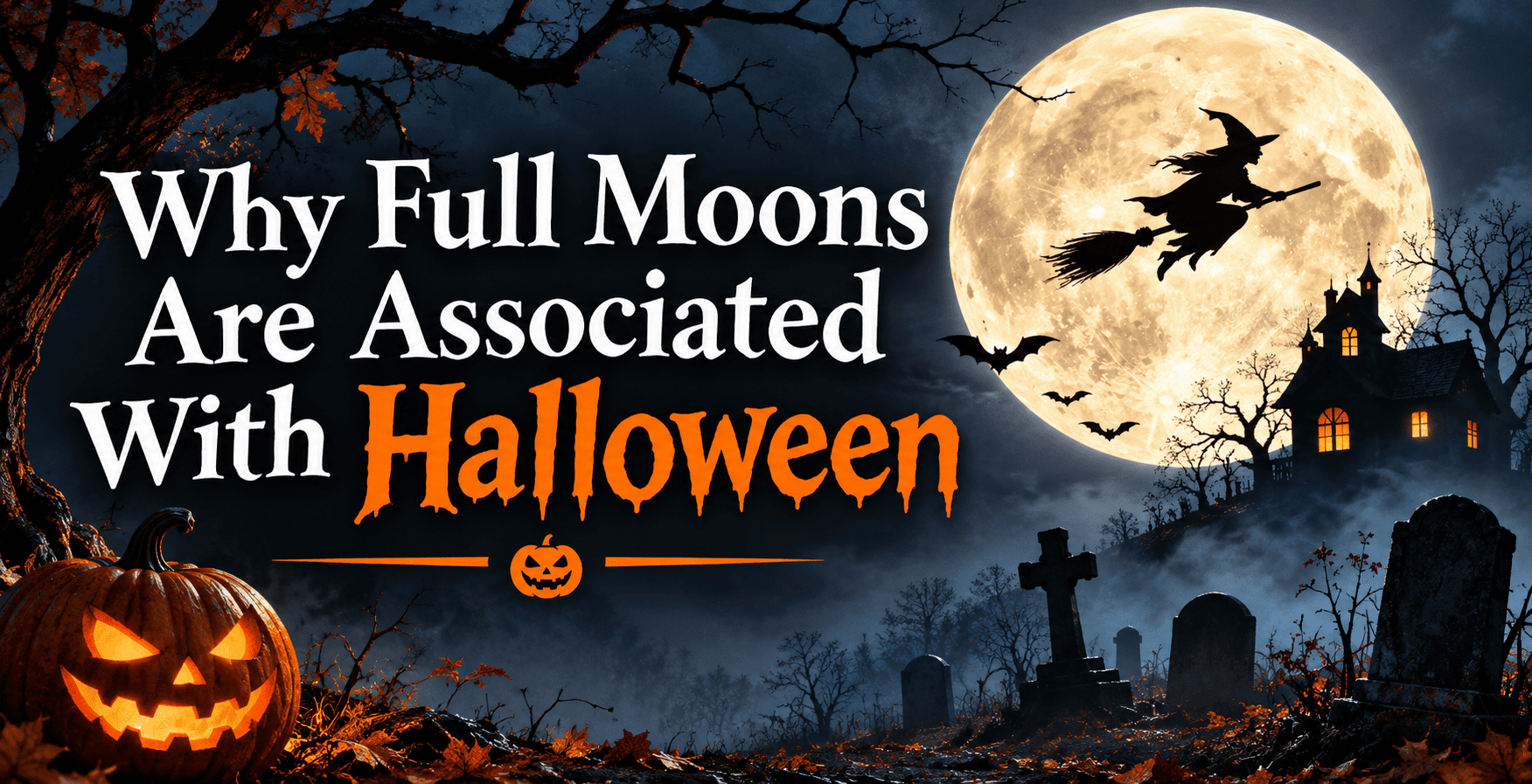
When people imagine Halloween night, they often picture a glowing full moon hanging above a haunted house, casting eerie shadows across a graveyard while witches fly through the sky and werewolves howl in the distance. The full moon has become one of the most recognizable symbols of Halloween, appearing in everything from horror movies and decorations to costumes, greeting cards, and spooky stories.
But why are full moons so closely associated with Halloween? Is there a historical reason behind this connection, or is it simply a tradition created by popular culture?
The answer involves centuries of folklore, ancient beliefs, supernatural legends, astronomy, and the human fascination with the mysterious power of the moon.
Although Halloween does not always fall on a full moon, the image of a bright moon illuminating a dark October night has become an essential part of the holiday’s spooky atmosphere.
The Ancient Connection Between the Moon and the Supernatural
Long before Halloween became the holiday we recognize today, ancient civilizations viewed the moon as a powerful and mysterious force.
The moon controlled the appearance of the night sky, changed shape throughout the month, and influenced the natural rhythm of life. Its predictable phases fascinated people who did not have modern scientific explanations for the world around them.
Many cultures associated the moon with supernatural forces, spiritual activity, fertility, transformation, and the passage of time.
A full moon was particularly significant because it represented the brightest and most visually dramatic phase of the lunar cycle.
In ancient folklore, the full moon was sometimes believed to be a time when supernatural powers grew stronger, mysterious creatures became more active, and unusual events were more likely to occur.
These beliefs developed differently across cultures, but they helped establish the moon as a lasting symbol of mystery.
When Halloween traditions evolved, the full moon naturally fit into the holiday’s growing association with spirits, magic, and the unknown.
How Samhain Influenced Halloween’s Moonlit Traditions
One of Halloween’s historical roots is Samhain, an ancient Gaelic seasonal festival traditionally marking the transition from the harvest season into winter.
Samhain was observed around the beginning of November, when daylight hours were growing shorter and the colder, darker part of the year was approaching.
In Irish folklore, Samhain became associated with supernatural encounters and a time when beings from the Otherworld might enter the human world.
This connection between seasonal darkness and supernatural activity helped shape later Halloween traditions.
However, an important distinction is that Samhain was not originally a festival that required a full moon. Its traditional timing was connected to the seasonal calendar rather than a particular lunar phase.
The full moon’s association with Halloween developed through a combination of older moon-related beliefs, folklore, and later artistic traditions.
Nevertheless, the image of moonlight shining over an ancient autumn landscape fits naturally with the mysterious atmosphere associated with Samhain.
Why Full Moons Became Associated With Witches
One of the strongest connections between full moons and Halloween comes from the traditional image of witches practicing magic beneath a glowing moon.
Throughout history, the moon has appeared in various magical and religious traditions. Different lunar phases were sometimes associated with rituals, divination, protection, and spiritual symbolism.
The full moon, because of its brightness and visual prominence, became particularly meaningful in some magical practices.
In later European folklore, literature, and art, witches were increasingly portrayed as mysterious figures who gathered at night, performed spells, and communicated with supernatural forces.
These stories did not universally require a full moon, but the moon provided a dramatic visual setting for witchcraft.
As Halloween illustrations and popular entertainment developed, artists began placing witches against enormous glowing moons.
The contrast of a dark witch silhouette flying across a bright moon created an image that was instantly recognizable.
Over time, this artistic tradition became one of Halloween’s most familiar symbols.
Today, witches flying across full moons appear on Halloween decorations, costumes, party invitations, and seasonal merchandise.
The Legend of Werewolves and the Full Moon
Few supernatural creatures are more closely associated with the full moon than the werewolf.
According to familiar modern werewolf legends, a person transforms into a wolf or wolf-like monster when the moon becomes full.
The transformation is often portrayed as uncontrollable, terrifying, and dangerous.
However, the relationship between werewolves and full moons is more complicated than many people realize.
Werewolf legends existed in European folklore long before modern horror movies. In older stories, transformation could result from curses, magical objects, spells, or other supernatural circumstances.
The idea that every werewolf must transform during a full moon was not a universal feature of these early legends.
Instead, the full moon became increasingly important through later literature and twentieth-century horror entertainment.
Classic werewolf films helped popularize the idea of moon-triggered transformation, eventually making it a defining characteristic of the creature.
Because werewolves became popular Halloween monsters, their connection to the full moon strengthened the moon’s place in Halloween imagery.
Today, the silhouette of a werewolf howling beneath a full moon is almost as recognizable as a witch flying across one.
Why Full Moons Were Once Associated With Strange Behavior
For centuries, some people believed the full moon could influence human behavior.
The word lunatic comes from the Latin word luna, meaning moon, reflecting historical beliefs connecting lunar phases with unusual mental states or behavior.
People sometimes blamed the full moon for strange dreams, sleeplessness, emotional changes, and unexplained events.
These beliefs helped inspire stories about madness, supernatural transformations, and mysterious nighttime behavior.
The idea that people might behave differently during a full moon eventually became a popular theme in horror fiction.
Characters might become violent, lose control, experience terrifying visions, or encounter supernatural forces.
However, modern scientific research has not established consistent evidence that full moons cause increases in violent crime, psychiatric emergencies, or unusual human behavior.
The moon’s influence over human behavior remains far more significant in folklore than in established science.
Nevertheless, these old beliefs contributed to the full moon’s reputation as something eerie and unpredictable.
The Full Moon and the Fear of the Dark
Before electric lighting became common, nighttime was considerably darker than most people experience today.
Traveling through forests, rural roads, and isolated villages after sunset could be difficult and dangerous.
A full moon provided natural illumination, making it easier to see paths, buildings, animals, and surrounding landscapes.
But moonlight could also create an unsettling atmosphere.
Trees cast long shadows, unfamiliar shapes became visible in the distance, and ordinary objects could appear strange under pale lunar light.
Imagine walking along a deserted road hundreds of years ago, surrounded by darkness while a bright full moon illuminated the landscape.
A moving shadow might appear to be a ghost.
An animal’s distant cry might sound like a supernatural creature.
A figure standing near a cemetery might become the subject of a frightening story.
These experiences helped make moonlit nights an effective setting for ghost stories and supernatural legends.
Halloween eventually adopted this imagery because it captures the combination of beauty, mystery, and fear that defines the holiday.
How Horror Movies Made Full Moons a Halloween Symbol
Although folklore established many of the moon’s supernatural associations, horror movies played a major role in making the full moon an iconic Halloween image.
Early horror filmmakers frequently used moonlit landscapes to establish suspense.
A bright moon behind a castle, cemetery, or abandoned house immediately suggested that something frightening might happen.
The moon also served a practical artistic purpose.
In black-and-white films, strong contrasts between light and darkness helped create dramatic images.
A glowing moon provided a striking background for bats, twisted trees, monsters, and Gothic architecture.
As horror films became increasingly popular, these visual conventions spread into posters, books, television programs, and Halloween decorations.
Eventually, the full moon became a kind of visual shorthand for horror.
An artist could place a large moon behind a haunted house, and viewers would immediately recognize the image as spooky.
This association became so powerful that Halloween imagery often features a full moon even when the actual lunar phase on October 31 is completely different.
Why Bats Are Often Shown Flying Across a Full Moon
Another classic Halloween image features bats flying across a bright full moon.
Bats are nocturnal animals, meaning many species are active during nighttime hours.
Their dark silhouettes and unusual flight patterns have contributed to their association with mystery and supernatural folklore.
In European vampire legends and later Gothic fiction, bats became especially connected with vampires.
Bram Stoker’s 1897 novel Dracula helped reinforce the association between vampires and bats in popular culture.
Halloween artists discovered that bats flying across a glowing moon created an effective and recognizable image.
The moon provides a bright background that makes the bats’ silhouettes stand out.
This simple visual contrast became a favorite in Halloween illustrations.
Although bats do not require full moons to fly, the combination of bats and moonlight remains one of Halloween’s most enduring decorative themes.
Do Full Moons Actually Happen on Halloween?
Despite how frequently full moons appear in Halloween artwork, an actual full moon on October 31 is relatively uncommon.
The lunar cycle, measured from one full moon to the next, lasts approximately 29.5 days.
Because the lunar cycle does not align perfectly with our calendar months, the date of the full moon changes from year to year.
This means Halloween can occur during any phase of the moon.
Some years, Halloween features a crescent moon.
Other years, the moon may be near its first or last quarter.
Occasionally, Halloween falls on the same date as a full moon.
Recent and upcoming Halloween full moons
| Year | Halloween moon |
|---|---|
| 2001 | Full moon |
| 2020 | Full moon |
| 2039 | Full moon |
Dates refer to the October 31 calendar date; exact full-moon timing depends on time zone.
The Halloween full moon in 2020 was especially memorable because it was also widely described as a Blue Moon.
A Blue Moon commonly refers to the second full moon occurring within a single calendar month.
In October 2020, the first full moon occurred on October 1, followed by another on October 31.
This made Halloween night particularly exciting for skywatchers and people who enjoy spooky seasonal traditions.
Why October’s Full Moon Is Called the Hunter’s Moon
The full moon occurring around October is sometimes known as the Hunter’s Moon.
Traditionally, the Hunter’s Moon is the full moon that follows the Harvest Moon.
The Harvest Moon is the full moon closest to the autumnal equinox in the Northern Hemisphere.
Because the Harvest Moon can occur in September or October, the Hunter’s Moon can fall in October or November.
The name is associated with traditional seasonal hunting practices.
After crops had been harvested, open fields could make it easier to spot animals preparing for winter.
The bright moonlight also provided additional visibility during the evening.
The Hunter’s Moon became associated with the changing seasons, colder weather, and the approach of winter.
Its autumn setting makes it especially fitting for Halloween, even though the Hunter’s Moon is not always the full moon nearest October 31.
The Spiritual Meaning of Full Moons in Folklore
Across different cultures and spiritual traditions, full moons have represented completion, transformation, renewal, and heightened awareness.
Some traditions view the full moon as a time for reflection, celebration, or spiritual rituals.
Others associate it with mystery and supernatural activity.
Halloween developed its own combination of these themes.
The holiday is connected with the remembrance of the dead, changing seasons, and stories about the boundary between the ordinary world and the supernatural.
A full moon visually reinforces those ideas.
Its bright, circular appearance can symbolize completion, while its presence in the dark sky creates a sense of mystery.
However, these meanings are cultural and symbolic rather than scientific evidence of supernatural powers.
The full moon’s spiritual significance varies considerably depending on the tradition and the beliefs of the people observing it.
Why Graveyards and Haunted Houses Are Shown Under Full Moons
Halloween decorations frequently feature haunted houses, cemeteries, crooked trees, and abandoned castles beneath enormous full moons.
This combination is not accidental.
A full moon creates a powerful contrast between light and darkness.
When artists place a dark haunted house in front of a bright moon, the building becomes a dramatic silhouette.
The same technique works with gravestones, bare tree branches, bats, and witches.
These images are easy to recognize even from a distance.
The moon also gives the scene an atmosphere of isolation.
A deserted cemetery illuminated by moonlight appears quiet, mysterious, and potentially threatening.
Without the moon, the same scene might simply look like a dark landscape.
With the moon, it becomes a classic Halloween setting.
This artistic technique has been used for generations in Gothic illustrations, horror movie posters, and seasonal decorations.
Are Ghosts More Active During a Full Moon?
One common supernatural belief suggests that ghosts and spirits become more active during a full moon.
Some ghost stories describe apparitions appearing beneath moonlight or supernatural encounters becoming more likely during certain lunar phases.
These beliefs are part of broader folklore connecting the moon with the unseen world.
Halloween adds another layer because it has long been associated with stories about the dead and supernatural visitors.
Combining Halloween night with a full moon creates an especially dramatic setting for ghost stories.
However, there is no reliable scientific evidence that full moons increase paranormal activity or make ghost encounters more likely.
The association survives because it is deeply rooted in storytelling, cultural traditions, and the human imagination.
For people who enjoy Halloween legends, the possibility of a ghost appearing beneath a full moon remains a compelling part of the holiday’s atmosphere.
Why Children Associate Full Moons With Halloween
For many children, the connection between Halloween and full moons begins with cartoons, picture books, decorations, and costumes.
Halloween illustrations often feature a familiar combination of symbols: a jack-o’-lantern, a haunted house, a black cat, bats, and a bright full moon.
These images appear repeatedly throughout childhood.
As a result, people begin to associate the full moon with Halloween long before they learn about lunar cycles or the holiday’s history.
The association becomes even stronger through animated Halloween specials and family-friendly spooky movies.
A glowing moon can make a scene feel mysterious without making it excessively frightening.
This allows the full moon to serve as both a spooky symbol and a playful seasonal decoration.
The image continues to influence Halloween traditions as children grow older and create decorations of their own.
How the Full Moon Became Part of Modern Halloween Decorations
Today, the full moon is everywhere during the Halloween season.
It appears on yard decorations, window silhouettes, party banners, greeting cards, costumes, and illuminated displays.
Some homeowners use large glowing moon decorations behind haunted house scenes.
Others project moving clouds and moonlight onto their homes to create a spooky nighttime atmosphere.
Halloween photographers often use the moon as a dramatic background for seasonal pictures.
The full moon also appears in digital artwork, social media graphics, and Halloween-themed advertisements.
Its popularity comes from its versatility.
The moon can look beautiful, mysterious, magical, romantic, or terrifying depending on the surrounding imagery.
A full moon above a pumpkin patch might feel peaceful and nostalgic.
The same moon above a deserted cemetery might feel frightening.
This ability to create different emotions makes the full moon one of Halloween’s most effective visual symbols.
Interesting Facts About Full Moons and Halloween
Several fascinating facts help explain the relationship between Halloween and the moon.
1. Halloween does not always have a full moon. The moon’s phases change independently of the calendar date.
2. The lunar cycle lasts about 29.5 days. This causes full moons to occur on different dates throughout the year.
3. The full moon is linked to werewolves largely through later storytelling. Early werewolf folklore included many different explanations for transformation.
4. Witches flying across full moons became popular through art and entertainment. The image developed into a recognizable Halloween symbol.
5. October’s full moon is not always the Hunter’s Moon. The name depends on its relationship to the Harvest Moon.
6. The 2020 Halloween full moon was also a Blue Moon. It was the second full moon of that October.
7. Full moons have been associated with mysterious behavior for centuries. These beliefs influenced supernatural legends even though modern science does not support many of the claims.
8. The moon is useful in Halloween artwork because it creates strong silhouettes. Bats, witches, trees, and haunted houses stand out against its bright appearance.
9. A Halloween full moon is not a requirement of Samhain. The festival’s traditional date was not determined by a full-moon phase.
10. The next Halloween full moon after 2020 occurs in 2039. It will provide another opportunity for a particularly atmospheric October 31 sky.
Why the Full Moon Still Captures Our Imagination on Halloween
Even in a world where science can explain the moon’s phases and predict lunar events with remarkable accuracy, the full moon continues to inspire mystery.
There is something captivating about seeing a large, glowing moon rise above the horizon on a chilly autumn evening.
Its pale light changes the appearance of familiar surroundings.
Ordinary trees become strange silhouettes.
Quiet roads seem more mysterious.
Old buildings take on a Gothic appearance.
For generations, storytellers have used these qualities to create suspense and wonder.
Halloween celebrates many of the same emotions.
It allows people to explore fear through costumes, decorations, ghost stories, and playful supernatural traditions.
The full moon fits perfectly into this experience because it transforms an ordinary nighttime scene into something memorable.
It connects modern Halloween celebrations with centuries of folklore, legends, and artistic imagination.
Final Thoughts: Why Full Moons Will Always Be a Symbol of Halloween
The full moon’s association with Halloween developed from a combination of ancient lunar symbolism, supernatural folklore, witchcraft imagery, werewolf legends, Gothic art, and horror entertainment.
Although Halloween does not always occur during a full moon, the connection has become so deeply established that it is difficult to imagine the holiday without one.
From witches flying across the night sky to werewolves howling in the distance, the full moon provides the perfect background for Halloween’s most famous supernatural characters.
Its beauty and mystery have inspired generations of storytellers, artists, and Halloween enthusiasts.
And perhaps that is why the image remains so powerful.
On Halloween night, when the air grows colder, the streets become quiet, and shadows stretch across the ground, a glowing moon can make the ordinary world feel just a little more mysterious.
The full moon does not need to possess supernatural powers to create Halloween magic. Sometimes, all it takes is moonlight, imagination, and a good ghost story.
What is your favorite Halloween image: a witch flying across a full moon, a werewolf howling beneath it, or a haunted house glowing in the moonlight?
Leave a Reply