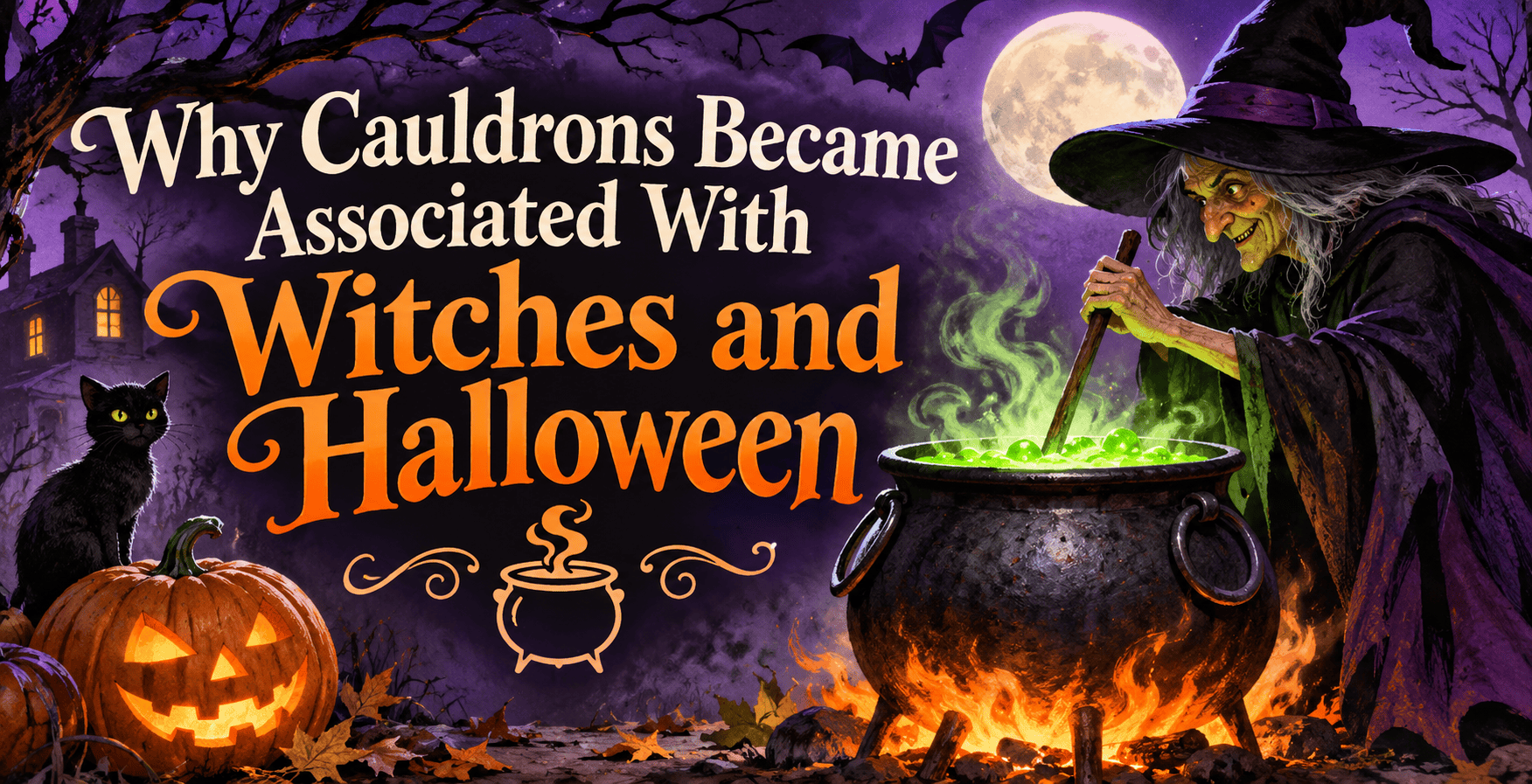
When people picture a witch on Halloween, they often imagine a mysterious figure standing over a large black cauldron, stirring a bubbling potion filled with strange ingredients. Green smoke rises into the night air, magical spells are whispered, and something supernatural seems to be brewing.
The witch’s cauldron has become one of Halloween’s most recognizable symbols, appearing in decorations, costumes, movies, haunted houses, and spooky stories.
But why are witches so closely associated with cauldrons? Were these large cooking pots actually used for witchcraft, or did their connection to magic develop through folklore and superstition?
The answer involves centuries of history, ancient traditions, European witchcraft beliefs, mythology, and the transformation of everyday household objects into symbols of the supernatural.
Understanding why cauldrons became associated with witches and Halloween reveals how ordinary cooking equipment became one of the most enduring images of magic and mystery.
What Is a Cauldron?
A cauldron is a large metal pot traditionally used for cooking food, boiling water, preparing medicines, and heating liquids over an open fire.
Historically, cauldrons were commonly made from iron, bronze, or copper. Many featured rounded bottoms and sturdy handles that allowed them to hang above fireplaces or outdoor cooking fires.
Before modern stoves and kitchen appliances, cauldrons were practical household necessities.
Families used them to prepare soups, stews, grains, and other meals that required long cooking times. Large cauldrons were particularly useful because they could hold enough food to feed several people.
They were also used for tasks beyond cooking, including heating water for washing and preparing herbal mixtures.
Nothing about these ordinary household activities was inherently magical.
However, because cauldrons were associated with fire, transformation, mysterious ingredients, and the preparation of unfamiliar substances, they eventually became connected with supernatural beliefs.
The Ancient History of Cauldrons and Magic
The association between cauldrons and supernatural power existed long before the modern Halloween witch appeared.
In several ancient cultures, large vessels were connected with religious ceremonies, offerings, abundance, healing, and transformation.
Cauldrons held special significance in some Celtic mythological traditions.
Rather than serving merely as cooking equipment, certain legendary cauldrons possessed extraordinary powers.
Some could provide endless food, restore life, or symbolize the boundary between the natural and supernatural worlds.
These stories helped establish the cauldron as something more mysterious than an ordinary household pot.
Magical Cauldrons in Celtic Mythology
One of the most fascinating examples comes from Welsh mythology.
In the medieval Welsh tale Branwen Daughter of Llŷr, a magical cauldron has the power to restore dead warriors to life.
However, those revived by the cauldron lose their ability to speak.
This unusual detail illustrates how magical cauldrons could represent both extraordinary power and unsettling consequences.
Another important figure is Ceridwen, a character from Welsh legendary tradition who prepares a powerful mixture in a cauldron.
Her magical brew is associated with inspiration, wisdom, and transformation.
These stories helped establish cauldrons as symbols of mysterious knowledge and supernatural change.
Although ancient and medieval Celtic traditions influenced later interpretations of magic, the familiar Halloween witch did not emerge directly from any single Celtic legend.
Instead, the modern image developed through the combination of many different traditions.
Why Witches Became Associated With Cooking Pots
During the Middle Ages and early modern period, European communities often relied on household remedies and traditional knowledge to treat common illnesses.
People prepared herbal mixtures, heated medicinal ingredients, and boiled plants in ordinary cooking vessels.
Some individuals developed reputations for possessing special knowledge about herbs, healing, or folk remedies.
These practices were not necessarily considered witchcraft.
However, as fears surrounding witchcraft increased in parts of Europe, certain activities became vulnerable to suspicion.
People accused of practicing harmful magic were sometimes believed to prepare dangerous substances, magical mixtures, or poisons.
The cauldron gradually became a convenient visual symbol for these imagined activities.
Because a large cooking pot could hold almost anything, storytellers could easily transform it into a vessel containing mysterious ingredients.
An ordinary household object became associated with secret knowledge, forbidden practices, and supernatural danger.
It is important to recognize that people accused of witchcraft did not all practice magic or prepare mysterious potions. Many accusations arose from fear, conflict, religious tensions, and social suspicion rather than actual supernatural practices.
How Witchcraft Trials Strengthened the Cauldron Connection
European witch trials contributed to the development of the frightening witch stereotype.
Between approximately the fifteenth and eighteenth centuries, thousands of people were prosecuted for alleged witchcraft across Europe.
The accusations varied, but some involved claims of harmful spells, poisoning, supernatural gatherings, and agreements with evil forces.
Popular beliefs sometimes imagined witches using unusual substances to create magical effects.
Cooking vessels became part of this broader imagery.
However, there was no universal historical practice in which accused witches gathered around large cauldrons to brew spells.
The familiar image was shaped by folklore, artistic imagination, literature, and later popular entertainment.
As stories about witches spread, the cauldron offered an easily recognizable object that artists and storytellers could use to represent magical preparation.
Over time, it became difficult to separate the fictional witch’s cooking pot from the larger cultural image of witchcraft.
The Influence of Shakespeare’s Macbeth
One of the most influential literary works connecting witches with bubbling cauldrons is Macbeth by William Shakespeare.
Written in the early seventeenth century, the play features three witches who prepare a mysterious mixture while chanting over a cauldron.
Their scene includes strange ingredients, ominous language, and supernatural predictions.
The famous phrase “Double, double toil and trouble” became closely associated with witches stirring magical brews.
Shakespeare did not invent the idea of witches preparing magical mixtures, but his play helped popularize a particularly memorable version of the image.
The witches’ cauldron became a powerful theatrical symbol.
It combined several frightening elements: darkness, fire, strange ingredients, mysterious predictions, and the suggestion that supernatural forces were being summoned.
As Macbeth was performed and adapted over the centuries, its witches influenced later representations in literature, theater, illustration, and film.
The bubbling cauldron became an essential part of the fictional witch’s appearance.
Why Witches Are Often Shown Stirring Bubbling Potions
The image of a witch stirring a bubbling potion is especially effective because it transforms an ordinary activity into something mysterious.
Cooking involves combining ingredients and using heat to change their properties.
In everyday life, these transformations produce meals, medicines, and other useful substances.
In magical stories, the same process can produce extraordinary results.
A witch might supposedly combine herbs, animal parts, mysterious powders, or imaginary ingredients to create a potion capable of changing someone’s appearance, casting a spell, or revealing the future.
The bubbling liquid adds suspense because the viewer cannot immediately identify what is inside.
Smoke, steam, unusual colors, and glowing effects make the process appear supernatural.
The cauldron also gives fictional witches something recognizable to do while performing magic.
Rather than simply waving their hands, they can gather ingredients, recite incantations, and stir a mysterious mixture.
This makes the scene visually dramatic and easy to remember.
Were Cauldrons Really Used in Witchcraft?
Cauldrons and other cooking vessels have been used in various historical folk practices, including the preparation of herbal remedies and ritual substances.
However, the historical reality is much more complicated than Halloween imagery suggests.
There is no evidence that all people associated with witchcraft traditionally used large black cauldrons.
Many historical magical practices involved prayers, charms, written symbols, small containers, candles, herbs, or ordinary household objects.
Large cauldrons were primarily practical tools.
Some modern practitioners of witchcraft and contemporary Pagan traditions use cauldrons symbolically or ritually.
They may represent transformation, the elements, purification, or spiritual renewal.
These modern uses should not automatically be confused with the accusations made during historical witch trials.
The familiar Halloween cauldron is best understood as a combination of mythology, folklore, literary influence, and modern artistic tradition.
How Cauldrons Became Associated With Halloween
The connection between cauldrons and Halloween developed as different traditions gradually merged.
Halloween has historical connections to seasonal customs surrounding the end of harvest, the beginning of winter, and beliefs about spirits and the dead.
The ancient Gaelic festival of Samhain is frequently discussed in relation to Halloween’s development.
Samhain marked a seasonal transition and was associated in later folklore with supernatural activity.
However, there is no strong historical basis for claiming that witches brewing potions in cauldrons was a standard ancient Samhain custom.
The familiar Halloween cauldron became prominent through later cultural developments.
As Halloween evolved into a celebration featuring costumes, decorations, ghost stories, and supernatural characters, witches became especially popular.
By the nineteenth and twentieth centuries, witches were increasingly represented in seasonal illustrations, greeting cards, advertisements, and entertainment.
Their appearance became more standardized.
The pointed hat, broomstick, black cat, and bubbling cauldron formed a recognizable collection of witch-related symbols.
Because cauldrons already had strong associations with magical mixtures and mysterious rituals, they fit naturally into Halloween imagery.
Why Halloween Cauldrons Are Usually Black
Most Halloween cauldrons are depicted as large, rounded black pots.
This appearance partly reflects traditional iron cookware.
Cast iron and other iron cooking vessels could appear dark, especially after repeated exposure to heat, smoke, and cooking fires.
A dark cauldron also creates a dramatic visual effect.
When placed over bright orange flames or filled with glowing green liquid, the black exterior provides strong contrast.
In Halloween decorations, black is commonly associated with darkness, mystery, and the supernatural.
These visual associations reinforced the cauldron’s spooky appearance.
Today, many Halloween cauldrons are made from lightweight plastic rather than metal, but they often imitate the rounded shape and dark surface of traditional cooking pots.
Why Witch Potions Are Often Green
Although historical cauldrons contained ordinary foods and liquids, fictional witch potions are frequently shown as bright green mixtures.
Green has become a popular color for magical brews because it can suggest something strange, unnatural, poisonous, or mysterious.
In cartoons and fantasy movies, green liquid provides an instantly recognizable signal that the substance is not ordinary soup.
Bright green bubbles and smoke also stand out against a black cauldron.
Other common potion colors include purple, red, and blue.
Purple often suggests mystery or enchantment, while red can suggest danger or powerful magic.
These color associations are largely products of artistic convention rather than historical rules about witchcraft.
The Cauldron as a Symbol of Transformation
One reason cauldrons appear so frequently in mythology and magical stories is their connection to transformation.
A cooking pot changes raw ingredients into something new.
Water becomes steam, plants release their flavors, and separate ingredients combine into a finished mixture.
This ordinary process provides a natural metaphor for magical change.
In mythology, a cauldron might transform death into life, ignorance into wisdom, or ordinary substances into powerful medicines.
In modern magical symbolism, the cauldron may represent renewal, creativity, hidden potential, or the possibility of change.
Its meaning is not always frightening.
While Halloween decorations often emphasize sinister potions, older mythological traditions sometimes presented magical cauldrons as sources of nourishment, abundance, or restoration.
How Movies and Cartoons Popularized Witch Cauldrons
The twentieth-century entertainment industry played a major role in making cauldrons a permanent part of Halloween imagery.
Animated films, children’s books, television programs, and fantasy movies frequently showed witches standing over bubbling pots.
The cauldron became a simple way to communicate that a character was preparing magic.
Audiences did not need an explanation.
A pointed hat, a broomstick, and a bubbling cauldron immediately identified a fictional witch.
Movies also made the cauldron more visually exciting.
Special effects introduced glowing liquids, rising smoke, strange sounds, and colorful explosions.
These dramatic details strengthened the association between cauldrons and supernatural activity.
Family-friendly Halloween entertainment often made the image playful rather than terrifying.
A witch’s cauldron could contain a dangerous spell in one story and a harmless batch of magical candy in another.
This flexibility helped the cauldron become suitable for both frightening haunted houses and cheerful children’s celebrations.
Why Cauldrons Are Popular Halloween Decorations
Cauldrons remain popular Halloween decorations because they are recognizable, versatile, and easy to incorporate into different themes.
A large black cauldron can serve as a centerpiece for a haunted house, a witch-themed display, or a Halloween party.
Some decorations feature artificial flames beneath the pot.
Others use lighting effects to create the appearance of bubbling green or purple liquid.
Fog effects can make a cauldron look as though a magical potion is producing mysterious smoke.
Smaller decorative cauldrons are often used as candy containers, party favors, or tabletop decorations.
Their shape also makes them useful for Halloween games and themed displays.
The cauldron works equally well in a playful setting or a frightening one.
That versatility is one reason it has remained popular for generations.
The Connection Between Cauldrons and Halloween Candy
Modern Halloween celebrations have given cauldrons a much friendlier purpose.
Instead of holding mysterious potions, many decorative cauldrons are filled with candy.
Small plastic cauldrons are especially popular as trick-or-treat containers and party favors.
Their rounded shape resembles traditional cooking pots, while their lightweight construction makes them convenient for children.
This adaptation demonstrates how Halloween symbols change over time.
An object once associated with dangerous magic in fictional stories can become a cheerful container for sweets.
The same symbol can represent mystery, imagination, and celebration depending on how it is used.
Interesting Facts About Witches and Cauldrons
Several historical and cultural details make the witch’s cauldron more interesting than it first appears.
-
Cauldrons existed long before modern Halloween traditions. Large cooking vessels were used in ancient societies for practical and ceremonial purposes.
-
Not every magical cauldron was associated with evil. Some mythological cauldrons represented nourishment, wisdom, healing, or restoration.
-
Shakespeare helped popularize the bubbling witch’s brew. The witches in Macbeth became an influential image in Western literature and theater.
-
Real historical cauldrons were everyday household objects. Most were used for cooking, heating water, and other ordinary tasks.
-
The familiar Halloween witch developed gradually. Her cauldron, pointed hat, broomstick, and black cat came together through centuries of changing imagery.
-
Modern cauldrons can have spiritual meanings. Some contemporary practitioners use them as symbols of transformation or renewal.
-
Halloween cauldrons are often decorative rather than functional. Plastic candy buckets and illuminated displays imitate the appearance of older metal vessels.
Why the Witch’s Cauldron Still Fascinates People
The witch’s cauldron continues to capture the imagination because it represents the possibility that something extraordinary might emerge from something ordinary.
A cooking pot is familiar and practical.
Yet in folklore, literature, and fantasy, it becomes a vessel capable of holding mysterious powers.
The bubbling liquid creates anticipation.
What ingredients have been added? What spell is being prepared? What might happen when the mixture is finished?
These unanswered questions make the cauldron an effective storytelling device.
It also connects modern Halloween celebrations with much older traditions involving mythology, transformation, and supernatural beliefs.
Although the familiar Halloween image is largely fictional, its cultural roots extend across centuries.
Final Thoughts: How an Ordinary Cooking Pot Became a Halloween Icon
Cauldrons became associated with witches and Halloween through a gradual combination of ancient mythology, everyday cooking traditions, European witchcraft beliefs, literature, and popular entertainment.
In the beginning, cauldrons were practical vessels used to prepare food, heat water, and perform household tasks.
Mythological stories gave some cauldrons extraordinary powers, while later witchcraft folklore connected cooking vessels with magical mixtures and mysterious substances.
Shakespeare’s Macbeth helped make the bubbling witch’s brew an unforgettable image.
Eventually, Halloween illustrations, movies, cartoons, and decorations transformed the cauldron into one of the holiday’s most recognizable symbols.
Today, the witch’s cauldron can represent frightening spells, magical transformations, or simply a container overflowing with Halloween candy.
Its enduring popularity shows how an ordinary object can acquire extraordinary meaning through generations of storytelling.
The next time you see a black cauldron bubbling beneath a Halloween witch, remember that the familiar image carries centuries of mythology, superstition, theatrical imagination, and cultural history.
When you think of a witch’s cauldron on Halloween, do you imagine a frightening magical potion or a fun decoration filled with candy?
Leave a Reply