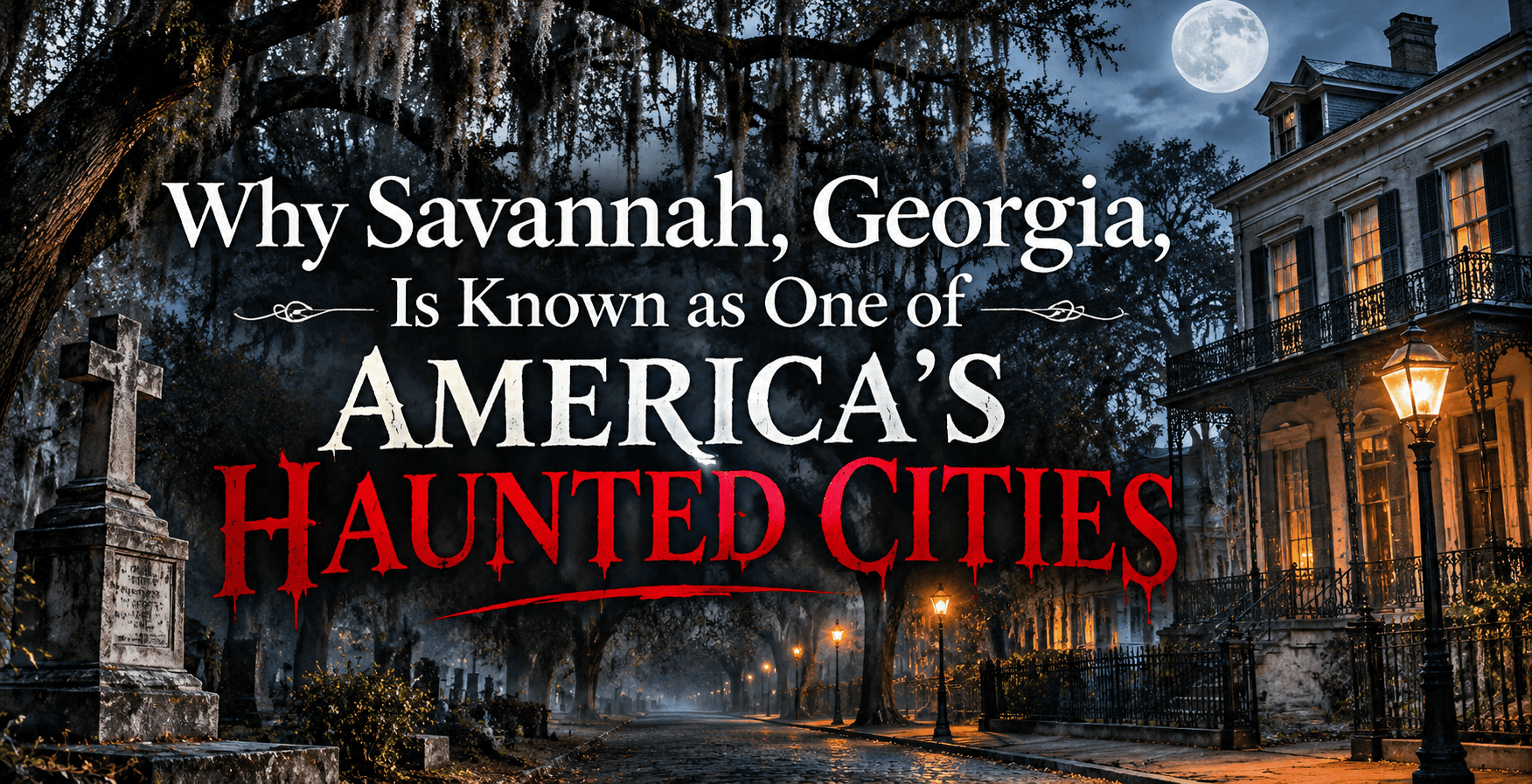
Savannah, Georgia, is famous for its beautiful historic squares, moss-covered oak trees, cobblestone streets, and elegant Southern architecture. However, beneath the charm of this historic coastal city lies a darker reputation. Savannah is widely considered one of the most haunted cities in America, attracting visitors who want to explore its mysterious past, legendary ghost stories, and supposedly haunted buildings.
From centuries-old cemeteries and historic mansions to mysterious tunnels and former battlefields, Savannah has become a popular destination for paranormal enthusiasts and curious travelers alike.
But why is Savannah, Georgia, considered so haunted? The answer involves nearly 300 years of history, including wars, disease outbreaks, devastating fires, tragic deaths, and generations of ghostly folklore.
While there is no scientific evidence proving that ghosts inhabit Savannah, the city’s haunted reputation has become an important part of its cultural identity.
1. Savannah’s History Dates Back to 1733
One of the biggest reasons Savannah is considered haunted is its long and sometimes tragic history.
Savannah was founded in 1733 by British general James Edward Oglethorpe, making it one of Georgia’s oldest cities. Established along the Savannah River, the settlement became an important center for trade, transportation, and colonial development.
Over the centuries, Savannah experienced dramatic historical events, including the American Revolution, the Civil War, yellow fever epidemics, destructive fires, and economic hardship.
Many of the city’s oldest buildings remain standing today, preserving the architecture and atmosphere of earlier generations.
These historic surroundings have helped inspire countless stories about spirits that supposedly remain connected to the places where they once lived.
For visitors walking through Savannah after sunset, its narrow streets, dimly lit squares, and towering live oaks can create an atmosphere that feels like stepping back in time.
2. Savannah’s Cemeteries Are Surrounded by Ghost Stories
Savannah’s historic cemeteries are among the city’s most recognizable locations associated with paranormal legends.
Two cemeteries, in particular, have contributed to Savannah’s haunted reputation.
Colonial Park Cemetery
Established in 1750, Colonial Park Cemetery is one of Savannah’s oldest surviving burial grounds.
Located in the heart of the Historic District, it contains graves dating to the colonial era and the early years of the United States.
Thousands of people are believed to have been buried within its grounds, including victims of disease outbreaks and prominent early residents.
The cemetery is surrounded by stories of mysterious shadows, unexplained sounds, and ghostly figures.
One frequently repeated legend claims that some gravestones were altered or damaged by Union soldiers during the Civil War. Although the cemetery’s monuments have experienced damage and changes over time, individual stories about soldiers altering inscriptions should not automatically be accepted as established historical fact.
Today, Colonial Park Cemetery remains a popular stop on Savannah’s ghost tours.
Bonaventure Cemetery
Bonaventure Cemetery is another famous burial ground associated with Savannah’s mysterious atmosphere.
Located along the Wilmington River, the cemetery is known for its elaborate monuments, beautiful sculptures, and enormous live oak trees covered in Spanish moss.
Its peaceful yet haunting appearance has inspired photographers, writers, and ghost-story enthusiasts for generations.
Bonaventure gained international attention through the book Midnight in the Garden of Good and Evil and its film adaptation.
Although many visitors associate the cemetery with supernatural stories, its strongest connection to Savannah’s haunted identity comes from its striking scenery, historical significance, and longstanding place in Southern Gothic culture.
3. The Sorrel-Weed House and Its Ghostly Legends
One of Savannah’s best-known supposedly haunted buildings is the Sorrel-Weed House.
Built during the 1840s, this historic mansion is located near Madison Square.
The house is admired for its Greek Revival architecture and connection to Savannah’s wealthy nineteenth-century society.
However, its reputation extends far beyond architecture.
According to local ghost stories, the mansion is associated with tragic deaths, unexplained noises, strange shadows, and reports of paranormal activity.
Some stories involve members of the Sorrel household and enslaved people who lived or worked on the property. The more sensational details of these accounts are disputed or lack reliable historical documentation.
Visitors participating in paranormal tours have reported unusual sensations, mysterious sounds, and unexplained experiences.
Whether these reports have ordinary explanations or something more mysterious remains a matter of personal interpretation.
The Sorrel-Weed House has nevertheless become one of Savannah’s most recognizable haunted attractions.
4. The Marshall House Hotel Is Famous for Ghost Sightings
Savannah’s historic hotels also play an important role in the city’s haunted reputation.
One of the most famous is The Marshall House.
Opened in 1851, the hotel has witnessed many chapters of Savannah’s history.
During the Civil War, portions of the building were used for medical purposes, and the property also has historical associations with the city’s yellow fever epidemics.
Over the years, stories have circulated about guests hearing mysterious footsteps, encountering unexplained noises, and seeing figures dressed in clothing from earlier centuries.
Some visitors claim to have heard children running through hallways when no children were nearby.
Others describe strange sensations or unusual activity inside certain rooms.
These accounts are part of the hotel’s folklore rather than verified evidence of supernatural activity.
Still, The Marshall House remains a popular destination for travelers interested in Savannah’s haunted history.
5. Yellow Fever Epidemics Contributed to Savannah’s Haunted Reputation
One of the darkest chapters in Savannah’s history involves the deadly yellow fever outbreaks of the nineteenth century.
Yellow fever is a mosquito-borne viral disease that caused widespread illness and death before scientists understood how it spread.
Savannah’s warm climate, coastal location, and busy port made the city particularly vulnerable to outbreaks.
In 1820, a devastating epidemic killed more than 700 residents. Another major outbreak in 1854 claimed more than 1,000 lives.
Families lost loved ones, neighborhoods experienced widespread suffering, and cemeteries became lasting reminders of these tragedies.
Over time, stories developed about restless spirits, mysterious figures, and supernatural activity near places associated with the epidemics.
These stories are folklore, but the suffering that inspired them was real.
For many people, Savannah’s haunted reputation reflects the emotional weight of a city that has experienced repeated periods of extraordinary loss.
6. Savannah Was the Site of Revolutionary War Battles
Savannah’s military history provides another explanation for its ghostly reputation.
During the American Revolution, Savannah became an important strategic location.
British forces captured the city in 1778, and American and French forces attempted to retake it during the Siege of Savannah in 1779.
The assault resulted in heavy casualties.
Among those mortally wounded was Polish-born military commander Casimir Pulaski, who fought alongside American forces.
Today, Savannah’s historic squares and monuments preserve memories of the city’s Revolutionary War past.
Local ghost stories sometimes describe soldiers appearing near former military sites or mysterious sounds resembling marching footsteps.
Although these supernatural accounts cannot be verified, the battles themselves are well documented.
Savannah’s history of warfare has provided generations of storytellers with material for haunting legends.
7. The Civil War Left Its Mark on Savannah
The American Civil War also shaped Savannah’s identity.
Savannah served as an important Confederate port before Union forces occupied the city in December 1864.
General William Tecumseh Sherman entered Savannah after completing his March to the Sea.
Unlike many other Southern communities devastated during the campaign, much of Savannah’s historic architecture survived.
This preservation helped the city retain numerous buildings associated with the nineteenth century.
According to local folklore, some of these buildings are haunted by soldiers, former residents, and people who died during the war.
Ghost tours occasionally include stories about mysterious military figures, unexplained footsteps, and apparitions wearing period uniforms.
The Civil War’s impact on Savannah is historical fact, while the reported ghostly encounters remain unverified stories.
8. The Mercer-Williams House and a Famous Murder Case
Another building associated with Savannah’s mysterious reputation is the Mercer Williams House Museum.
Located on Monterey Square, the mansion became internationally famous following a controversial 1981 shooting.
Antiques dealer Jim Williams shot and killed Danny Hansford inside the house.
Williams maintained that he acted in self-defense. After four trials, he was acquitted.
The case later became central to John Berendt’s bestselling 1994 nonfiction book, Midnight in the Garden of Good and Evil.
The book and its 1997 film adaptation introduced millions of readers and moviegoers to Savannah’s unusual personalities, historic mansions, and mysterious atmosphere.
Ghost stories associated with the Mercer-Williams House grew alongside the property’s fame.
Although the shooting and subsequent trials are documented historical events, supernatural claims involving the house remain unproven.
9. Savannah’s Historic Squares Create an Eerie Atmosphere
Savannah is famous for its carefully planned historic squares.
The city’s original layout was designed around public spaces that encouraged community gathering and organized development.
Today, the Historic District features 22 surviving squares surrounded by historic buildings, churches, monuments, and oak trees.
During daylight hours, these squares are popular places for sightseeing and relaxation.
At night, however, their appearance can feel dramatically different.
Streetlights illuminate winding branches, shadows stretch across brick walkways, and Spanish moss moves in the coastal breeze.
This distinctive setting contributes to the city’s supernatural reputation.
Wright Square, for example, is associated with the legend of Alice Riley, an indentured servant executed during Savannah’s colonial period.
According to local folklore, her spirit still wanders the area.
While there is no evidence confirming the haunting, stories like this demonstrate how historical events can become deeply connected to particular locations.
10. The Pirates’ House Is Surrounded by Legends
Savannah’s maritime history has also inspired numerous ghost stories.
As an important Atlantic port, the city attracted sailors, merchants, shipbuilders, and travelers from around the world.
One of its most famous historic establishments is The Pirates’ House.
The property is associated with Savannah’s early seafaring history and has become a popular destination for visitors interested in pirates and maritime folklore.
Stories about the building include mysterious tunnels, kidnapped sailors, and ghostly figures appearing in historic rooms.
Some legends claim that sailors were taken through underground passages and forced aboard ships.
Although Savannah’s maritime past is well documented, many of the more dramatic stories surrounding the Pirates’ House lack reliable historical evidence.
Nevertheless, the combination of historic architecture, pirate legends, and mysterious storytelling has helped make the location a recognizable part of haunted Savannah.
11. Ghost Tours Have Made Savannah Famous Worldwide
One of the biggest reasons Savannah is known as a haunted city is its thriving ghost-tour industry.
Visitors can explore the Historic District through guided walking tours, nighttime trolley rides, historic-house tours, and paranormal-themed experiences.
Tour guides often combine documented history with local legends, dramatic storytelling, and accounts of unexplained encounters.
Popular subjects include haunted hotels, historic cemeteries, mysterious murders, Revolutionary War soldiers, and ghostly residents of old mansions.
Savannah’s walkable streets and preserved architecture make it particularly suitable for nighttime storytelling.
The city’s tourism industry has embraced this reputation, frequently promoting Savannah as one of America’s most haunted destinations.
However, calling Savannah the most haunted city in America is a cultural and promotional description rather than a scientifically measurable distinction.
What makes Savannah unusual is how closely its supernatural folklore is connected to its visible historic environment.
12. Why Spanish Moss Makes Savannah Feel Haunted
Few natural features are as closely associated with Savannah as Spanish moss hanging from enormous live oak trees.
The long, gray-green strands create a distinctive Southern Gothic appearance.
When wind moves through the branches, the moss sways above historic streets and cemeteries.
At night, this movement can create unusual shadows and silhouettes.
Combined with Savannah’s old buildings, iron fences, brick sidewalks, and dimly illuminated squares, the scenery creates an atmosphere that seems perfectly suited for ghost stories.
Spanish moss itself has no supernatural properties.
It is an epiphytic flowering plant that grows on trees without taking nutrients directly from them.
However, its appearance has become an essential visual element of Savannah’s haunted identity.
For many visitors, the city’s environment feels mysterious even before they hear their first ghost story.
13. Southern Gothic Literature Helped Shape Savannah’s Reputation
Savannah’s connection to Southern Gothic storytelling has strengthened its haunted reputation.
Southern Gothic literature frequently explores themes involving death, family secrets, moral conflict, social inequality, decaying grandeur, and the lingering consequences of the past.
Savannah provides a striking real-world setting for these themes.
Its historic mansions, old cemeteries, complicated social history, and dramatic architecture create an atmosphere familiar to readers of Southern Gothic fiction.
Midnight in the Garden of Good and Evil played a particularly important role in popularizing Savannah’s mysterious image.
The book introduced audiences to a city filled with unusual characters, hidden conflicts, and unforgettable locations.
Although the work is nonfiction, its storytelling helped establish Savannah as a destination associated with mystery and intrigue.
The resulting popularity brought increased attention to the city’s historic buildings and supernatural legends.
14. Why Savannah’s Haunted Reputation Continues Today
Savannah’s haunted identity continues because its history remains visible throughout the city.
Unlike places where older buildings have disappeared through redevelopment, Savannah has preserved much of its historic urban environment.
Visitors can walk past buildings constructed more than a century ago, explore public squares dating to the colonial period, and visit cemeteries containing generations of residents.
These physical connections to the past make historical stories feel immediate.
Savannah also benefits from a strong storytelling tradition.
Ghost stories are passed between residents, tour guides, visitors, and generations of families.
Some accounts are rooted in documented tragedies. Others are exaggerated, misremembered, or entirely fictional.
Over time, these stories become part of the city’s cultural character.
The result is a destination where history and legend are often experienced together.
Is Savannah, Georgia, Really Haunted?
Whether Savannah is genuinely haunted depends largely on personal beliefs.
People who believe in paranormal activity may interpret unusual sounds, mysterious shadows, and unexplained experiences as evidence of spirits.
Others attribute these experiences to natural causes, historic-building noises, suggestion, lighting conditions, or the powerful influence of storytelling.
There is no scientifically established evidence that Savannah has more supernatural activity than other American cities.
However, its reputation as a haunted destination is undeniable.
Savannah possesses an extraordinary combination of preserved architecture, historic cemeteries, military history, tragic events, and supernatural folklore.
These elements make it one of America’s most recognizable cities for ghost tourism.
Frequently Asked Questions About Haunted Savannah
Why is Savannah called America’s most haunted city?
Savannah earned its reputation through centuries of history involving wars, yellow fever epidemics, deadly fires, historic cemeteries, and mysterious local legends. Its preserved buildings and popular ghost tours have strengthened this identity.
What is the most famous haunted house in Savannah?
The Sorrel-Weed House is among Savannah’s best-known supposedly haunted houses. Its historic architecture and longstanding ghost stories make it a popular paranormal attraction.
What is the most famous haunted cemetery in Savannah?
Colonial Park Cemetery is one of the city’s most prominent ghost-tour landmarks. Bonaventure Cemetery is also internationally recognized for its atmospheric setting, historic monuments, and association with Southern Gothic storytelling.
Are Savannah’s ghost stories based on true events?
Some stories are inspired by documented historical events, including wars, epidemics, and deaths. However, many supernatural details have not been verified and should be understood as folklore.
Why are ghost tours so popular in Savannah?
Savannah’s walkable Historic District, atmospheric scenery, preserved buildings, and abundance of historical stories make it especially appealing for nighttime ghost tours.
Is Savannah a good place to visit during Halloween?
Yes. Savannah is a popular Halloween destination because of its historic atmosphere, ghost tours, cemetery history, and longstanding reputation for mysterious legends.
Final Thoughts: Why Savannah Remains One of America’s Most Haunted Cities
Savannah, Georgia, is more than a beautiful Southern destination. It is a city where nearly three centuries of American history have created an extraordinary collection of legends, mysteries, and ghost stories.
From Colonial Park Cemetery and the Sorrel-Weed House to the Marshall House and the historic squares, Savannah offers countless locations associated with supernatural folklore.
Its history includes devastating epidemics, military conflicts, tragic deaths, and generations of people whose lives shaped the city.
Yet what truly distinguishes Savannah is how much of that history remains visible.
The old buildings still stand. The cemeteries still preserve the names of former residents. The oak trees still shade streets that have witnessed centuries of change.
Whether ghosts actually wander Savannah’s historic neighborhoods may never be proven.
But one thing is certain: Savannah has mastered the art of keeping its history alive through storytelling.
And perhaps that is the real reason Savannah, Georgia, continues to be known as one of America’s most haunted cities.
Would you visit Savannah for its haunted history, or would you rather explore its mysterious streets during the safety of daylight?

Leave a Reply