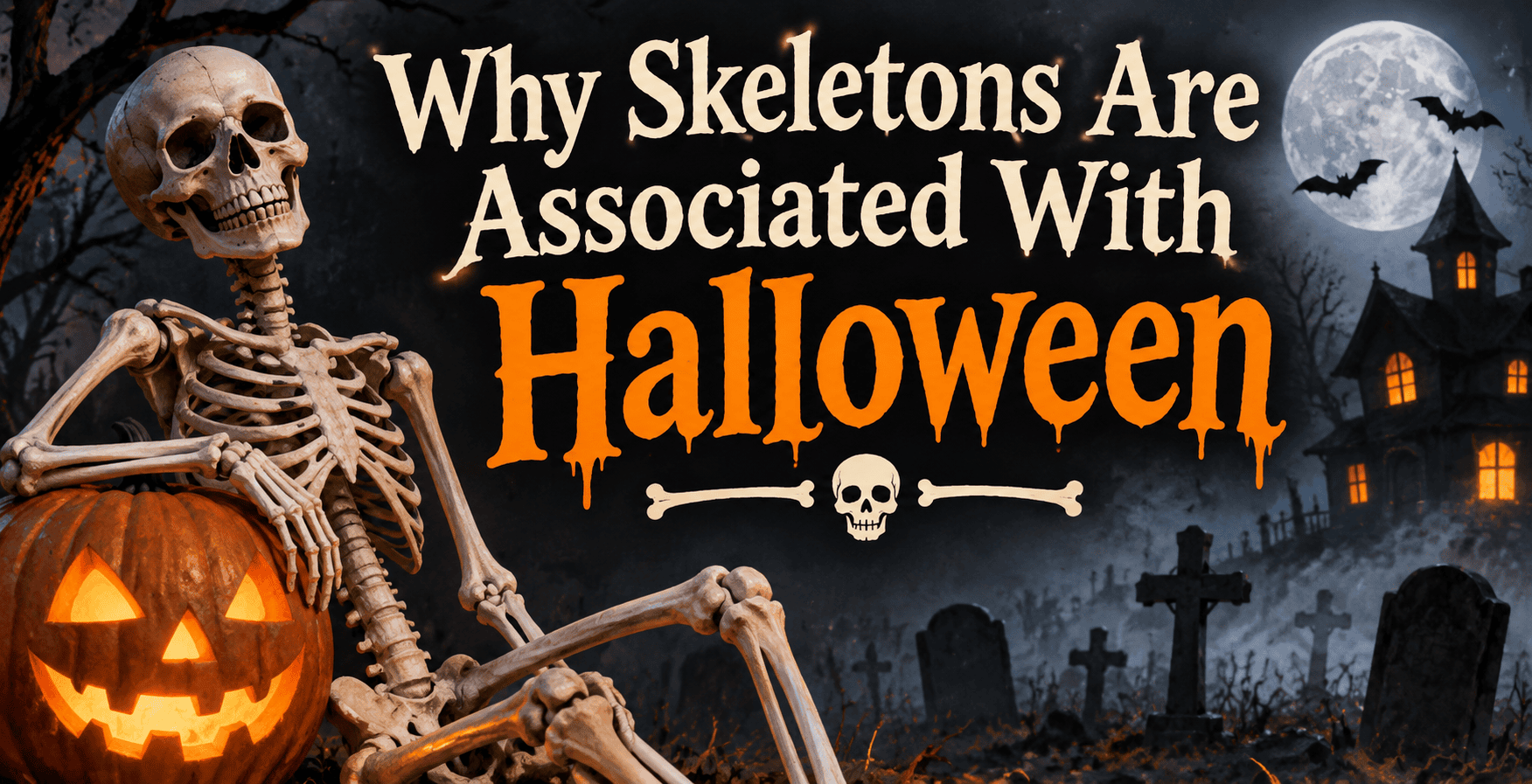
When Halloween arrives, skeletons seem to appear everywhere. They hang from porches, sit in rocking chairs, climb the sides of houses, and greet trick-or-treaters with their eerie grins. From small plastic bones to towering skeleton decorations, these spooky figures have become one of the most recognizable symbols of Halloween.
But have you ever wondered why skeletons are associated with Halloween in the first place?
The answer goes much deeper than frightening decorations and haunted houses. Skeletons have represented death, mortality, spirits, and the supernatural for thousands of years. Their connection to Halloween developed through ancient seasonal traditions, medieval religious customs, European folklore, and changing attitudes toward death.
Today, skeletons can be frightening, funny, or even friendly. However, their history reveals why they remain such a powerful part of Halloween celebrations.
The Ancient Connection Between Halloween and Death
To understand why skeletons became associated with Halloween, we must first explore the ancient origins of the holiday.
Halloween developed from several historical traditions, including the ancient Celtic festival of Samhain and later Christian observances associated with remembering the dead.
Samhain marked the transition from the harvest season into winter. Celebrated around the beginning of November, it was an important seasonal festival in parts of ancient Ireland and other Celtic regions.
Winter brought shorter days, colder temperatures, and uncertainty about survival. Food supplies had to last through the difficult months ahead, and the natural world appeared to be dying as trees lost their leaves and vegetation disappeared.
Samhain also became associated with supernatural beings and encounters between the human world and the Otherworld.
Although modern accounts sometimes exaggerate what is known about ancient Samhain celebrations, the festival’s connections with seasonal change and supernatural traditions helped shape later Halloween folklore.
Skeletons fit naturally into these themes because they visually represent death and the remains of the human body.
However, there is no clear historical evidence that ancient Celts used skeleton decorations in the same way people do today.
The connection developed gradually as different traditions influenced Halloween.
Skeletons as Ancient Symbols of Death
Long before Halloween existed, human skeletons were used as symbols of mortality.
Across different civilizations, bones and skulls reminded people that death was an unavoidable part of life.
Ancient societies sometimes incorporated human remains or skeletal imagery into burial customs, religious practices, and artistic representations of the afterlife.
The human skeleton was especially powerful because it revealed what remained after the body decomposed.
Unlike ghosts, monsters, or imaginary creatures, skeletons represented something real and universal.
Every human being has a skeleton, regardless of wealth, social position, or background.
This made skeletal imagery an effective reminder that death eventually comes to everyone.
As Halloween became increasingly associated with ghosts, graveyards, and the supernatural, skeletons became an obvious visual symbol.
They represented the mysterious boundary between life and death.
How Christianity Influenced Halloween Skeleton Traditions
Christian traditions also contributed to Halloween’s association with death.
Halloween falls on October 31, the evening before All Saints’ Day on November 1.
All Souls’ Day, observed on November 2 in Western Christianity, became another important occasion for remembering the dead.
Together, these observances helped establish a period of remembrance associated with departed souls, mortality, and the afterlife.
During the Middle Ages, European Christian art frequently included skulls, bones, graves, and images of death.
These images were intended to encourage reflection on the temporary nature of earthly life.
One particularly influential tradition was known as memento mori, a Latin phrase meaning “remember that you must die.”
Skulls and skeletons appeared in paintings, religious objects, tombs, and other works of art.
Rather than simply frightening people, these symbols encouraged them to consider their actions, spiritual responsibilities, and mortality.
As Halloween customs developed over the centuries, skeletal imagery already had a strong cultural association with death.
This helped make skeletons a natural addition to Halloween symbolism.
The Medieval Dance of Death
One of the most fascinating historical connections between skeletons and Halloween comes from the medieval European artistic tradition known as the Dance of Death, or Danse Macabre.
What was the Dance of Death?
The Dance of Death became popular in Europe during the late Middle Ages, particularly in the aftermath of devastating epidemics and widespread mortality.
Artists depicted skeletons or personifications of death leading living people toward the grave.
Kings, queens, religious leaders, merchants, farmers, and ordinary citizens appeared together in these scenes.
The message was simple: nobody could escape death.
Wealth, power, beauty, and social standing offered no permanent protection.
Skeletons were sometimes shown dancing, playing musical instruments, or interacting with the living.
These images combined frightening subject matter with dark humor.
That combination remains familiar in modern Halloween decorations.
A skeleton playing a guitar, dancing on a lawn, or sitting at a dinner table reflects a similar idea: making death appear strangely human and sometimes humorous.
The medieval Dance of Death was not originally a Halloween custom, but it helped establish the visual language that later Halloween imagery would draw upon.
Why Skeletons Are Considered Scary
Skeletons can create an immediate feeling of uneasiness because they remind us of our own mortality.
Most people associate visible human bones with death, burial grounds, or medical settings.
Seeing a skeleton outside those expected environments can feel unnatural.
A skeleton standing in a doorway or appearing to move independently creates an especially unsettling image.
It suggests that something normally lifeless has returned to activity.
This idea connects skeletons to stories about ghosts, restless spirits, and the undead.
Throughout history, supernatural folklore has frequently explored the possibility of the dead returning to interact with the living.
Although ghosts and skeletons are different supernatural figures, they share an important characteristic in popular imagination.
Both challenge the boundary between life and death.
Halloween celebrates this boundary through costumes, decorations, storytelling, and playful fear.
Skeletons provide a recognizable way to explore these frightening ideas without confronting actual danger.
How Skeletons Became Popular Halloween Decorations
Skeletons did not become common Halloween decorations overnight.
Their popularity grew as Halloween evolved into a more widespread community and commercial celebration.
During the nineteenth century, Halloween customs in North America developed through influences brought by immigrants, particularly from Ireland and Scotland.
Celebrations included parties, games, costumes, storytelling, and seasonal traditions.
By the late nineteenth and early twentieth centuries, Halloween parties became increasingly popular.
Decorations began featuring familiar symbols such as black cats, witches, pumpkins, ghosts, and frightening figures.
As commercial Halloween products expanded, manufacturers produced paper decorations, greeting cards, masks, costumes, and party supplies.
Skeletons were particularly useful because their distinctive appearance could be reproduced in many forms.
Paper skeletons with movable joints became popular decorations.
These figures could be hung from walls or doors, with arms and legs positioned to create amusing or frightening poses.
Later, plastic skeletons became widely available.
Advances in manufacturing made Halloween decorations more affordable, durable, and elaborate.
Today, skeleton decorations range from inexpensive tabletop figures to enormous animated displays with glowing eyes, moving limbs, and sound effects.
What began as a traditional symbol of death has become a major part of Halloween decorating culture.
Why Skeletons Are Connected to Ghosts and Graveyards
Halloween decorations often combine skeletons with ghosts, tombstones, coffins, and haunted cemeteries.
These symbols share a common theme: the mystery of what happens after death.
Graveyards have long appeared in ghost stories and supernatural folklore.
They represent the physical resting places of the dead, making them natural settings for frightening tales.
Skeletons add a visual element to these stories.
A skeleton emerging from a grave suggests that the dead are returning to the world of the living.
This image became especially common in horror entertainment, haunted attractions, and Halloween displays.
Skeletons are also closely connected to the concept of the undead.
Unlike ghosts, which are typically portrayed as spirits without physical bodies, animated skeletons appear as human remains brought back to life.
Their empty eye sockets, exposed bones, and unnatural movements make them effective horror figures.
Yet Halloween often presents these images in a playful way.
A skeleton rising from a fake grave may frighten visitors for a moment before making them laugh.
This mixture of fear and entertainment is one of the defining characteristics of modern Halloween.
The Influence of Gothic Literature and Horror Movies
Literature and entertainment helped strengthen the relationship between skeletons and Halloween.
Gothic fiction frequently explored themes involving death, supernatural forces, ancient burial grounds, and mysterious creatures.
During the nineteenth century, Gothic stories became increasingly influential in popular culture.
Later, horror films introduced audiences to elaborate graveyard scenes, animated remains, haunted castles, and other frightening imagery.
Skeletons became familiar visual shorthand for danger, curses, and supernatural activity.
Animated films and cartoons also contributed to their popularity.
Unlike realistic portrayals of death, cartoon skeletons could dance, sing, tell jokes, and behave like ordinary people.
This helped transform skeletons from exclusively frightening figures into entertaining Halloween characters.
One famous example is the 1929 animated short The Skeleton Dance, which features skeletons emerging from a graveyard and dancing together.
Its playful combination of music, humor, and spooky imagery demonstrated how skeletons could entertain rather than simply terrify.
Over time, this approach became a major part of Halloween culture.
Today, dancing skeletons appear on decorations, costumes, party supplies, and seasonal merchandise.
Skeletons and the Mexican Day of the Dead
Skeleton imagery is also strongly associated with Mexico’s Day of the Dead, or Día de los Muertos.
Although the holiday occurs around the same time as Halloween, the two celebrations have distinct histories and meanings.
Día de los Muertos is a tradition centered on remembering and honoring deceased loved ones.
Families may create altars, display photographs, prepare favorite foods, and visit cemeteries.
Colorful skulls and skeleton figures are important elements of the celebration.
One especially recognizable image is La Catrina, an elegantly dressed skeletal figure associated with Mexican art and cultural traditions.
Rather than representing death only as something terrifying, Day of the Dead imagery often approaches mortality with remembrance, humor, and celebration.
Skeletons may be depicted dancing, wearing fashionable clothing, playing music, or participating in everyday activities.
These images emphasize the relationship between life, death, memory, and cultural identity.
Because Halloween and Día de los Muertos occur close together on the calendar, their imagery sometimes overlaps in modern decorations and popular media.
However, the holidays should not be treated as interchangeable.
Halloween commonly emphasizes costumes, supernatural entertainment, and playful scares, while Día de los Muertos centers on remembrance and continuing connections with those who have died.
Why Skeletons Are Often Shown Dancing
Dancing skeletons are among the most amusing Halloween decorations.
They appear in costumes, animated displays, cartoons, and even elaborate outdoor scenes.
But why are skeletons so frequently shown dancing?
Part of the answer comes from historical artistic traditions such as the Dance of Death.
These images portrayed death as an active figure interacting with people.
Another reason is that dancing skeletons create an entertaining contradiction.
A skeleton represents a body without life, yet dancing requires movement, rhythm, and energy.
Seeing something associated with death behave as though it were alive produces an unusual mixture of humor and discomfort.
This makes dancing skeletons especially suitable for Halloween.
They can be spooky without being excessively frightening.
Their movements also work well in animated decorations, where mechanical joints can create exaggerated dancing motions.
The result is a Halloween character that appeals to both children and adults.
Why Skeletons Are Popular Halloween Costumes
Skeleton costumes remain among the most recognizable Halloween outfits.
Their popularity comes from several practical and cultural reasons.
First, skeletons are immediately identifiable.
A black outfit featuring white bones can create a convincing skeleton appearance without complicated accessories.
Second, skeleton costumes can be adapted for almost any age.
Children may wear friendly cartoon skeleton outfits, while adults may choose more realistic or frightening designs.
Third, skeleton costumes connect directly to Halloween’s themes of death and the supernatural.
They allow people to temporarily transform themselves into something associated with the afterlife.
Glow-in-the-dark skeleton costumes add another entertaining element.
When the lights go out, the bones remain visible, creating the illusion of a floating or moving skeleton.
Skeleton makeup has also become increasingly popular.
Face paint can transform an ordinary face into a skull using dark eye sockets, exposed teeth, and shaded cheekbones.
These designs range from simple Halloween makeup to elaborate artistic creations.
Why Giant Skeleton Decorations Became So Popular
In recent years, oversized skeleton decorations have become especially popular in American Halloween displays.
Giant skeletons can be seen standing in front yards, leaning against houses, sitting on rooftops, and appearing in elaborate neighborhood scenes.
One major reason for their popularity is visual impact.
A large skeleton immediately attracts attention and creates a dramatic Halloween atmosphere.
Oversized decorations are also highly shareable on social media.
Homeowners frequently photograph their displays and post them online, inspiring others to create increasingly elaborate scenes.
Another reason is versatility.
A giant skeleton can be decorated differently for various occasions.
Some homeowners dress their skeletons in costumes, give them humorous props, or incorporate them into seasonal displays beyond Halloween.
The trend demonstrates how skeletons have evolved from symbols of mortality into recognizable characters with personalities.
They remain spooky, but they can also be funny, creative, and surprisingly charming.
The Symbolic Meaning of Skeletons on Halloween
Although skeletons are now commonly used for entertainment, they continue to carry several symbolic meanings.
1. Mortality
Skeletons remind people that life is temporary and that death is a universal human experience.
2. The Afterlife
Their association with graves and the dead connects them to questions about what happens after death.
3. The Supernatural
Animated skeletons suggest that forces beyond ordinary human understanding may exist.
4. Fear of the Unknown
Death remains one of humanity’s greatest mysteries, and skeletons visually represent that uncertainty.
5. Humor and Celebration
Modern Halloween skeletons often turn frightening subjects into playful entertainment.
6. Equality in Death
Historical skeletal imagery frequently emphasized that all people eventually face the same fate, regardless of their position in society.
These meanings help explain why skeletons remain such enduring symbols.
They can communicate serious ideas while also providing opportunities for creativity and fun.
Interesting Facts About Halloween Skeletons
There are several fascinating details about skeletons and their connection to Halloween.
A typical adult human skeleton contains 206 bones. Babies are born with more bones, some of which fuse as they grow.
Skeletons were symbols of death long before Halloween became a modern holiday. Ancient cultures used skulls and bones in religious, artistic, and burial traditions.
Medieval artwork frequently portrayed skeletons interacting with living people. The Dance of Death reminded viewers that mortality affects everyone.
Paper skeletons became popular Halloween party decorations. Their movable limbs made them easy to display in entertaining poses.
Skeleton costumes are among the simplest recognizable Halloween disguises. Their distinctive bone patterns make them easy to identify.
Dancing skeletons have appeared in animation for nearly a century. Early animated films helped establish their humorous reputation.
Not all skeleton imagery is intended to be frightening. In different cultural traditions, skeletal figures can represent remembrance, reflection, celebration, or humor.
Modern Halloween skeletons are often treated like characters. Homeowners give them names, personalities, costumes, and elaborate seasonal displays.
Why Skeletons Remain a Halloween Tradition
Halloween has changed dramatically over the centuries.
What developed through ancient seasonal observances, Christian commemorations, folk customs, and community celebrations eventually became a holiday known for costumes, candy, decorations, and entertainment.
Yet skeletons have remained a fitting symbol because they connect so many of Halloween’s themes.
They represent death without requiring an actual encounter with it.
They suggest the supernatural without proving anything about the afterlife.
They can frighten people while also making them laugh.
Most importantly, skeletons are universally recognizable.
A skull or a set of bones immediately communicates an idea that crosses languages and cultures.
Whether displayed in a haunted house, printed on a Halloween invitation, or dressed in a ridiculous costume, a skeleton brings centuries of symbolism into a modern celebration.
That combination of history, mystery, and entertainment helps explain why skeletons continue to appear every October.
Final Thoughts: Why Are Skeletons Associated With Halloween?
Skeletons are associated with Halloween because they have represented death, mortality, and the supernatural for centuries.
Their connection to the holiday developed through ancient seasonal traditions, Christian remembrance of the dead, medieval European art, folklore, Gothic entertainment, and modern Halloween celebrations.
Over time, skeletons evolved from serious reminders of human mortality into decorations and costumes that can be frightening, humorous, or both.
Today, a skeleton hanging from a porch or dancing across a front lawn might seem like nothing more than seasonal fun.
But behind that familiar Halloween grin is a long history of humanity’s fascination with death and the unknown.
Perhaps that is what makes skeletons such enduring Halloween symbols.
They remind us of something serious while allowing us to laugh at something frightening.
And every Halloween, when skeletons return to our neighborhoods, windows, and front yards, they continue a tradition that connects the mysteries of the past with the playful celebrations of today.
Do you prefer Halloween skeletons that are genuinely scary, or do you enjoy the funny, creative skeleton displays that make people laugh?
Leave a Reply