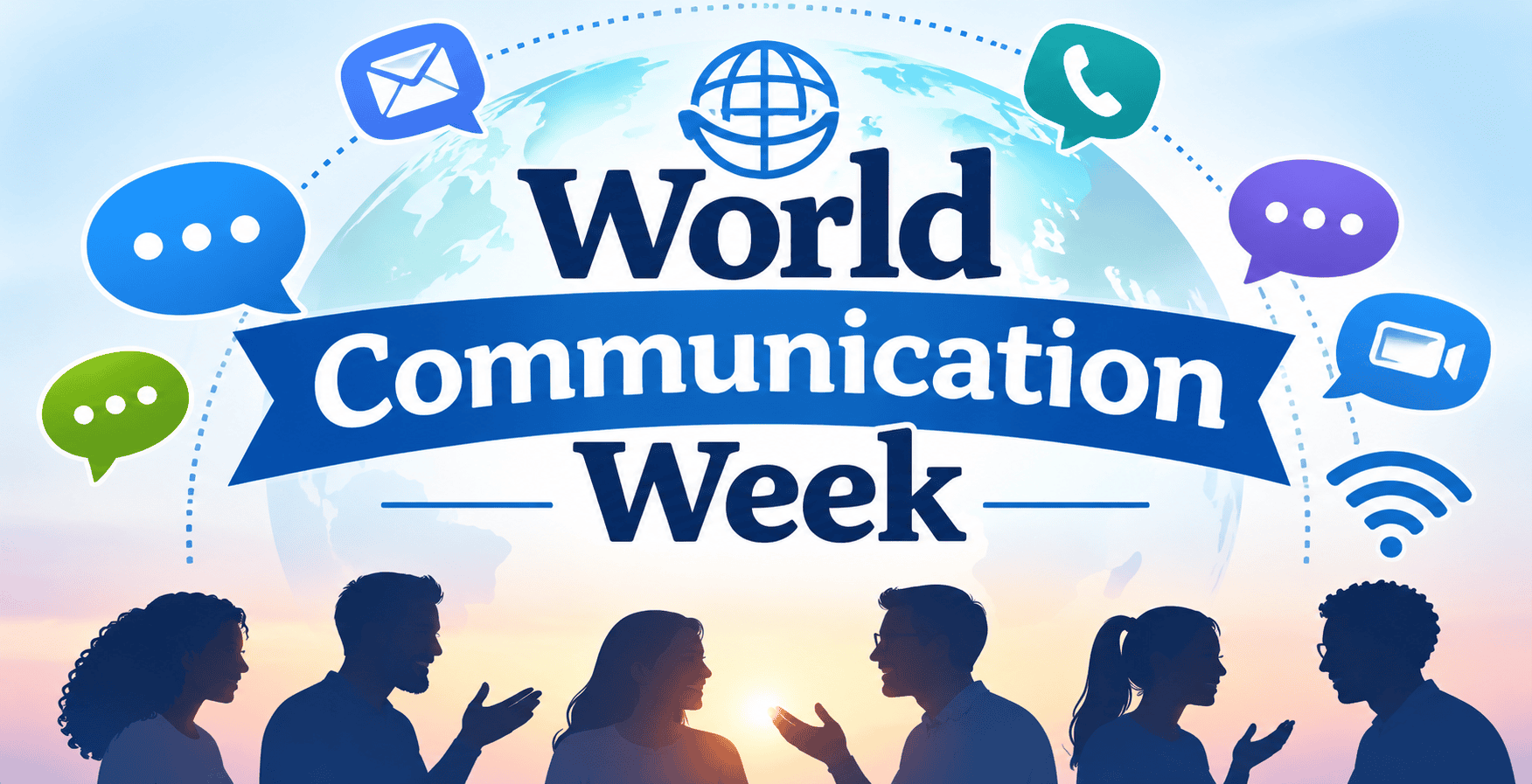
Communication is one of the most important parts of human life. Every conversation, message, gesture, and expression allows us to share ideas, express emotions, build relationships, and understand the world around us. Whether we are speaking with family members, connecting with friends, communicating at work, or reaching out to someone who needs encouragement, our words and actions can make a lasting difference.
World Communication Week is an opportunity to recognize the importance of effective communication and encourage people to become better listeners, more thoughtful speakers, and more compassionate individuals.
In a world where technology makes it possible to communicate instantly across continents, meaningful human connection remains just as important as ever.
This observance reminds us that communication is not simply about talking. It is about listening, understanding, respecting differences, and making others feel heard.
What Is World Communication Week?
World Communication Week is a communication-awareness observance that encourages people to reflect on how they interact with others and how better communication can improve everyday life.
It provides an opportunity to explore the many forms of communication that influence our relationships, workplaces, communities, and personal well-being.
Communication takes many forms, including:
- Verbal communication: Sharing thoughts and ideas through spoken words.
- Nonverbal communication: Expressing feelings through facial expressions, gestures, posture, and body language.
- Written communication: Connecting through letters, emails, text messages, and other written materials.
- Visual communication: Using images, symbols, signs, and graphics to convey information.
- Digital communication: Interacting through social media, video calls, messaging applications, and online platforms.
- Active listening: Paying attention to others and making a genuine effort to understand their perspectives.
Each form plays an important role in how we connect with the people around us.
World Communication Week encourages individuals to recognize these different communication methods and consider how they can communicate more effectively.
When Is World Communication Week Celebrated?
World Communication Week is listed on some awareness calendars as taking place during the first week of November, generally November 1–7.
However, it is important to distinguish this informal observance from World Communication Day, also known as World Communications Day, which is a separate observance established by the Catholic Church.
World Communication Week does not have the same widely documented international recognition or standardized official history as some major global awareness events.
Regardless of its formal status, the week offers a meaningful opportunity to celebrate communication and strengthen relationships.
Why Communication Is Important
Communication influences nearly every aspect of our lives.
From childhood through adulthood, our ability to communicate helps us develop friendships, maintain family relationships, solve problems, and participate in society.
When communication is effective, people are more likely to understand one another and work together successfully.
When communication breaks down, misunderstandings, frustration, conflict, and emotional distance can develop.
1. Communication Builds Stronger Relationships
Healthy relationships depend on open and honest communication.
Whether between spouses, parents and children, friends, or coworkers, meaningful conversations help people develop trust and emotional closeness.
Sharing feelings, discussing concerns, and expressing appreciation can strengthen relationships over time.
Sometimes, a simple conversation can prevent a small misunderstanding from becoming a major disagreement.
2. Communication Encourages Understanding
Everyone experiences life differently.
Our backgrounds, beliefs, experiences, and emotions influence how we interpret the world.
Effective communication allows us to learn about perspectives that differ from our own.
Listening respectfully does not mean we must agree with everything another person says. It means recognizing their right to express themselves and making an effort to understand their viewpoint.
3. Communication Helps Resolve Conflict
Disagreements are a natural part of human relationships.
However, the way people communicate during disagreements can determine whether a conflict becomes worse or leads to a solution.
Calm conversations, respectful language, and active listening can help reduce tension.
Instead of focusing only on proving a point, effective communication encourages people to identify problems and work toward solutions.
4. Communication Supports Emotional Well-Being
Being able to express feelings is an important part of emotional health.
Talking about stress, sadness, fear, disappointment, or happiness can help people feel connected and supported.
Likewise, listening to someone who is struggling can provide comfort and reassurance.
Not every difficult conversation requires advice or solutions. Sometimes, simply being present and listening is enough.
5. Communication Creates Opportunities
Strong communication skills are valuable in education, employment, leadership, and personal development.
People who communicate clearly are often better equipped to explain ideas, collaborate with others, ask questions, and advocate for their needs.
These skills can help individuals build confidence and navigate challenging situations.
The History of Human Communication
Communication has been essential to human civilization for thousands of years.
Long before smartphones, computers, or written languages, people communicated through sounds, gestures, facial expressions, and visual symbols.
As societies developed, communication methods became increasingly sophisticated.
Early Human Communication
Early humans relied on spoken language, gestures, storytelling, and visual representations to share information.
Cave paintings and ancient symbols provide evidence of early efforts to preserve experiences and communicate ideas.
These methods helped communities pass knowledge and traditions between generations.
The Development of Writing
The invention of writing transformed human communication.
Ancient civilizations developed writing systems that made it possible to record laws, preserve history, conduct trade, and share knowledge across distances and generations.
Written communication eventually became one of the foundations of organized societies.
The Printing Revolution
The development and spread of printing technology dramatically increased access to written information.
Printing made books, educational materials, and other documents easier to reproduce and distribute.
This helped ideas travel farther and reach larger audiences.
The Age of Electronic Communication
The invention of the telegraph, telephone, radio, and television transformed how people exchanged information.
Messages that once required days or weeks to arrive could eventually be transmitted almost instantly.
These technologies connected communities and changed the way people received news and entertainment.
Communication in the Digital Age
Today, communication takes place through smartphones, email, social media, video conferencing, and countless digital platforms.
People can maintain relationships across continents, collaborate remotely, and share information with global audiences.
However, modern communication also presents challenges, including information overload, online misunderstandings, misinformation, and reduced face-to-face interaction.
World Communication Week provides an opportunity to reflect on how we can use these powerful tools more responsibly.
10 Ways to Celebrate World Communication Week
Celebrating World Communication Week does not require elaborate events or expensive activities.
Small changes in everyday communication can make a meaningful difference.
1. Practice Active Listening
Give someone your complete attention during a conversation.
Put away your phone, avoid interrupting, and focus on understanding what the other person is saying.
Listening is one of the simplest ways to demonstrate respect.
2. Reach Out to Someone You Have Not Spoken With Recently
Contact an old friend, distant relative, former coworker, or someone you have lost touch with.
A simple message asking how someone is doing can reopen a meaningful connection.
3. Have a Technology-Free Conversation
Set aside time to speak with someone without televisions, smartphones, or other distractions.
Enjoy a conversation where both people can focus entirely on one another.
4. Express Appreciation
Tell someone how much they mean to you.
Thank a family member, friend, teacher, neighbor, or coworker for something they have done.
Words of appreciation can strengthen relationships and brighten someone’s day.
5. Learn About Different Communication Styles
People communicate differently depending on their personalities, cultures, experiences, and individual needs.
Some individuals prefer direct conversations, while others feel more comfortable expressing themselves through writing.
Learning to respect these differences can improve understanding.
6. Practice Kindness in Online Conversations
Before posting a comment or responding to a disagreement, consider how your words might affect others.
Avoid unnecessary insults, personal attacks, and hurtful language.
Digital communication should reflect the same respect we hope to receive in person.
7. Write a Meaningful Letter
Write a letter to someone who has made a difference in your life.
It could be a parent, child, friend, mentor, or someone who supported you during a difficult time.
A handwritten letter can become a treasured keepsake.
8. Improve Your Communication Skills
Spend time learning about active listening, public speaking, conflict resolution, or emotional intelligence.
Improving communication is an ongoing process that benefits nearly every area of life.
9. Encourage Open Family Conversations
Create opportunities for family members to discuss their experiences, concerns, and accomplishments.
Family dinners, weekend gatherings, and regular check-ins can help strengthen communication.
10. Be Present for Someone Who Needs Support
Sometimes, the most meaningful communication happens when we listen rather than speak.
Reach out to someone experiencing loneliness, grief, stress, or uncertainty.
Let them know they matter and that they do not have to face everything alone.
The Importance of Listening in Communication
One of the most overlooked aspects of communication is listening.
Many people enter conversations thinking about what they want to say next instead of focusing on what the other person is expressing.
True listening requires patience, attention, and a willingness to understand.
Active listening includes maintaining appropriate eye contact, asking thoughtful questions, avoiding unnecessary interruptions, and acknowledging another person’s feelings.
It also means recognizing that silence can be meaningful.
Some people need time to organize their thoughts before speaking.
Others may struggle to explain complicated emotions.
Allowing someone the space to communicate at their own pace can create a more comfortable and supportive environment.
Good communication is not measured by how much we say, but by how well we understand one another.
Communication and Mental Health
Communication can play an important role in supporting emotional well-being.
People experiencing stress, anxiety, loneliness, or grief may benefit from having someone they trust who is willing to listen.
Open conversations can help reduce feelings of isolation and make it easier to ask for support.
However, not everyone feels comfortable discussing personal struggles.
Some people fear being judged, misunderstood, or dismissed.
Creating a supportive environment means responding with patience, empathy, and respect.
Helpful communication may include asking how someone is feeling, acknowledging their emotions, and avoiding assumptions about their experiences.
It is also important to respect boundaries.
Someone may not be ready to talk, and that choice deserves understanding.
Communication During Grief and Difficult Times
Communication becomes especially meaningful when someone is experiencing loss.
Grief can make ordinary conversations difficult. People may struggle to explain what they are feeling or find that words cannot adequately describe their pain.
Friends and family members sometimes avoid conversations about loss because they worry about saying the wrong thing.
Unfortunately, silence and avoidance can leave grieving individuals feeling forgotten.
A compassionate message, a sincere question, or a willingness to listen can provide meaningful comfort.
Rather than trying to fix someone’s grief, we can communicate care through simple statements such as:
- “I’m thinking about you.”
- “I’m here if you want to talk.”
- “Would you like to share a memory?”
- “You don’t have to explain how you’re feeling.”
- “I haven’t forgotten your loved one.”
For parents who have lost a child, hearing their child’s name and knowing others remember them can be particularly meaningful.
Communication does not erase grief, but it can remind someone that they are not alone in carrying it.
How Technology Has Changed Communication
Modern technology has made communication faster and more accessible than at any previous point in history.
Video calls allow families separated by thousands of miles to see one another.
Messaging applications make it possible to exchange information immediately.
Social media platforms provide opportunities to share experiences, discover communities, and maintain connections.
Online support groups can also bring together people facing similar challenges.
Despite these advantages, technology can sometimes create emotional distance.
Short text messages may lack the tone and context of face-to-face conversations.
Social media disagreements can escalate quickly when people misunderstand intentions.
Constant notifications may also distract us from the people physically present in our lives.
The goal should not necessarily be to communicate less through technology, but to communicate more intentionally.
Technology works best when it strengthens human connection rather than replacing meaningful relationships.
Teaching Children Healthy Communication Skills
Communication skills begin developing early in life.
Parents, caregivers, and educators can help children learn how to express emotions, listen respectfully, and resolve disagreements.
Children benefit from environments where their questions are welcomed and their feelings are acknowledged.
Adults can model healthy communication by speaking calmly, admitting mistakes, and demonstrating respectful disagreement.
Encouraging children to describe their feelings also helps them develop emotional awareness.
Instead of simply telling a child to stop being upset, an adult might ask what happened and help the child identify the emotion they are experiencing.
These everyday conversations can build skills that remain valuable throughout adulthood.
Communication in the Workplace
Effective communication is essential for successful teamwork and professional relationships.
Clear instructions, constructive feedback, and respectful discussions can help employees understand expectations and collaborate efficiently.
Poor communication, on the other hand, can contribute to confusion, mistakes, unnecessary stress, and workplace conflict.
Organizations can use World Communication Week as an opportunity to encourage better communication practices.
This might include improving meeting structures, encouraging employee feedback, reviewing communication policies, or offering professional development opportunities.
Leaders also play an important role by demonstrating transparency, accountability, and active listening.
When people feel comfortable asking questions and expressing concerns, workplaces can become more supportive and productive.
Common Barriers to Effective Communication
Even people with good intentions sometimes struggle to communicate effectively.
Common barriers include emotional stress, cultural differences, distractions, language differences, assumptions, and poor listening habits.
Misunderstandings can also arise when someone interprets another person’s tone or body language incorrectly.
Recognizing these challenges is the first step toward overcoming them.
Helpful strategies include slowing down difficult conversations, asking clarifying questions, avoiding assumptions, and choosing appropriate communication methods.
For example, a complicated emotional discussion may be better handled through a phone call or face-to-face conversation than through a series of short text messages.
Patience and flexibility can make communication more effective.
How to Become a Better Communicator
Improving communication is a lifelong process.
No one communicates perfectly in every situation.
However, developing a few consistent habits can make conversations more productive and relationships more meaningful.
Start by thinking before speaking.
Consider whether your words are accurate, necessary, respectful, and appropriate for the situation.
Be willing to ask questions when something is unclear.
Avoid assuming you know another person’s intentions.
Pay attention to your tone and body language, especially during disagreements.
Practice acknowledging mistakes and apologizing when necessary.
Most importantly, remember that communication involves both expressing yourself and making space for others.
The goal is not always to win an argument or persuade someone to agree.
Sometimes, the greatest success is simply reaching a better understanding.
Why World Communication Week Matters Today
In a society filled with constant messages, notifications, headlines, and online conversations, genuine understanding can sometimes feel difficult to achieve.
People may communicate more frequently than ever while still experiencing loneliness or emotional disconnection.
World Communication Week encourages us to look beyond the number of messages we send and consider the quality of our interactions.
Are we listening when someone needs to be heard?
Are we choosing kindness when disagreements arise?
Are we making time for meaningful conversations with the people we love?
Are we using technology to build relationships rather than allowing it to distract us from them?
These questions remind us that communication is not merely a practical skill.
It is an important part of compassion, connection, and community.
Final Thoughts: Every Conversation Is an Opportunity to Connect
World Communication Week reminds us that words have power.
They can encourage someone who is struggling, repair a damaged relationship, express gratitude, or help another person feel understood.
But communication is about more than words.
It is also found in a reassuring smile, a patient silence, a thoughtful gesture, and the willingness to listen without judgment.
We may not always know what someone else is experiencing, and we may not always have the perfect words to say.
What matters is making the effort to communicate with sincerity, kindness, and respect.
As we recognize World Communication Week, consider reaching out to someone, starting a meaningful conversation, or simply becoming a better listener.
Because sometimes, a few thoughtful words can change someone’s entire day.
What is one conversation that made a lasting difference in your life, and what did it teach you about the importance of communication?



Leave a Reply