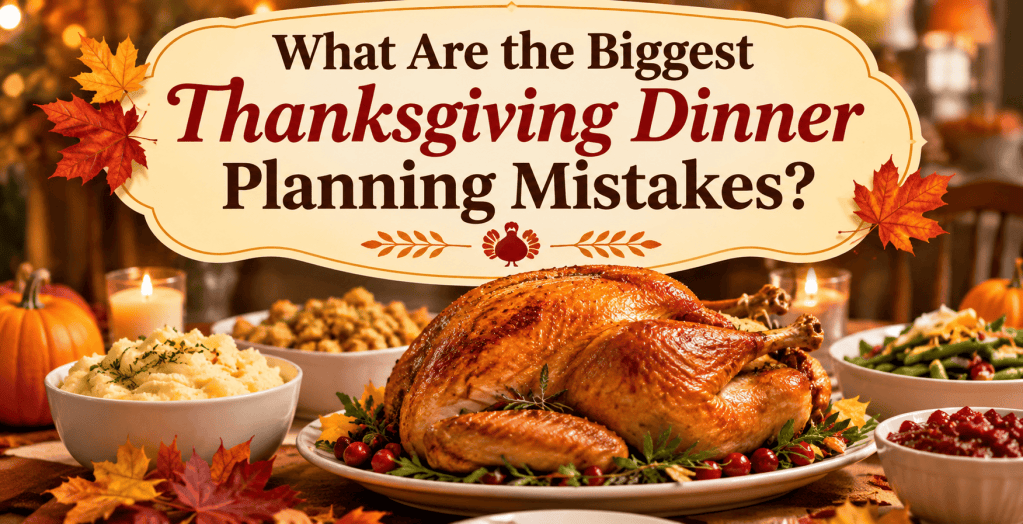
Thanksgiving dinner is supposed to be a time for gathering with family and friends, enjoying delicious food, and creating lasting memories. However, preparing a Thanksgiving feast can quickly become overwhelming when small planning mistakes turn into major problems.
From underestimating how long a turkey takes to cook to preparing too many dishes at the last minute, even experienced home cooks can struggle with Thanksgiving dinner planning.
The good news is that most Thanksgiving dinner disasters are completely preventable.
Understanding the biggest Thanksgiving dinner planning mistakes can help you save time, reduce stress, avoid wasting food, and create a holiday meal everyone will enjoy.
Whether you are hosting Thanksgiving for the first time or have been preparing holiday dinners for years, avoiding these common mistakes can make your celebration much easier.
Why Is Thanksgiving Dinner So Difficult to Plan?
Thanksgiving dinner is different from an ordinary family meal because it usually involves preparing several dishes that must be ready around the same time.
A traditional Thanksgiving menu might include roasted turkey, mashed potatoes, stuffing, gravy, sweet potato casserole, green bean casserole, cranberry sauce, dinner rolls, and multiple desserts.
Each dish requires different ingredients, cooking temperatures, preparation methods, and cooking times.
The challenge becomes even greater when you have limited oven space, unexpected guests, dietary restrictions, or a tight budget.
Without a clear plan, Thanksgiving cooking can quickly become a stressful experience.
The secret to a successful Thanksgiving dinner is not necessarily preparing the most elaborate meal. It is knowing what to prepare, when to prepare it, and how to organize everything efficiently.
1. Waiting Until the Last Minute to Plan Thanksgiving Dinner
One of the biggest Thanksgiving dinner planning mistakes is waiting until the week of Thanksgiving to start organizing the meal.
Last-minute planning often leads to forgotten ingredients, crowded grocery stores, limited turkey selections, and unnecessary stress.
Popular Thanksgiving ingredients can also become harder to find as the holiday approaches.
How to avoid this mistake:
Begin planning your Thanksgiving dinner approximately two weeks before the holiday.
During this time, you should:
-
Decide how many guests you will invite.
-
Create your Thanksgiving dinner menu.
-
Check your kitchen equipment and serving dishes.
-
Make a complete grocery shopping list.
-
Purchase nonperishable ingredients.
-
Determine which dishes can be prepared ahead of time.
Starting early gives you enough time to make adjustments without feeling rushed.
2. Preparing Too Many Thanksgiving Dishes
Thanksgiving is known for its abundance of food, but preparing too many dishes can create unnecessary work and expense.
Many hosts feel pressured to serve every traditional Thanksgiving recipe, even when their guests may not eat everything.
Preparing multiple casseroles, several potato dishes, numerous desserts, and too many appetizers can overwhelm your kitchen.
It can also leave you with more leftovers than your family can reasonably enjoy.
How to avoid this mistake:
Focus on a balanced Thanksgiving menu rather than an oversized one.
A manageable dinner might include:
-
One main dish, such as roasted turkey.
-
Two or three vegetable or potato side dishes.
-
One stuffing or dressing recipe.
-
Cranberry sauce and gravy.
-
Dinner rolls.
-
One or two desserts.
You can always add a family favorite if it is especially important to your Thanksgiving traditions.
Remember that a smaller menu prepared well is often better than a large menu that leaves the cook exhausted.
3. Buying the Wrong Size Turkey
Choosing the wrong turkey size is another common Thanksgiving planning mistake.
A turkey that is too small may not provide enough food for everyone, while an oversized turkey can take longer to thaw and cook than expected.
Many hosts also forget to consider whether their guests prefer white meat, dark meat, or generous leftovers.
How much turkey should you buy?
A practical guideline is approximately 1 to 1½ pounds of whole turkey per person.
For example:
| Number of Guests | Suggested Turkey Size |
|---|---|
| 4 people | 6–8 pounds |
| 6 people | 8–10 pounds |
| 8 people | 10–12 pounds |
| 10 people | 12–15 pounds |
| 12 people | 15–18 pounds |
These amounts account for bones and portions that are not eaten.
If you want plenty of leftovers, choose a turkey toward the larger end of the recommended range.
For smaller gatherings, a turkey breast may be more practical than roasting an entire bird.
4. Forgetting How Long a Frozen Turkey Takes to Thaw
One of the most frustrating Thanksgiving mistakes happens before cooking even begins.
You wake up on Thanksgiving morning and discover that your turkey is still frozen.
A frozen turkey cannot safely be thawed by leaving it on the kitchen counter overnight.
Proper thawing requires advance planning.
How to avoid this mistake:
When thawing a turkey in the refrigerator, allow approximately 24 hours for every 4–5 pounds.
For example:
-
8–12 pounds: approximately 2–3 days.
-
12–16 pounds: approximately 3–4 days.
-
16–20 pounds: approximately 4–5 days.
-
20–24 pounds: approximately 5–6 days.
Keep the turkey in a tray or pan on the bottom shelf of the refrigerator to prevent raw juices from dripping onto other foods.
If you need to thaw it faster, use the cold-water method, allowing approximately 30 minutes per pound. Keep the turkey wrapped, submerged in cold water, and change the water every 30 minutes.
A turkey thawed using the cold-water method should be cooked immediately.
Planning your thawing schedule is one of the simplest ways to prevent a Thanksgiving cooking emergency.
5. Not Creating a Thanksgiving Cooking Timeline
Even with all the right ingredients, Thanksgiving dinner can become chaotic without a cooking schedule.
Turkey, casseroles, mashed potatoes, gravy, vegetables, and rolls may all require attention at different times.
Without a timeline, you might discover that several dishes need the oven simultaneously.
How to avoid this mistake:
Start with your planned dinner time and work backward.
For example, if Thanksgiving dinner is scheduled for 4:00 p.m., a simplified timeline might look like this:
| Time | Thanksgiving Task |
|---|---|
| 9:00 a.m. | Prepare ingredients and check cooking schedule |
| 10:00 a.m. | Begin roasting turkey, if appropriate for its size |
| 12:00 p.m. | Prepare cold sides and organize serving dishes |
| 1:00 p.m. | Prepare potatoes and casserole ingredients |
| 2:00 p.m. | Check turkey temperature and prepare finishing tasks |
| 3:00 p.m. | Rest turkey when fully cooked; finish sides and gravy |
| 3:30 p.m. | Warm rolls, transfer food to serving dishes |
| 4:00 p.m. | Serve Thanksgiving dinner |
This is only an example. Your actual turkey start time must be based on its weight, oven temperature, and cooking method.
Use a food thermometer rather than relying on the clock to determine when the turkey is fully cooked.
A written timeline makes it easier to stay organized and reduces last-minute confusion.
6. Underestimating Thanksgiving Turkey Cooking Time
Many Thanksgiving hosts assume that a turkey will cook exactly according to the time printed on the packaging.
However, actual cooking time can vary depending on the bird’s size, oven performance, starting temperature, and whether the turkey is stuffed.
A turkey that finishes late can delay the entire meal.
How to avoid this mistake:
Allow extra time in your cooking schedule.
Use a reliable food thermometer and verify that the turkey reaches 165°F in the thickest part of the breast, the innermost part of the thigh, and the innermost part of the wing.
If you cook stuffing inside the turkey, the center of the stuffing must also reach 165°F.
For easier timing and more even cooking, consider baking stuffing separately.
Once the turkey is cooked, allow it to rest before carving.
Resting gives you time to finish gravy, warm side dishes, and prepare the table.
7. Forgetting About Limited Oven Space
A common Thanksgiving problem occurs when every recipe requires the oven at the same time.
The turkey may occupy most of the oven for several hours, leaving little room for casseroles, rolls, and roasted vegetables.
Trying to squeeze too many dishes into the oven can affect cooking times and heat circulation.
How to avoid this mistake:
Choose recipes that use different cooking methods.
For example:
-
Roast the turkey in the oven.
-
Prepare mashed potatoes on the stovetop.
-
Cook certain vegetables in a slow cooker.
-
Make cranberry sauce ahead of time.
-
Prepare no-bake desserts.
-
Bake casseroles before or after the turkey, depending on safe holding and reheating needs.
If you have an air fryer, slow cooker, or electric roaster, these appliances may help free up oven space.
The goal is to avoid having every dish compete for the same equipment.
8. Not Preparing Thanksgiving Food Ahead of Time
Trying to prepare every dish on Thanksgiving Day is one of the easiest ways to become overwhelmed.
Many traditional Thanksgiving recipes can be partially or completely prepared before the holiday.
Ignoring these opportunities creates unnecessary work on the busiest cooking day of the year.
What Thanksgiving dishes can you prepare ahead?
Several options include:
-
Cranberry sauce, which can be refrigerated for several days.
-
Pie crusts, which can be prepared and refrigerated or frozen.
-
Pumpkin and pecan pies, which can be baked ahead and stored appropriately.
-
Chopped vegetables, stored in covered containers in the refrigerator.
-
Casserole components, prepared ahead according to the recipe.
-
Dinner rolls, which can be baked and frozen.
For make-ahead dishes, follow safe cooling, refrigeration, and reheating instructions.
Preparing even three or four items ahead of time can make Thanksgiving Day significantly easier.
9. Forgetting to Ask About Dietary Restrictions
A Thanksgiving dinner may look perfect, but guests with dietary restrictions might discover that they have very little they can eat.
Food allergies, vegetarian diets, gluten intolerance, and other dietary needs should be considered before creating the final menu.
How to avoid this mistake:
Ask guests about dietary restrictions when inviting them.
You do not necessarily need to prepare an entirely separate Thanksgiving dinner.
Instead, consider including a few flexible dishes.
For example, roasted vegetables can often be prepared without dairy, and certain side dishes can be made vegetarian by using vegetable broth.
For food allergies, carefully check ingredients and prevent cross-contact during preparation and serving.
A little advance communication helps everyone feel included.
10. Making Every Thanksgiving Recipe for the First Time
Thanksgiving may seem like the perfect opportunity to try elaborate recipes, but preparing an entire menu of unfamiliar dishes can be risky.
New recipes sometimes require more preparation, special equipment, or additional cooking time.
If something goes wrong, you may not have enough time to make adjustments.
How to avoid this mistake:
Build your Thanksgiving menu around recipes you already know how to prepare.
If you want to try something new, choose one or two dishes rather than experimenting with the entire meal.
You can also test a new recipe several days or weeks before Thanksgiving.
This allows you to adjust ingredients, cooking times, and portion sizes before serving guests.
11. Forgetting to Check Kitchen Supplies
Running out of aluminum foil, discovering that your roasting pan is too small, or realizing that you do not have enough serving utensils can create unnecessary problems.
Many Thanksgiving hosts focus so much on groceries that they overlook kitchen equipment.
How to avoid this mistake:
Check your kitchen supplies at least one week before Thanksgiving.
Make sure you have a roasting pan, meat thermometer, cutting board, sharp carving knife, casserole dishes, serving spoons, food storage containers, and enough plates and utensils for everyone.
Also check whether your refrigerator has enough space for the turkey, ingredients, and prepared dishes.
A few minutes spent checking supplies can prevent frustrating interruptions on Thanksgiving Day.
12. Not Planning Thanksgiving Dinner Portions Correctly
Preparing too little food can leave guests hungry, while preparing far too much can waste money and refrigerator space.
Portion planning becomes especially difficult when serving multiple side dishes.
Guests usually take smaller servings of each dish when there are many options available.
How to avoid this mistake:
Use approximate serving guidelines when shopping.
| Thanksgiving Dish | Suggested Amount Per Person |
|---|---|
| Whole turkey | 1–1½ pounds raw |
| Mashed potatoes | ½–¾ cup |
| Stuffing | ½–¾ cup |
| Vegetable side | ½ cup |
| Gravy | ¼ cup |
| Cranberry sauce | 2–4 tablespoons |
| Dinner rolls | 1–2 rolls |
| Pie | 1 slice |
These are planning estimates rather than strict requirements.
Adjust quantities based on your guests’ appetites, the number of dishes being served, and whether you want leftovers.
13. Forgetting About Thanksgiving Appetizers and Drinks
Hosts often spend so much time planning the main dinner that they forget guests may arrive several hours before the meal.
Without drinks or light snacks, guests may become hungry while waiting.
However, serving too many appetizers can also spoil everyone’s appetite.
How to avoid this mistake:
Offer a small selection of simple appetizers, such as cheese and crackers, fresh vegetables, fruit, or a light dip.
For beverages, consider water, sparkling water, apple cider, iced tea, and other family favorites.
Keep appetizers simple so they do not create additional cooking responsibilities.
14. Not Delegating Thanksgiving Responsibilities
Many hosts believe they must prepare every dish, decorate the table, serve drinks, entertain guests, and clean the kitchen themselves.
Trying to handle everything alone can turn Thanksgiving into an exhausting experience.
How to avoid this mistake:
Give guests or family members specific responsibilities.
One person might bring dessert, another could prepare a vegetable side dish, and someone else could handle drinks.
Guests can also help set the table, organize serving dishes, or clean up afterward.
Delegating responsibilities allows the host to focus on the most important cooking tasks.
Thanksgiving should be about sharing time together, not proving that one person can do everything.
15. Forgetting to Plan for Thanksgiving Leftovers
Thanksgiving leftovers are one of the best parts of the holiday, but they require proper planning.
Without enough refrigerator space or storage containers, leftover food may sit at room temperature for too long.
This can increase the risk of foodborne illness.
How to avoid this mistake:
Have clean, shallow food storage containers ready before dinner.
Refrigerate perishable leftovers within two hours of cooking or serving, or within one hour if temperatures are above 90°F.
Divide large portions into smaller containers so they cool more quickly.
Most cooked Thanksgiving leftovers should be eaten within three to four days when properly refrigerated at 40°F or below.
Freeze portions you will not use within that time.
Planning ahead makes it easier to enjoy turkey sandwiches, leftover casseroles, and other Thanksgiving favorites safely.
16. Not Allowing Enough Time to Set the Thanksgiving Table
Table preparation is often one of the last things hosts think about.
Unfortunately, setting the table while trying to finish cooking can add unnecessary pressure.
You may also discover that you do not have enough chairs, napkins, or serving space.
How to avoid this mistake:
Set the Thanksgiving table the night before whenever possible.
Arrange plates, silverware, glasses, napkins, and decorations in advance.
Decide where each serving dish will go and whether you need a separate buffet area.
Keeping the table organized helps dinner service run more smoothly.
17. Trying to Make Thanksgiving Dinner Perfect
Perhaps the biggest Thanksgiving planning mistake is expecting everything to be perfect.
Hosts sometimes become so focused on cooking an impressive meal that they forget the reason for the celebration.
A slightly overcooked casserole, a missing side dish, or a dessert that does not look exactly like the recipe photograph does not have to ruin Thanksgiving.
How to avoid this mistake:
Set realistic expectations.
Choose recipes that match your cooking experience, available time, and budget.
Accept help when it is offered.
If something goes wrong, focus on finding a simple solution rather than allowing it to ruin the day.
The most meaningful Thanksgiving memories often come from the conversations, laughter, and moments shared around the table.
What Is the Best Way to Organize Thanksgiving Dinner?
The easiest way to organize Thanksgiving dinner is to divide preparation into manageable stages.
Two Weeks Before Thanksgiving
Finalize your guest list, choose your menu, determine turkey size, and create your grocery list.
Check kitchen equipment and begin purchasing nonperishable ingredients.
One Week Before Thanksgiving
Purchase remaining ingredients as appropriate, confirm guest responsibilities, and prepare any items suitable for freezing.
Make sure your turkey thawing schedule is correct.
Three Days Before Thanksgiving
Begin refrigerator thawing if appropriate for your turkey’s size and schedule.
Prepare cranberry sauce, organize serving dishes, and complete other make-ahead tasks.
One Day Before Thanksgiving
Prepare desserts, chop vegetables, assemble suitable make-ahead dishes, and set the table.
Review your cooking timeline and confirm that all ingredients are available.
Thanksgiving Day
Follow your cooking schedule, monitor food temperatures, finish side dishes, and allow the turkey to rest before carving.
Make time to enjoy the meal rather than spending the entire day worrying about every detail.
Frequently Asked Questions About Thanksgiving Dinner Planning Mistakes
What is the most common Thanksgiving dinner mistake?
One of the most common mistakes is failing to create a realistic cooking schedule. Without a timeline, hosts may struggle to coordinate the turkey, side dishes, and desserts.
How early should you start planning Thanksgiving dinner?
Starting approximately two weeks before Thanksgiving gives most households enough time to organize guests, choose recipes, purchase ingredients, and prepare a cooking schedule.
Larger gatherings may benefit from even earlier planning.
What should you never do when cooking Thanksgiving turkey?
Never rely solely on cooking time or the appearance of the turkey to determine whether it is safe to eat.
Always use a food thermometer and verify that the required internal temperatures have been reached.
You should also avoid thawing a frozen turkey on the kitchen counter.
Is it better to cook Thanksgiving dinner the day before?
Many Thanksgiving dishes can be prepared ahead of time, but you do not need to cook the entire meal the day before.
Preparing desserts, cranberry sauce, and suitable casserole components ahead can significantly reduce your workload.
Turkey can also be cooked ahead when properly cooled, stored, and reheated, although many families prefer roasting it on Thanksgiving Day.
How do you keep Thanksgiving dinner warm without drying it out?
Keep hot foods at 140°F or above until serving.
Use appropriately set slow cookers, warming trays, or a low oven when suitable for the dish.
Cover foods when appropriate to help retain moisture.
Do not leave perishable foods at room temperature for extended periods.
What is the biggest mistake first-time Thanksgiving hosts make?
First-time hosts often underestimate how much time and coordination a full Thanksgiving dinner requires.
Choosing a simple menu, preparing dishes ahead, and creating a cooking timeline can make the experience much more manageable.
How can you make Thanksgiving dinner less stressful?
The best approach is to simplify the menu, start preparing early, delegate responsibilities, and avoid making every dish from scratch on Thanksgiving Day.
A well-organized dinner is usually more enjoyable than an unnecessarily complicated one.
Final Thoughts: Avoiding Thanksgiving Dinner Planning Mistakes
Thanksgiving dinner does not have to be stressful, expensive, or overwhelming.
Most holiday cooking problems can be avoided by planning early, choosing a manageable menu, understanding turkey cooking and thawing times, preparing dishes ahead, and organizing your kitchen.
Remember that Thanksgiving is not a competition to see who can prepare the largest meal or create the most beautiful table.
It is an opportunity to appreciate the people in your life, share meaningful traditions, and enjoy time together.
Some Thanksgiving celebrations include a house full of relatives and friends, while others involve only a few loved ones gathered around a small table.
Both can be equally meaningful.
The best Thanksgiving dinner is not necessarily the one with the most food or the most elaborate recipes. It is the one where everyone, including the person preparing the meal, has an opportunity to enjoy the day.
Leave a Reply