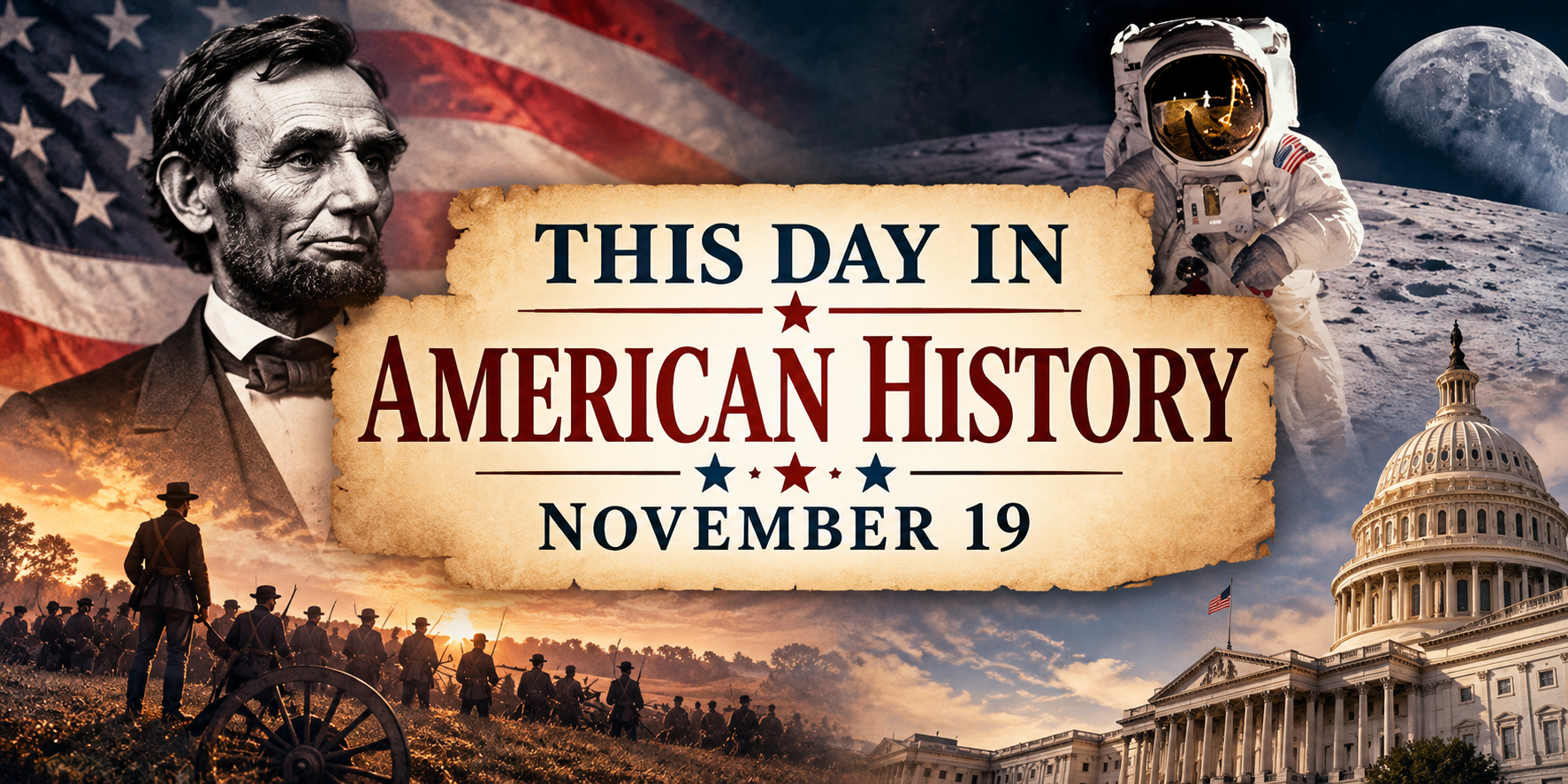
American history is filled with extraordinary moments that have shaped the nation’s identity, values, and future. Some dates are remembered for important political decisions, while others stand out because of groundbreaking achievements, powerful speeches, and events that changed the course of history.
November 19 is one of those remarkable dates.
From President Abraham Lincoln delivering the Gettysburg Address in 1863 to NASA successfully landing Apollo 12 on the Moon in 1969, November 19 has witnessed events that continue to influence American society.
This date also marks significant developments in diplomacy, presidential history, business, entertainment, and technology.
Each event offers a glimpse into the challenges, accomplishments, and decisions that helped shape the United States.
Let’s explore the most important events that happened on November 19 in American history and discover why they remain significant today.
November 19, 1794: The Jay Treaty Is Signed
On November 19, 1794, American diplomat John Jay signed an important agreement with Great Britain known as the Jay Treaty.
Although the United States had gained independence following the American Revolutionary War, tensions between the two countries remained high.
British troops continued occupying military posts in territory claimed by the United States, while disputes over trade and maritime rights threatened to create another conflict.
President George Washington wanted to avoid another war while the young American nation was still developing its government and economy.
He sent John Jay, who was serving as Chief Justice of the United States, to negotiate with British officials.
The resulting agreement addressed several outstanding issues between the countries.
Britain agreed to withdraw its troops from military posts in the Northwest Territory, and both nations established procedures for resolving certain financial disputes.
However, the treaty was controversial.
Many Americans believed it favored British interests and failed to adequately protect American merchants and sailors.
Despite the opposition, Washington supported the agreement because he believed preserving peace was essential to the nation’s future.
The Jay Treaty helped prevent an immediate war with Great Britain and demonstrated the importance of diplomacy during America’s early years.
November 19, 1831: President James A. Garfield Is Born
On November 19, 1831, James Abram Garfield was born in Orange Township, Ohio.
He would eventually become the 20th president of the United States.
Garfield grew up in difficult financial circumstances. His father died when he was young, leaving his mother to raise the family.
Despite these challenges, Garfield pursued an education and eventually became a teacher, college president, lawyer, military officer, and politician.
During the American Civil War, Garfield served in the Union Army and rose to the rank of major general.
He later entered Congress, representing Ohio in the United States House of Representatives.
Garfield developed a reputation as an intelligent and capable political leader.
In 1880, he won the presidential election and took office on March 4, 1881.
Unfortunately, his presidency was tragically short.
On July 2, 1881, Garfield was shot by Charles J. Guiteau at a railroad station in Washington, D.C.
He survived for several weeks but died on September 19, 1881.
His assassination intensified demands for reforms to the federal government’s employment system.
These efforts eventually contributed to the passage of the Pendleton Civil Service Reform Act in 1883.
Although Garfield served as president for only a short time, his life remains an important chapter in American political history.
November 19, 1863: Abraham Lincoln Delivers the Gettysburg Address
One of the most important events in American history occurred on November 19, 1863, when President Abraham Lincoln delivered the Gettysburg Address.
The speech took place during the dedication of the Soldiers’ National Cemetery in Gettysburg, Pennsylvania.
Just months earlier, the Battle of Gettysburg had been fought from July 1 through July 3, 1863.
The battle was one of the deadliest confrontations of the American Civil War.
Approximately 51,000 soldiers were killed, wounded, captured, or reported missing during the three-day conflict.
The Union victory marked a major turning point in the war, ending Confederate General Robert E. Lee’s invasion of the North.
When Lincoln arrived at Gettysburg, the nation remained deeply divided.
Thousands of families were mourning loved ones, and the future of the United States remained uncertain.
A Speech That Changed American History
Lincoln’s address lasted only a few minutes and contained approximately 272 words, depending on the version.
Despite its short length, the speech became one of the most influential presidential addresses ever delivered.
Lincoln began by referring to the founding of the United States 87 years earlier.
He reminded Americans that their nation had been established upon the principles of liberty and equality.
He then explained that the Civil War represented a test of whether a nation founded on those ideals could survive.
Rather than focusing only on the soldiers who had died, Lincoln challenged the living to continue the work for which those soldiers had sacrificed their lives.
He emphasized that the nation must experience a renewed commitment to freedom and that democratic government must endure.
Why the Gettysburg Address Still Matters
The Gettysburg Address helped redefine the meaning of the Civil War.
Lincoln presented the conflict as more than a struggle to preserve the Union.
It was also a battle over the future of liberty, equality, and American democracy.
His words would influence generations of Americans, including political leaders, civil rights advocates, educators, and ordinary citizens.
Today, the Gettysburg Address remains one of the most widely studied speeches in American history.
It reminds us that freedom and democracy require sacrifice, responsibility, and continued dedication.
November 19, 1919: The Senate Rejects the Treaty of Versailles
On November 19, 1919, the United States Senate rejected the Treaty of Versailles, the peace agreement negotiated following World War I.
President Woodrow Wilson had strongly supported the treaty and the creation of the League of Nations.
The League was intended to promote international cooperation and help prevent future wars.
Wilson believed that American participation was essential to establishing lasting peace.
However, many senators opposed portions of the treaty.
Some feared that membership in the League of Nations could involve the United States in foreign conflicts without sufficient congressional control.
Others believed the treaty threatened American independence in international affairs.
The disagreement created a major political confrontation between Wilson and the Senate.
On November 19, the Senate voted on competing versions of the treaty, but neither received the two-thirds majority required for ratification.
The United States ultimately never joined the League of Nations.
Instead, America negotiated separate peace agreements with its former wartime enemies.
The rejection of the Treaty of Versailles became a defining moment in American foreign policy.
It reflected the continuing debate over how deeply the United States should become involved in international organizations and overseas conflicts.
November 19, 1959: Ford Announces the End of the Edsel
On November 19, 1959, Ford Motor Company announced that it would discontinue production of its Edsel automobile line.
The Edsel had been introduced in 1957 for the 1958 model year.
Ford invested heavily in developing and promoting the brand, hoping it would become a major competitor in the American automobile market.
However, the Edsel struggled almost immediately.
Its unusual appearance, pricing, quality concerns, and changing consumer preferences contributed to disappointing sales.
The economic recession of 1957–1958 also hurt demand for midpriced automobiles.
Despite extensive advertising campaigns and substantial corporate investment, Ford could not generate enough consumer interest to sustain the brand.
The company discontinued the Edsel after only a few model years.
A Famous American Business Failure
The Edsel became one of the most frequently discussed product failures in American business history.
Its story demonstrated that extensive market research, major advertising campaigns, and financial investment do not guarantee commercial success.
Businesses must understand consumer expectations, market conditions, and the importance of delivering products that customers genuinely want.
Today, surviving Edsel automobiles have become collectibles.
What began as a commercial disappointment eventually became a memorable part of American automotive history.
November 19, 1969: Apollo 12 Lands on the Moon
On November 19, 1969, NASA successfully landed Apollo 12 on the Moon.
The mission became the second crewed lunar landing in human history.
Only four months earlier, Apollo 11 astronauts Neil Armstrong and Buzz Aldrin had become the first humans to walk on the lunar surface.
Apollo 12 demonstrated that NASA could repeat that extraordinary accomplishment while improving the accuracy of lunar landings.
The Apollo 12 Astronauts
The Apollo 12 crew consisted of three American astronauts.
Charles “Pete” Conrad Jr. served as mission commander.
Alan Bean served as lunar module pilot.
Richard Gordon served as command module pilot.
While Gordon remained in lunar orbit, Conrad and Bean descended to the Moon aboard the lunar module Intrepid.
They landed in an area known as the Ocean of Storms.
Their landing site was close to the unmanned Surveyor 3 spacecraft, which had reached the lunar surface in 1967.
Exploring the Lunar Surface
Conrad and Bean conducted scientific experiments, collected lunar samples, and retrieved components from Surveyor 3.
Scientists wanted to examine how the spacecraft’s materials had responded to prolonged exposure to the lunar environment.
The astronauts also installed scientific instruments designed to collect information about the Moon.
Apollo 12 demonstrated improved landing precision, which would become essential for future missions targeting specific scientific locations.
The astronauts returned safely to Earth on November 24, 1969.
Why Apollo 12 Was Important
Apollo 12 proved that landing humans on the Moon was not simply a one-time achievement.
NASA had developed the technology, training, and operational experience necessary to conduct additional lunar missions.
The mission also expanded scientific knowledge about the Moon’s surface and environment.
Apollo 12 remains an important achievement in American space exploration and a testament to the determination of scientists, engineers, astronauts, and thousands of supporting personnel.
November 19, 1985: Ronald Reagan and Mikhail Gorbachev Begin Their Historic Summit
On November 19, 1985, President Ronald Reagan and Soviet leader Mikhail Gorbachev met for the first time in Geneva, Switzerland.
The meeting represented an important moment in the Cold War.
For decades, the United States and Soviet Union had competed for political, military, and technological influence around the world.
Both nations possessed enormous nuclear arsenals, and tensions between them created widespread concerns about the possibility of nuclear war.
Relations had become particularly strained during the early 1980s.
However, the arrival of Gorbachev as Soviet leader created new opportunities for diplomatic discussions.
A Meeting That Helped Change the Cold War
Reagan and Gorbachev discussed nuclear weapons, international security, regional conflicts, and the relationship between their countries.
Although the summit did not immediately produce a major arms control agreement, it helped establish a personal relationship between the two leaders.
Both recognized the importance of continuing discussions despite their political disagreements.
The meeting helped create momentum for future negotiations.
In 1987, Reagan and Gorbachev signed the Intermediate-Range Nuclear Forces Treaty, which required the elimination of an entire category of American and Soviet missiles.
The Geneva Summit demonstrated that diplomacy could help reduce tensions between powerful nations.
It remains an important moment in the history of American foreign relations.
November 19, 1997: The McCaughey Septuplets Are Born
On November 19, 1997, Bobbi McCaughey gave birth to seven babies in Des Moines, Iowa.
The children became internationally famous as the first known set of septuplets to survive infancy.
The birth attracted enormous media attention across the United States.
Medical professionals had carefully monitored the pregnancy because carrying seven babies involved significant risks.
The children were delivered prematurely by cesarean section.
Their survival represented an extraordinary achievement in neonatal medicine.
A Remarkable Medical Story
The McCaughey septuplets consisted of four boys and three girls.
Their birth highlighted advances in prenatal care, premature infant treatment, and specialized medical support.
However, it also raised questions about fertility treatments and the health risks associated with pregnancies involving multiple babies.
The family’s story became one of the most widely followed human-interest stories of 1997.
Their arrival remains a memorable moment in American medical and social history.
November 19, 2007: Amazon Introduces the First Kindle
On November 19, 2007, Amazon introduced its first Kindle electronic reading device.
The Kindle represented a significant development in how Americans purchased, stored, and read books.
Before electronic readers became widely popular, most people relied primarily on printed books purchased from bookstores, libraries, or online retailers.
The Kindle offered a different experience.
Readers could purchase digital books and download them directly to a portable device.
Its electronic-ink screen was designed to resemble the appearance of printed pages.
How the Kindle Changed Reading
The original Kindle launched with a price of $399.
Although electronic books already existed, the Kindle helped introduce digital reading to a much larger audience.
Its wireless downloading capabilities made purchasing books more convenient.
Over time, electronic readers helped transform the publishing industry.
Independent authors gained new opportunities to publish and distribute their work without depending entirely on traditional publishing companies.
Readers gained access to extensive digital libraries that could be carried on a single device.
The Kindle became an important milestone in the history of American technology, literature, and publishing.
Famous Americans Born on November 19
November 19 is also the birthday of several notable Americans who made important contributions to politics, entertainment, business, and culture.
James A. Garfield – 1831
James A. Garfield became the 20th president of the United States.
His life reflected the importance of education, perseverance, and public service.
Although his presidency was cut short by assassination, his legacy remains part of American political history.
Dick Cavett – 1936
Dick Cavett became a respected American television host known for thoughtful interviews with entertainers, politicians, authors, and cultural figures.
His programs demonstrated that television interviews could encourage meaningful conversations about important social and cultural issues.
Ted Turner – 1938
Ted Turner became one of America’s most influential media entrepreneurs.
He helped transform cable television and founded CNN, which launched in 1980.
His work contributed to the development of continuous television news coverage.
Calvin Klein – 1942
Calvin Klein became an internationally recognized American fashion designer.
His brand became famous for clothing, denim, fragrances, and influential advertising campaigns.
His work helped shape American fashion and popular culture.
Meg Ryan – 1961
Meg Ryan became one of Hollywood’s most recognizable actresses, particularly through romantic comedies.
Her popular films include When Harry Met Sally…, Sleepless in Seattle, and You’ve Got Mail.
Her performances helped define romantic comedy films during the late 1980s and 1990s.
Jodie Foster – 1962
Jodie Foster became one of America’s most respected actresses and directors.
Beginning her career as a child performer, she went on to win Academy Awards for her performances in The Accused and The Silence of the Lambs.
Her career has spanned decades and includes numerous critically acclaimed performances.
Interesting Facts About November 19 in American History
November 19 includes several fascinating historical connections.
1. Abraham Lincoln delivered one of America’s most famous speeches in only a few minutes.
The Gettysburg Address demonstrated that a short speech could have an extraordinary influence on a nation’s identity.
2. Two important presidential milestones occurred on November 19.
James A. Garfield was born on this date in 1831, while Abraham Lincoln delivered the Gettysburg Address in 1863.
3. America’s second crewed Moon landing happened on November 19.
Apollo 12 demonstrated that lunar exploration could become a continuing scientific program.
4. A famous automobile failure was announced on this date.
Ford’s decision to discontinue the Edsel became an important lesson in American marketing and business strategy.
5. November 19 marked a turning point in Cold War diplomacy.
The first meeting between Reagan and Gorbachev helped establish communication that would contribute to improved relations between the United States and Soviet Union.
6. A remarkable medical achievement occurred in 1997.
The birth of the McCaughey septuplets attracted international attention and highlighted advances in neonatal care.
7. Digital reading took an important step forward in 2007.
Amazon’s introduction of the Kindle helped change how Americans accessed and enjoyed books.
What Can We Learn From November 19 in American History?
History provides valuable lessons about leadership, determination, innovation, and the consequences of important decisions.
The events of November 19 demonstrate several principles that remain relevant today.
Great Leadership Requires Vision
Abraham Lincoln understood that the Civil War represented more than a military struggle.
It was a test of the nation’s founding principles.
His Gettysburg Address encouraged Americans to remember the sacrifices of those who had died and continue working toward a stronger democracy.
Effective leadership often requires the ability to see beyond immediate circumstances and recognize a larger purpose.
Progress Requires Determination
The Apollo 12 mission demonstrated what people can accomplish through preparation, scientific knowledge, and teamwork.
The astronauts and engineers involved in the mission faced enormous technical challenges.
Their success showed that remarkable achievements often result from years of dedication and persistence.
Diplomacy Can Create Opportunities for Peace
The Jay Treaty and the Reagan-Gorbachev summit occurred nearly two centuries apart.
However, both events demonstrated the importance of communication between nations experiencing serious disagreements.
Diplomacy does not always produce immediate solutions, but it can help prevent conflict and establish opportunities for cooperation.
Failure Can Teach Important Lessons
The Edsel automobile reminds us that even successful companies can make costly mistakes.
However, failure can provide valuable information about consumer expectations, changing markets, and business decisions.
Learning from mistakes is an important part of future success.
Innovation Can Transform Everyday Life
The introduction of the Kindle demonstrated how technology could change an activity as familiar as reading.
New inventions often create opportunities that were previously unavailable.
Innovation can influence education, entertainment, communication, and the way people experience the world.
Why Remembering American History Matters
American history is more than a collection of names, dates, and historical events.
It tells the story of how the United States developed and how the decisions of previous generations continue to influence society.
Learning about the past helps us understand the challenges Americans faced and the choices that shaped the nation.
The events of November 19 remind us that history includes extraordinary accomplishments alongside difficult struggles.
The Gettysburg Address reflects the sacrifices of the Civil War and the continuing importance of freedom and equality.
The Treaty of Versailles controversy demonstrates how political disagreements can influence America’s role in international affairs.
Apollo 12 represents the achievements possible through scientific discovery and human determination.
The Reagan-Gorbachev summit illustrates how diplomacy can help reduce international tensions.
Even developments involving automobiles, entertainment, medicine, and technology reveal important aspects of American culture.
By studying these events, we gain a better understanding of the nation’s past and the responsibilities that come with shaping its future.
Conclusion: November 19 Is a Day of American Leadership, Sacrifice, and Achievement
November 19 holds an important place in American history.
Throughout the centuries, this date has witnessed events involving presidents, astronauts, diplomats, business leaders, scientists, and entertainers.
From the signing of the Jay Treaty in 1794 to the introduction of the Kindle in 2007, November 19 reflects the many ways America has changed and developed.
However, one event stands above the others in historical significance.
On November 19, 1863, Abraham Lincoln stood before a crowd in Gettysburg, Pennsylvania, and delivered a speech that would become one of the defining statements of American democracy.
His words reminded the nation that freedom and equality were ideals worth defending.
More than 160 years later, the Gettysburg Address continues to inspire Americans to reflect on the meaning of democracy and the sacrifices required to preserve it.
November 19 also reminds us that progress is not always easy.
Some historical moments represent extraordinary achievements, while others reveal mistakes, disagreements, and difficult decisions.
Together, they form the continuing story of the United States.
American history is not simply about remembering what happened yesterday. It is about understanding how the lessons of yesterday can help create a better tomorrow.
Which historical event from November 19 do you believe had the greatest impact on America, and why?


Leave a Reply