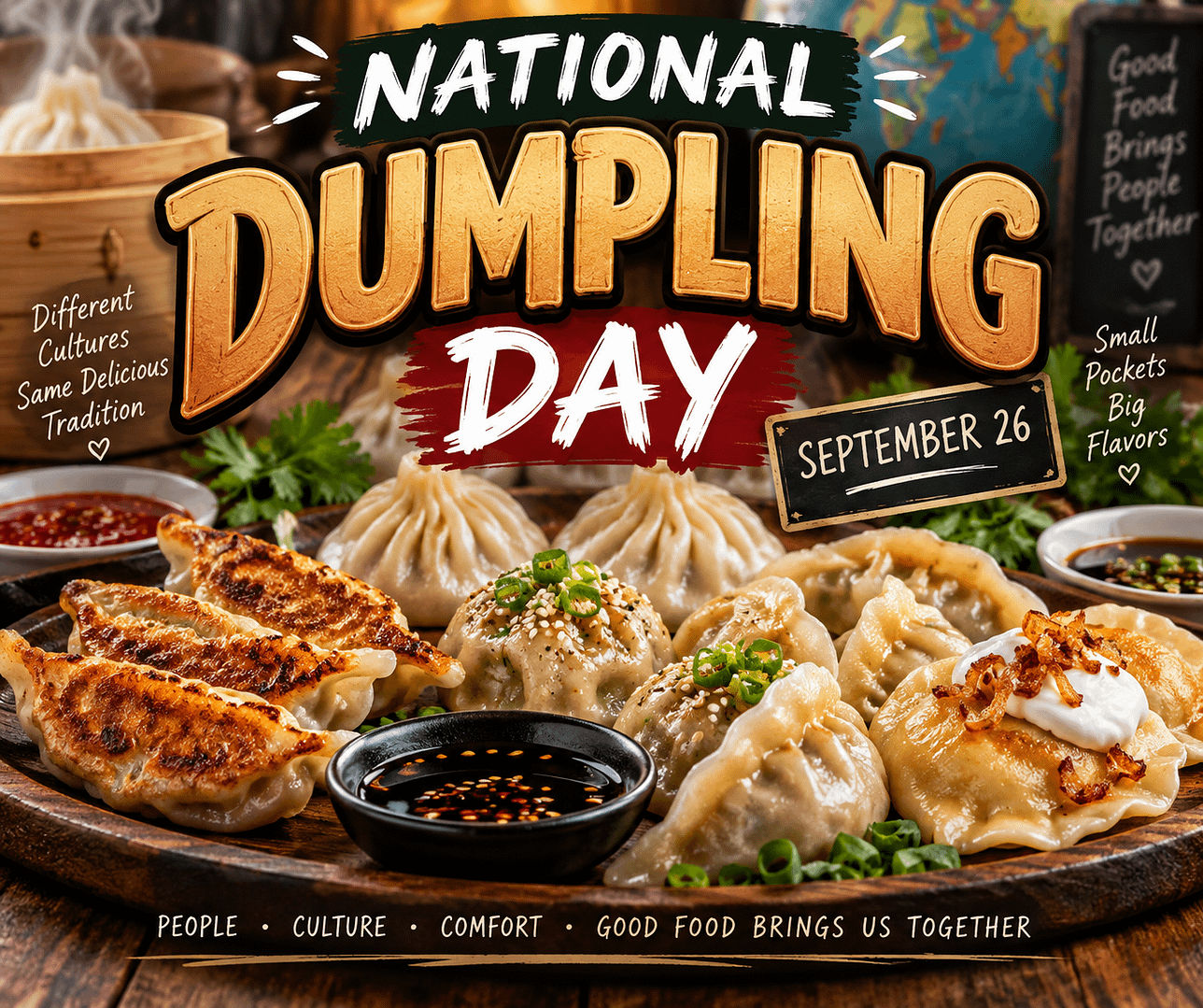
Few foods can bring people together quite like dumplings. Whether they are steamed, boiled, baked, simmered in soup, or fried until beautifully crisp, dumplings have earned a place at tables around the world.
National Dumpling Day, celebrated annually on September 26, gives food lovers the perfect excuse to enjoy these delicious little pockets of comfort.
But dumplings are much more than something tasty to eat. They represent generations of cooking traditions, family recipes, cultural celebrations, and the simple pleasure of gathering around a table with people we care about.
From Chinese jiaozi and Japanese gyoza to Polish pierogi, Italian ravioli, Indian momos, and Southern-style chicken and dumplings, the idea of wrapping or combining dough with delicious ingredients has appeared in countless cuisines.
National Dumpling Day is a celebration of all of them.
What Is National Dumpling Day?
National Dumpling Day is observed on September 26 and celebrates the incredible variety of dumplings enjoyed throughout the United States and around the world.
The word “dumpling” can describe many different foods.
Some dumplings consist of thin dough wrapped around meat, vegetables, cheese, seafood, or other fillings. Others are pieces or balls of dough cooked directly in broth, stew, or another dish.
Depending on where you live and the traditions you grew up with, the word dumpling may immediately make you picture something completely different.
Someone might imagine a bamboo steamer filled with delicate dumplings.
Another person might picture crispy potstickers sizzling in a skillet.
Someone else may think of pierogi covered with onions and sour cream.
And for many Americans, dumplings mean soft pieces of dough floating alongside tender chicken in a rich, comforting broth.
That incredible diversity is part of what makes National Dumpling Day so much fun.
Dumplings Have Been Enjoyed for Generations
Trying to identify one single origin for every type of dumpling is difficult because dough-based foods developed across numerous cultures over long periods of history.
Different civilizations discovered their own ways of combining flour or other starches with meats, vegetables, cheeses, seasonings, and sauces.
The results became foods that today fall under the broad dumpling family.
Many dumpling traditions also developed as practical cooking methods. A relatively small amount of meat or vegetables could be combined with dough to create a satisfying meal capable of feeding several people.
Over generations, these practical dishes became treasured traditions.
Recipes were passed from parents to children and grandparents to grandchildren.
Families developed their own fillings, folding techniques, seasonings, sauces, and preparation methods.
What may have started as an everyday meal eventually became part of cultural identity and family history.
Chinese Jiaozi
One of the world’s best-known dumpling traditions comes from China.
Jiaozi typically feature thin wrappers surrounding fillings that may contain pork, beef, shrimp, vegetables, cabbage, chives, or combinations of different ingredients.
They can be boiled, steamed, or pan-fried.
Dumplings are also associated with important Chinese celebrations, particularly Lunar New Year traditions in parts of China.
Their shape is sometimes associated with historical forms of Chinese currency, helping make them symbolic of prosperity and good fortune.
Making dumplings can also be a social experience.
Family members may gather around a table preparing wrappers, adding fillings, folding dumplings, and cooking large batches together.
The meal becomes about more than eating.
It becomes about spending time together.
Japanese Gyoza
Japanese gyoza are another popular member of the dumpling family.
They commonly contain ground meat and vegetables wrapped inside relatively thin dough.
One of the most popular preparations involves pan-frying the bottoms until crisp before adding liquid and covering the pan so the dumplings steam.
The result provides two textures at once.
You get a beautifully browned, slightly crunchy bottom combined with a soft wrapper and juicy filling.
Gyoza are often served alongside dipping sauces containing ingredients such as soy sauce, vinegar, and chili oil.
They make an excellent appetizer, side dish, snack, or part of a larger meal.
Polish Pierogi
Travel to Poland and neighboring parts of Central and Eastern Europe and you’ll encounter another beloved dumpling tradition: pierogi.
Pierogi are commonly filled with ingredients such as potatoes, cheese, meat, mushrooms, sauerkraut, or fruit.
They are generally boiled and may then be pan-fried.
Savory versions can be served with toppings such as butter, sautéed onions, or sour cream.
Sweet versions introduce an entirely different dumpling experience.
For many families with Polish and Eastern European heritage, making pierogi is an important tradition associated with family gatherings and holidays.
One generation teaches the next how to roll the dough, prepare the filling, seal the edges, and cook them correctly.
That is one of the beautiful things about dumplings.
Food becomes a way of preserving memories.
Momos
Momos are popular throughout Himalayan and South Asian communities, particularly in places including Nepal and Tibet and in parts of India.
These dumplings can contain meat, vegetables, cheese, or other flavorful fillings.
They are frequently steamed, although fried variations are also popular.
A good dipping sauce can transform the entire experience, especially when tomatoes, chilies, garlic, and spices are involved.
Momos have also become increasingly popular internationally as more people discover their incredible flavor.
Italian Ravioli
People don’t always immediately think of ravioli when discussing dumplings, but ravioli share the same basic concept: dough surrounding a delicious filling.
Traditional ravioli fillings vary tremendously.
You might encounter ricotta, spinach, mushrooms, squash, seafood, or meat.
Add a beautiful sauce, grated cheese, and fresh herbs, and something remarkably simple becomes an unforgettable meal.
Italy’s stuffed pasta traditions demonstrate just how universal the idea of placing delicious ingredients inside dough really is.
Chicken and Dumplings
In the United States, particularly throughout the South, chicken and dumplings have become classic comfort food.
Unlike many filled dumplings, the dumplings in this dish are generally pieces of dough cooked directly in chicken broth or stew.
Recipes differ from family to family.
Some cooks prefer fluffy biscuit-like dumplings.
Others make thin, rolled dumplings.
Either way, the combination of tender chicken, savory broth, vegetables, seasonings, and soft dumplings creates the kind of meal that feels especially satisfying on a cold evening.
Chicken and dumplings are also one of those dishes capable of bringing back memories.
One bite might remind someone of their grandmother’s kitchen, Sunday dinner, childhood winters, or a family recipe that has been made for decades.
Why Are Dumplings So Popular?
Part of the appeal is variety.
You could eat dumplings several times in one week and have a completely different experience every time.
They can be:
- Steamed
- Boiled
- Pan-fried
- Deep-fried
- Baked
- Simmered in soup or broth
Then there are the fillings.
Pork, beef, chicken, shrimp, crab, potatoes, cheese, cabbage, mushrooms, spinach, onions, fruit, and countless other ingredients can become part of a dumpling.
Different dipping sauces create even more possibilities.
Soy-based sauces can provide saltiness and umami.
Chili oil adds heat.
Vinegar provides acidity.
Creamy sauces can add richness.
Herbs and garlic can provide freshness and depth.
The possibilities seem nearly endless.
Dumplings Are Comfort Food
There is another reason dumplings have survived through generations.
They are comforting.
Something about warm dough surrounding a flavorful filling creates an especially satisfying bite.
Dumplings also frequently appear in foods connected with family and home.
Maybe you remember helping someone fold dumplings at the kitchen table.
Maybe your grandmother made pierogi every Christmas.
Perhaps chicken and dumplings were served whenever the weather became cold.
Or maybe your favorite memory is simply ordering far too many dumplings with friends and sharing everything in the middle of the table.
Food has a remarkable ability to connect itself with memory.
Years later, a familiar flavor can transport us back to a particular kitchen, restaurant, holiday, person, or moment.
Making Dumplings Together
One of the best ways to celebrate National Dumpling Day is by making dumplings yourself.
Even better, invite other people to help.
Set up a dumpling-making station with wrappers, filling, small bowls of water, and plenty of workspace.
Everyone can learn how to place the correct amount of filling inside the wrapper and seal the edges.
Don’t worry if they aren’t perfect.
Homemade dumplings don’t need to look identical.
In fact, the slightly uneven shapes can become part of the fun.
After everyone has made a batch, steam, boil, or pan-fry them and enjoy the results together.
You could even turn the evening into a friendly competition to see who creates the most impressive dumpling.
Create a Dumpling Tasting Night
Can’t decide which dumpling you want?
Try several.
National Dumpling Day provides a great opportunity to organize a dumpling tasting night.
Choose dumplings from different culinary traditions and place them in the middle of the table.
You might serve gyoza, pierogi, potstickers, momos, wontons, and ravioli.
Add several dipping sauces and allow everyone to sample different combinations.
You can rate them, compare fillings, and discover something you have never tried before.
Just remember that comparing them isn’t always easy.
Sometimes the correct answer to “Which dumpling is best?” is simply:
Another dumpling.
Visit a Local Restaurant
You don’t have to cook to celebrate.
National Dumpling Day is also an excellent opportunity to support local restaurants.
Search your community for Chinese, Japanese, Korean, Nepalese, Tibetan, Polish, Italian, or other restaurants offering dumpling-style dishes.
Order something familiar or challenge yourself to try something completely new.
If you usually order pan-fried dumplings, try steamed ones.
If pork is normally your favorite filling, try vegetables or shrimp.
If you’ve never eaten momos or pierogi, National Dumpling Day gives you an excellent reason to start.
Supporting a locally owned restaurant makes the celebration even better.
Build the Perfect Dumpling Dipping Sauce
Sometimes the sauce is almost as important as the dumpling.
A simple dipping sauce can be created by combining soy sauce with rice vinegar and a small amount of sesame oil.
From there, customize it.
Add minced garlic.
Add chopped green onions.
Add ginger.
Add chili crisp.
Add sesame seeds.
Add a little sweetness.
You can create several sauces ranging from mild to spicy and let everyone choose their favorite.
Host a Dumpling Party
National Dumpling Day could easily become an entire party theme.
Ask everyone attending to bring a different type of dumpling.
One person brings potstickers.
Someone else brings pierogi.
Another person brings gyoza.
Someone brings ravioli.
Another prepares chicken and dumplings.
Suddenly you have an international dumpling buffet without requiring one person to cook everything.
Add drinks, music, dipping sauces, and dessert, and you’ve created a memorable celebration centered around one remarkably versatile food.
Dumplings Show How Food Connects the World
Perhaps the most fascinating thing about dumplings is how many cultures created foods built around similar ideas.
The names change.
The ingredients change.
The shapes change.
The cooking methods change.
But the basic idea appears again and again.
Take dough.
Add something delicious.
Cook it.
Share it.
That simplicity has produced thousands of variations across generations.
Dumplings remind us that while culinary traditions can be incredibly different, there are also surprising similarities between the foods people enjoy around the world.
September 26 Is the Perfect Day to Try Something New
National Dumpling Day doesn’t require complicated plans.
You could celebrate with a plate of crispy potstickers during lunch.
You could order gyoza with dinner.
You could make homemade pierogi with your family.
You could visit a restaurant and finally try momos.
Or you could prepare a big pot of chicken and dumplings and enjoy an evening of classic comfort food.
The important thing is enjoying the experience.
Food holidays are supposed to be fun, and few foods offer more possibilities than dumplings.
Happy National Dumpling Day!
On September 26, celebrate one of the world’s most versatile comfort foods.
Steam them.
Boil them.
Fry them.
Bake them.
Drop them into a bubbling pot of broth.
Dip them into your favorite sauce.
Most importantly, share them with someone.
Because while dumplings may come in countless shapes, sizes, flavors, and traditions, some of the best food experiences happen when we’re sitting around a table together.
Happy National Dumpling Day!
What kind of dumpling would you choose first: potstickers, gyoza, pierogi, momos, ravioli, or chicken and dumplings?
Leave a Reply