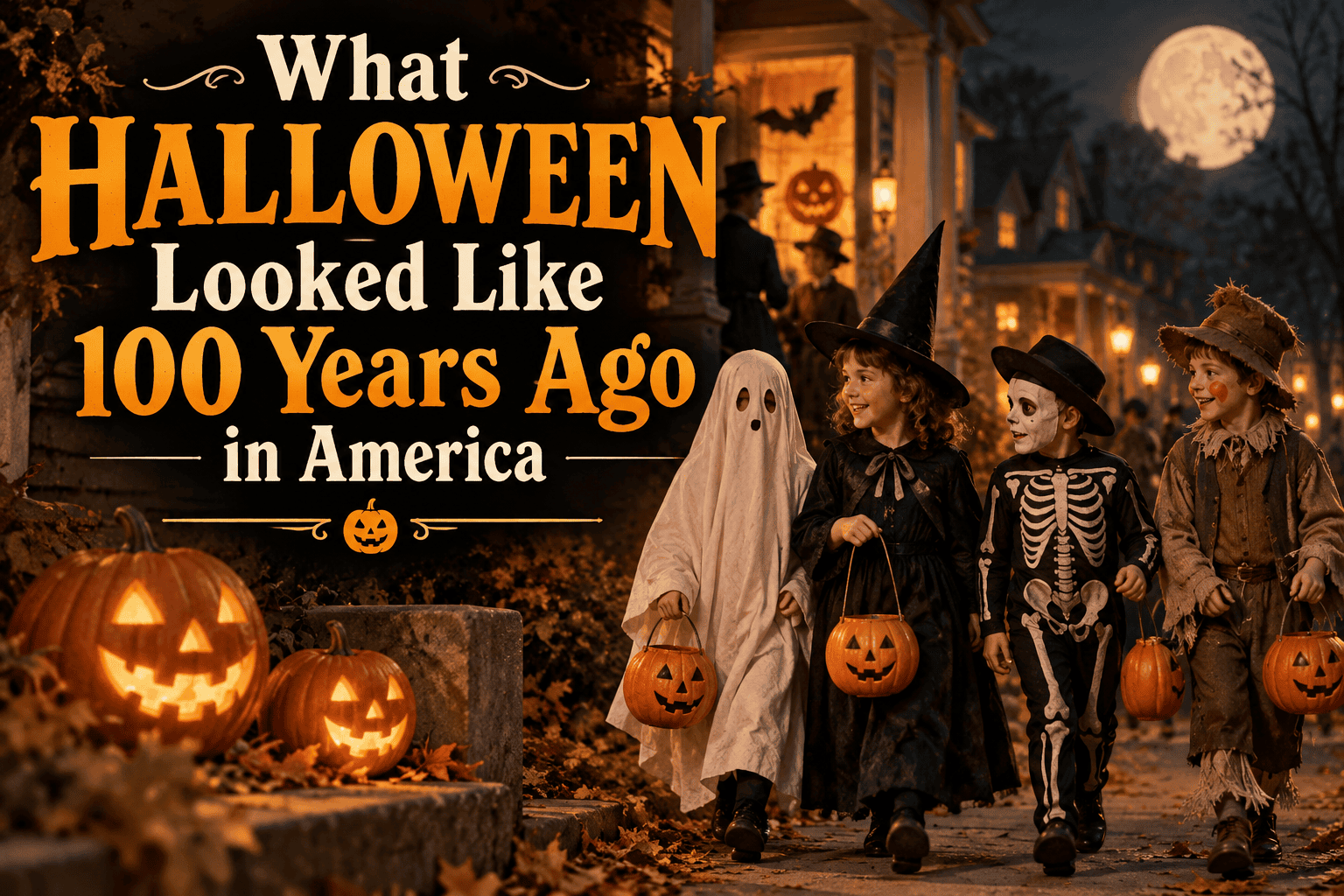
Discover how Americans celebrated Halloween in the 1920s, from homemade costumes and neighborhood parties to spooky superstitions, old-fashioned games, and traditions that helped shape the holiday we know today.
Halloween in America looked very different 100 years ago. In 1926, there were no elaborate haunted theme parks, no social media costume trends, and no massive displays of inflatable decorations covering front lawns. Instead, Halloween was a holiday filled with homemade costumes, neighborhood gatherings, mysterious superstitions, practical jokes, and simple traditions passed down through generations.
Children and adults celebrated Halloween in ways that might seem unusual today. Rather than visiting dozens of houses collecting candy, many families attended parties, played fortune-telling games, told ghost stories, and participated in community festivities.
The Halloween of the 1920s was a fascinating combination of old European customs, American creativity, and changing social traditions.
Understanding what Halloween looked like 100 years ago reveals how much the holiday has changed while showing that many of its most beloved traditions have surprisingly deep roots.
Halloween in America During the 1920s
By the 1920s, Halloween had become an increasingly popular celebration throughout the United States.
The holiday’s traditions had been influenced by centuries of European customs, particularly those brought to America by Irish and Scottish immigrants.
Originally associated with seasonal changes, supernatural beliefs, and the approach of winter, Halloween gradually developed into a social occasion focused on entertainment and community gatherings.
During the early twentieth century, Americans began moving away from some of the holiday’s more mysterious religious and supernatural associations.
Halloween became an opportunity for families, schools, churches, and neighborhood organizations to host parties and seasonal celebrations.
However, the holiday still retained its spooky atmosphere.
Ghosts, witches, black cats, skeletons, and jack-o’-lanterns were already familiar Halloween symbols.
What made Halloween in the 1920s unique was the combination of these traditional images with the growing excitement of modern American life.
1. Halloween Costumes Were Usually Homemade
One of the biggest differences between Halloween in 1926 and Halloween today was how people dressed for the occasion.
Most families did not purchase elaborate costumes from large retail stores.
Instead, Halloween costumes were often created using clothing, fabric, household materials, and whatever could be found around the house.
Children might dress as ghosts using old white sheets, while others wore oversized clothing, handmade masks, or costumes inspired by familiar supernatural characters.
Popular costume themes included:
-
Ghosts and spirits
-
Witches wearing pointed hats
-
Skeletons
-
Black cats
-
Clowns
-
Pirates
-
Devils
-
Scarecrows
-
Storybook characters
Some costumes were intentionally frightening, with exaggerated faces and unsettling masks.
Early commercially produced costumes and masks were available, but homemade outfits remained common.
Unlike modern Halloween costumes inspired by movies, television, and video games, many costumes of the 1920s reflected folklore, traditional characters, and local creativity.
2. Halloween Parties Were More Popular Than Trick-or-Treating
Today, Halloween is strongly associated with children walking from house to house collecting candy.
However, organized trick-or-treating was not yet a widespread American tradition in 1926.
Although some communities had customs involving children visiting neighbors for treats or performing playful tricks, the familiar door-to-door practice developed more broadly in the decades that followed.
Instead, Halloween parties were a major part of the celebration.
Families hosted gatherings in their homes, while schools, churches, and community organizations organized seasonal events.
These parties frequently featured homemade decorations, games, refreshments, costumes, and storytelling.
Guests might gather around a table decorated with pumpkins, apples, candles, and autumn leaves.
Music, dancing, and friendly competitions were also common entertainment.
For many Americans, Halloween was less about collecting candy and more about spending an evening enjoying the company of friends and neighbors.
3. Halloween Was a Night of Mischief and Practical Jokes
Halloween in the 1920s had a reputation for mischief.
In some communities, the holiday was associated with pranks carried out by children and teenagers.
Common examples included ringing doorbells and running away, moving gates, hiding objects, and playing harmless tricks on neighbors.
However, not all Halloween mischief was harmless.
Some incidents involved damaged property, overturned outdoor objects, and other forms of vandalism.
Community leaders became increasingly concerned about the problems associated with Halloween night.
As a result, schools, churches, and civic organizations promoted organized Halloween parties as a way to provide safer entertainment.
This effort to replace destructive pranks with supervised activities eventually helped shape the family-friendly Halloween celebrations that became more familiar later in the twentieth century.
4. Jack-o’-Lanterns Were Already a Halloween Favorite
Pumpkin carving was already an established Halloween tradition in America by the 1920s.
Families hollowed out pumpkins and carved faces into them, creating glowing decorations for windows, porches, and party tables.
Many early jack-o’-lanterns had simple designs.
Instead of the detailed patterns and artistic carvings popular today, pumpkins frequently featured triangular eyes, crooked noses, and large toothy smiles.
Some faces were cheerful, while others were designed to appear frightening.
Candles were commonly placed inside the pumpkins to illuminate their carved expressions.
The tradition had roots in older European practices of carving lanterns from vegetables such as turnips.
In America, pumpkins became a natural choice because they were widely available during the autumn harvest and were easier to carve.
By 1926, the glowing jack-o’-lantern had become one of Halloween’s most recognizable decorations.
5. Halloween Decorations Were Simple but Spooky
Halloween decorations 100 years ago were considerably less elaborate than modern displays.
There were no animated skeletons towering over houses or synchronized lighting systems covering entire neighborhoods.
Instead, decorations were often handmade or purchased as inexpensive paper ornaments.
Common Halloween decorations included black cats, witches, bats, owls, pumpkins, moons, and ghosts.
Orange and black were already strongly associated with the holiday.
Orange represented autumn harvests and pumpkins, while black reflected darkness and the supernatural.
Families decorated their homes with crepe-paper streamers, cardboard cutouts, candles, and seasonal plants.
Commercial Halloween postcards and paper decorations were also popular during the early twentieth century.
Some decorations were surprisingly artistic, featuring detailed illustrations of witches flying across moonlit skies or black cats sitting beside glowing pumpkins.
Although the materials were simple, the atmosphere could be wonderfully mysterious.
6. Halloween Games Were a Major Attraction
Halloween parties in the 1920s often centered around games that entertained both children and adults.
Many of these activities had been popular for generations.
One familiar game was bobbing for apples.
Participants attempted to grab apples floating in a tub of water using only their mouths.
Other games involved balancing objects, guessing mysterious items, and participating in playful competitions.
Some Halloween party games were designed around luck, romance, or fortune-telling.
Guests might attempt to predict future events or discover clues about whom they would eventually marry.
These activities reflected the older belief that Halloween was a special night when the future might be revealed.
For young adults, Halloween parties could be especially exciting because they offered opportunities for socializing, flirting, and enjoying group entertainment.
7. Fortune-Telling Was an Important Halloween Tradition
One of the most fascinating aspects of Halloween 100 years ago was the popularity of fortune-telling games.
Today, Halloween is primarily associated with costumes and candy.
In the 1920s, however, many partygoers still enjoyed traditional games intended to reveal their romantic futures.
Some customs involved apple peels.
A participant would peel an apple in one long strip and toss the peel over a shoulder.
According to folklore, the shape of the fallen peel might resemble the first initial of a future spouse.
Other games involved nuts, mirrors, candles, and hidden objects.
A person might attempt to see the image of a future sweetheart in a mirror under particular conditions.
These activities were generally treated as playful entertainment rather than reliable predictions.
Nevertheless, they gave Halloween parties an atmosphere of mystery and excitement.
8. Halloween Candy Was Different From Today’s Treats
Candy existed long before the 1920s, but Halloween candy traditions were different from those familiar today.
Because widespread trick-or-treating had not yet developed, candy was more commonly associated with parties, seasonal treats, and general confectionery sales.
Popular sweets during the era included candy corn, chocolates, caramels, hard candies, and homemade confections.
Candy corn had already been manufactured for decades and was associated with autumn.
Families might prepare popcorn balls, candied apples, fudge, and other homemade treats for Halloween gatherings.
Apples and nuts were especially appropriate for the season because Halloween celebrations remained closely connected to the autumn harvest.
The modern practice of purchasing large bags of individually wrapped candy specifically for trick-or-treaters became widespread much later.
9. Halloween Was Closely Connected to the Autumn Harvest
Halloween in 1926 retained a stronger connection to seasonal harvest traditions than many modern celebrations.
Pumpkins, apples, corn, hay, and colorful autumn leaves were common features of decorations and festivities.
In rural communities, the holiday could overlap with harvest parties and other seasonal gatherings.
Families might decorate with corn stalks, gourds, and produce from local farms.
Harvest imagery also appeared on Halloween postcards, invitations, and party decorations.
These traditions reflected the importance of agriculture in American life.
Although cities were growing rapidly during the 1920s, many Americans still maintained strong cultural connections to farming and the changing seasons.
Halloween provided an opportunity to celebrate autumn before the arrival of winter.
10. Schools and Churches Helped Shape Halloween Celebrations
During the 1920s, community organizations played an important role in making Halloween a more organized holiday.
Schools hosted parties featuring costumes, games, and refreshments.
Church groups sometimes arranged seasonal socials or alternative celebrations.
Civic organizations promoted neighborhood gatherings to discourage destructive Halloween pranks.
These events helped transform Halloween into a more structured community celebration.
Rather than allowing young people to spend the evening engaging in mischief, organizers encouraged supervised entertainment.
The growing involvement of schools and local organizations also helped make Halloween more accessible to families.
This community-centered approach laid part of the foundation for the organized parades, festivals, and children’s celebrations that became increasingly common in later decades.
11. Halloween Postcards Were Extremely Popular
Before social media, text messaging, and electronic greeting cards, Americans used printed postcards to send seasonal greetings.
Halloween postcards had become especially popular during the early twentieth century.
Many featured colorful illustrations of pumpkins, witches, black cats, ghosts, and romantic fortune-telling scenes.
Some cards included playful poems or humorous messages.
Others depicted children enjoying Halloween games or young couples participating in traditional rituals.
By the 1920s, Halloween postcards were part of a broader greeting-card culture.
Although the postcard craze had reached its greatest popularity earlier in the century, Halloween cards remained familiar seasonal items.
Today, surviving examples provide a fascinating glimpse into the artwork, humor, and customs associated with Halloween in the past.
12. Halloween Masks Could Be Surprisingly Frightening
Modern Halloween costumes often feature recognizable characters from popular entertainment.
In the 1920s, many masks were designed around exaggerated or mysterious faces.
Homemade masks could be created from paper, cardboard, fabric, or other materials.
Commercial masks also existed, including inexpensive designs made from molded or printed materials.
Some featured distorted human expressions, animals, clowns, or supernatural creatures.
Because early masks often lacked the polished appearance of modern costume accessories, they could look unusually eerie.
Combined with dim lighting and homemade clothing, these masks gave Halloween gatherings a distinctive atmosphere.
The unsettling appearance of vintage Halloween costumes continues to fascinate collectors and historians today.
13. Halloween Entertainment Was More Personal
Halloween entertainment in 1926 generally involved direct participation.
Instead of watching online videos or visiting elaborate commercial attractions, people created their own amusement.
Ghost stories were a popular form of entertainment.
Families and friends gathered to share frightening tales, mysterious legends, and local folklore.
Partygoers played games, danced, listened to music, and participated in costume contests.
In some communities, theaters offered seasonal entertainment, and public celebrations attracted large crowds.
The 1920s were also an important period in the growth of radio and motion pictures.
These new forms of entertainment were beginning to influence American culture, although they had not yet transformed Halloween into the enormous commercial event familiar today.
Much of the holiday’s enjoyment still came from creativity, imagination, and personal interaction.
14. Halloween Celebrations Varied Across America
Halloween did not look exactly the same everywhere in the United States.
Celebrations differed according to geography, community traditions, family backgrounds, and local customs.
In some cities, Halloween parties and public festivities were increasingly popular.
In rural communities, harvest gatherings and traditional games could play a larger role.
Some neighborhoods experienced considerable Halloween mischief, while others emphasized organized entertainment.
Regional and cultural differences also influenced how families celebrated.
Not every household participated in Halloween, and some religious communities avoided certain customs because of their supernatural associations.
The Halloween experience of a child growing up in a small Midwestern town could be very different from that of a child living in New York City or another large urban area.
These differences remind us that Halloween developed gradually rather than becoming a uniform national celebration overnight.
15. Halloween Was Beginning to Become a Commercial Holiday
Although Halloween in 1926 was much simpler than today’s celebration, commercial businesses were already recognizing its growing popularity.
Stores sold seasonal decorations, masks, party supplies, greeting cards, and sweets.
Manufacturers produced paper ornaments featuring familiar Halloween characters.
Party-planning books and magazines offered ideas for games, refreshments, costumes, and decorations.
Department stores and other retailers promoted seasonal merchandise.
However, Halloween spending was still far removed from the enormous industry it would eventually become.
Many families continued to rely on homemade decorations and inexpensive entertainment.
The commercial growth of Halloween would accelerate throughout the twentieth century as trick-or-treating, mass-produced costumes, television advertising, and large-scale retail promotions became more widespread.
How Halloween in 1926 Compares With Halloween Today
Looking at Halloween 100 years ago reveals just how dramatically the holiday has evolved.
| Halloween in 1926 | Halloween today |
|---|---|
| Homemade costumes were common | Store-bought and elaborate costumes are widely available |
| Home and community parties were central | Trick-or-treating, parties, and attractions are popular |
| Door-to-door trick-or-treating was not yet widespread | Trick-or-treating is a major tradition |
| Handmade paper decorations were popular | Electronic and animated decorations are common |
| Fortune-telling and traditional games were party favorites | Costume contests, haunted attractions, and themed entertainment are common |
| Homemade treats and seasonal sweets were served | Individually wrapped candy is a major part of the holiday |
| Pranks were a prominent concern in some communities | Organized family activities are widespread |
Despite these differences, many familiar Halloween traditions were already present a century ago.
Pumpkins, costumes, witches, ghosts, black cats, candy, and spooky entertainment have remained recognizable elements of the holiday.
What Did Halloween Night Feel Like in 1926?
Imagine walking through an American neighborhood on Halloween night in 1926.
The autumn air is cool, and fallen leaves cover the sidewalks.
A carved pumpkin glows from a front porch, illuminated by a flickering candle.
Inside a nearby house, families and friends gather around a decorated table.
Paper bats hang from the ceiling, and orange-and-black streamers stretch across the room.
Children wear homemade costumes, some dressed as ghosts and others wearing unusual masks.
Laughter fills the house as guests bob for apples and participate in fortune-telling games.
Someone begins telling a ghost story, and the room grows quiet.
Outside, a group of mischievous teenagers may be preparing a practical joke.
Across town, a school or community organization is hosting a Halloween social with music, refreshments, and seasonal entertainment.
There are no glowing smartphone screens, no elaborate digital decorations, and no enormous bags of trick-or-treat candy.
Yet the excitement of Halloween is unmistakable.
The celebration is built around imagination, tradition, mystery, and community.
This imagined scene captures customs documented during the era, although individual celebrations varied considerably.
When Did Halloween Become the Holiday We Know Today?
The transformation of Halloween continued throughout the decades following the 1920s.
During the 1930s and 1940s, organized community celebrations remained important, while door-to-door Halloween customs continued developing.
Trick-or-treating became increasingly familiar in many American communities during the 1940s and especially the 1950s, although World War II temporarily disrupted some celebrations.
As suburban neighborhoods expanded after the war, Halloween became more strongly associated with children visiting nearby homes for candy.
Candy manufacturers and retailers increasingly promoted products specifically for Halloween.
Television, movies, and popular culture also influenced costume choices and holiday entertainment.
By the late twentieth century, Halloween had become a major commercial and cultural celebration.
Haunted houses, theme park attractions, elaborate costumes, and extensive home decorations grew in popularity.
The holiday continued evolving into the large-scale event celebrated across America today.
Why Halloween Traditions From 100 Years Ago Still Matter
Halloween traditions from the 1920s offer more than an interesting look into the past.
They demonstrate how holidays change while preserving familiar customs.
Many Halloween activities that Americans enjoyed a century ago remain recognizable today.
Families still carve pumpkins.
Children still dress in costumes.
Friends still gather for parties.
Ghost stories, haunted decorations, and mysterious folklore continue to capture people’s imaginations.
Even traditional activities such as bobbing for apples occasionally appear at modern Halloween gatherings.
Perhaps the greatest difference is not the traditions themselves but the way Americans experience them.
A century ago, Halloween entertainment was often created at home with simple materials and shared directly with neighbors.
Today, families can choose from countless commercial attractions, decorations, costumes, and events.
Both approaches reflect the same desire to celebrate a night that is playful, mysterious, and different from ordinary life.
Final Thoughts: A Simpler but Still Spooky Halloween
Halloween in America 100 years ago was a celebration of creativity, community, folklore, and autumn traditions.
In 1926, children dressed in homemade costumes, families carved pumpkins, and neighbors gathered for parties filled with games, laughter, and ghost stories.
Fortune-telling customs added mystery to the evening, while practical jokes sometimes created problems for local communities.
Although trick-or-treating had not yet become the nationwide tradition we recognize today, many of Halloween’s most enduring symbols were already firmly established.
The holiday would continue changing throughout the twentieth century, eventually becoming one of America’s most recognizable seasonal celebrations.
Yet beneath the modern costumes, candy displays, and elaborate decorations, the spirit of old-fashioned Halloween remains.
It is still a night when imagination takes over, ordinary neighborhoods become a little more mysterious, and people come together to celebrate the unusual.
If you could travel back 100 years and experience Halloween in America during the 1920s, would you prefer the homemade costumes, old-fashioned games, and neighborhood parties, or would you rather celebrate Halloween the way we do today?

Leave a Reply