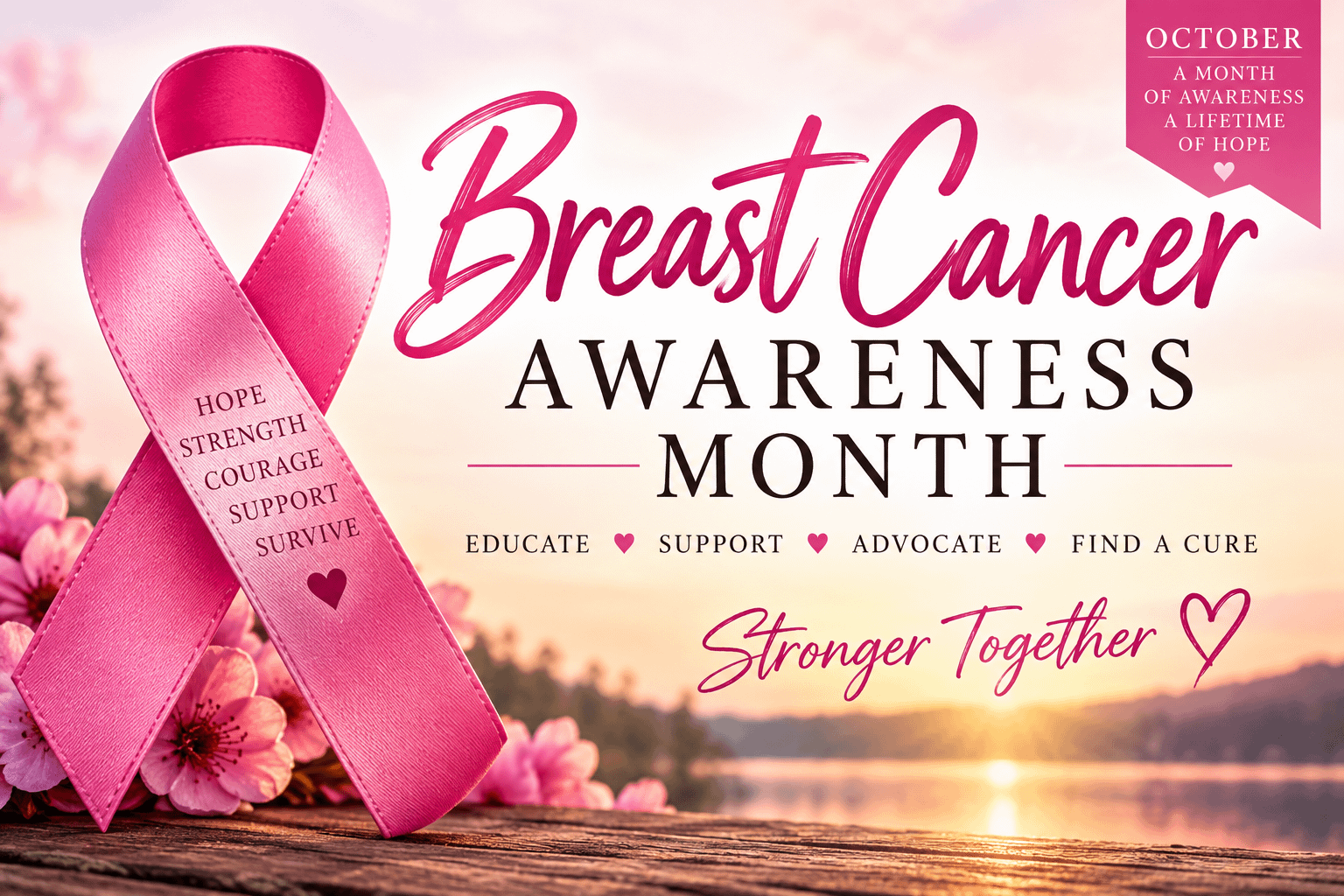
Every October, communities around the world recognize Breast Cancer Awareness Month, a time dedicated to increasing awareness about breast cancer, encouraging appropriate screening and early detection, supporting people who have been diagnosed, honoring survivors, and remembering those whose lives have been lost to the disease.
The familiar pink ribbon has become one of the most recognizable symbols of cancer awareness. But Breast Cancer Awareness Month is about much more than wearing pink.
Behind every ribbon is a person.
A mother. A daughter. A sister. A wife. A grandmother. A friend. A coworker. A neighbor.
And men can develop breast cancer as well.
Every diagnosis affects more than one person. Families rearrange their lives around appointments. Friends become caregivers. Partners sit beside hospital beds. Children watch someone they love endure treatment. Survivors learn how to live with a body and outlook that may have changed forever.
October gives us an opportunity to talk about those experiences while also sharing information that may help people recognize changes in their bodies and have informed conversations with healthcare professionals.
Why Breast Cancer Awareness Month Matters
Breast cancer remains one of the most commonly diagnosed cancers worldwide.
Awareness campaigns have helped make conversations about breast health more common, but awareness alone isn’t enough. People also need access to reliable information, appropriate screening, timely medical care, treatment, and emotional support.
Breast Cancer Awareness Month encourages us to turn awareness into meaningful action.
That could mean scheduling a medical appointment you have been postponing. It could mean learning your family health history. It might involve checking on a friend undergoing treatment, donating to a reputable organization, helping someone get to an appointment, or simply listening when a survivor wants to talk.
Sometimes support is found in the smallest gestures.
Understanding Breast Cancer
Breast cancer occurs when abnormal cells in breast tissue grow uncontrollably. There are several different types of breast cancer, and they can behave differently from one another.
A diagnosis therefore isn’t a single, universal experience.
Treatment depends on factors such as the type and stage of cancer, tumor characteristics, a person’s overall health, and other individual circumstances. Treatment can include surgery, radiation therapy, chemotherapy, hormone therapy, targeted therapy, immunotherapy, or combinations of treatments.
This is why personalized medical guidance is so important.
Know the Possible Warning Signs
Knowing what is normal for your body can help you recognize a change that deserves medical attention.
Possible signs of breast cancer can include:
- A new lump or thickening in the breast or underarm
- Changes in the size or shape of a breast
- Skin changes, including dimpling or puckering
- Nipple changes or inversion
- Nipple discharge other than breast milk
- Persistent breast or nipple pain
- Redness, irritation, swelling, or other unusual changes to the breast
Many breast changes are not cancer, but an unexplained or persistent change should still be evaluated by a healthcare professional rather than self-diagnosed.
Don’t ignore something simply because you hope it will disappear.
Getting it checked can provide answers, and when cancer is present, finding it earlier can often expand treatment options.
The Importance of Screening
Breast cancer screening aims to find cancer before symptoms develop.
Mammography is an important screening tool, but recommendations about when to begin screening and how frequently to have it can vary according to age, personal risk factors, family history, and the guidelines being followed.
That is why screening decisions are best made with a healthcare professional.
Some people may need additional imaging or earlier screening because they have a higher-than-average risk.
Instead of assuming that one screening schedule applies to everyone, ask:
What breast cancer screening plan is appropriate for me based on my age and personal risk?
That simple conversation could be extremely important.
Learn Your Family History
Family medical history can play an important role in understanding breast cancer risk.
If possible, learn whether close relatives have experienced breast cancer, ovarian cancer, pancreatic cancer, prostate cancer, or other cancers that could sometimes be associated with inherited genetic changes.
Certain inherited mutations, including changes involving the BRCA1 and BRCA2 genes, can significantly increase breast cancer risk.
Having a family history does not mean someone will develop cancer, and having no known family history does not mean someone cannot develop it.
However, knowing your history gives your healthcare provider more information when assessing your individual risk.
People with concerning personal or family histories may be referred for genetic counseling or testing when appropriate.
Breast Cancer Can Affect Men Too
Although breast cancer overwhelmingly affects women, men can develop it.
Because male breast cancer is much less common, people may not realize that a lump, nipple change, discharge, skin change, or other unusual symptom should be medically evaluated.
Breast cancer awareness should therefore include everyone.
No one should dismiss a concerning breast change simply because of their sex.
Supporting Someone Going Through Breast Cancer
When someone you care about receives a breast cancer diagnosis, it can be difficult to know what to say.
You don’t need perfect words.
Sometimes the most meaningful thing you can say is:
“I’m here.”
Instead of saying, “Let me know if you need anything,” consider offering something specific.
Bring dinner.
Drive them to an appointment.
Pick up groceries.
Help with childcare.
Walk their dog.
Sit with them during treatment.
Send a message before an important appointment.
Check on them after treatment ends, when everyone else assumes life has returned to normal.
Cancer treatment can be physically and emotionally exhausting, and practical help can relieve some of the everyday pressure surrounding it.
Listen Without Trying to Fix Everything
People dealing with cancer may experience fear, anger, sadness, uncertainty, gratitude, exhaustion, hope, and countless other emotions.
They should not have to pretend to be positive every moment.
Sometimes encouragement is helpful.
Sometimes they simply need someone willing to listen.
You don’t always need to provide an answer.
You don’t need to tell them everything will be okay when you cannot know that.
You can sit beside them and acknowledge what they’re experiencing.
Being present can be its own form of support.
Honoring Breast Cancer Survivors
Breast cancer survivors deserve recognition not only for what they endured during treatment but also for everything that can come afterward.
Survivorship can bring tremendous gratitude and joy, but it can also involve lingering side effects, body-image changes, fear of recurrence, financial pressures, relationship changes, and emotional challenges.
Finishing treatment does not necessarily mean every difficulty immediately disappears.
Continue supporting survivors beyond the celebrations.
Ask how they are doing.
Remember important follow-up appointments.
Celebrate milestones when they want to celebrate.
Allow difficult days when they need them.
Survival is not always the end of the story. Sometimes it is the beginning of learning how to live differently.
Remembering Those We Have Lost
Breast Cancer Awareness Month is also a time to remember those who died from the disease.
For grieving families, October’s pink ribbons and awareness campaigns may bring memories rushing back.
They may remember treatments, hospital rooms, conversations, birthdays, anniversaries, and the person they desperately wish were still beside them.
We honor those lives when we remember more than their illness.
We remember their laughter.
Their personalities.
Their dreams.
Their relationships.
Their accomplishments.
Their love.
Cancer may have been part of their story, but it was never the entirety of who they were.
Say their names.
Share their stories.
Keep their memories alive.
The Emotional Side of Breast Cancer
Cancer doesn’t affect only the body.
A diagnosis can dramatically affect mental and emotional well-being.
There may be anxiety while waiting for test results, fear before surgery, exhaustion during treatment, concerns about appearance, financial stress, uncertainty about the future, and worries about family members.
Partners and caregivers can experience emotional strain as well.
Mental health support can therefore be an important part of cancer care.
Counseling, support groups, peer communities, spiritual support, social workers, and trusted friends or relatives may all provide valuable sources of comfort.
Seeking emotional support isn’t weakness.
Cancer is an enormous burden to carry, and nobody should feel required to carry every part of it alone.
Awareness Must Include Access
Telling people to “get screened” is only part of the conversation.
Not everyone has equal access to healthcare.
Some people face financial barriers, transportation problems, limited insurance coverage, lack of nearby healthcare providers, language barriers, difficulty taking time away from work, or other challenges that make screening and treatment harder to obtain.
Breast cancer awareness should therefore include conversations about improving access to quality screening, diagnosis, treatment, and supportive care.
A person cannot benefit from medical advances they cannot reach.
Ways to Make Breast Cancer Awareness Month Meaningful
There are many ways to participate during October.
Wear pink if it helps start a conversation.
Share accurate information about breast cancer.
Encourage loved ones to discuss screening with their healthcare providers.
Support reputable breast cancer organizations.
Donate to research or patient assistance programs.
Participate in community awareness events.
Offer transportation or meals to someone undergoing treatment.
Support caregivers.
Check on survivors.
Remember those who have died.
And don’t allow the conversation to disappear when October ends.
Breast cancer exists every month of the year.
Hope Through Research and Progress
Decades of research have improved our understanding of breast cancer and led to advances in screening, diagnosis, surgery, radiation, medications, targeted treatments, and supportive care.
Research continues because there is still much more work to do.
Scientists are studying why different cancers behave differently, how treatments can become more precise, how resistance develops, how side effects can be reduced, and how outcomes can continue improving.
Every clinical breakthrough begins with questions.
Every research project adds another piece to our understanding.
And every advancement represents hope for someone who may receive a diagnosis tomorrow.
More Than a Pink Ribbon
It is easy for Breast Cancer Awareness Month to become associated primarily with pink merchandise, social media graphics, and ribbons.
But awareness should lead somewhere.
It should lead to conversations.
Education.
Screening.
Research.
Compassion.
Support.
And action.
A pink ribbon has meaning because of the people it represents.
The woman nervously walking into her first mammogram.
The patient beginning chemotherapy.
The survivor celebrating another year.
The husband supporting his wife through treatment.
The man who never imagined the lump in his chest could be breast cancer.
The caregiver who is exhausted but refuses to leave someone’s side.
The family remembering the person whose chair at the dinner table is now empty.
These are the people behind Breast Cancer Awareness Month.
Standing Together During October and Beyond
Breast Cancer Awareness Month reminds us that awareness can become powerful when it inspires people to care for themselves and one another.
Learn your risk factors.
Know what is normal for your body.
Talk with a healthcare professional about appropriate screening.
Don’t ignore unexplained changes.
Support someone going through treatment.
Stand beside survivors.
Recognize caregivers.
Remember those who have died.
And continue supporting research that may improve the future for people who will face this disease.
October may be the month when the world turns pink, but compassion should never be limited to thirty-one days.
Behind every diagnosis is a human being.
Behind every survivor is a story.
Behind every person we’ve lost is a life worth remembering.
And behind every act of awareness is an opportunity to remind someone facing breast cancer:
You are seen. You are loved. You matter. And you do not have to walk this road alone.
Who will you honor, remember, support, or encourage this Breast Cancer Awareness Month?