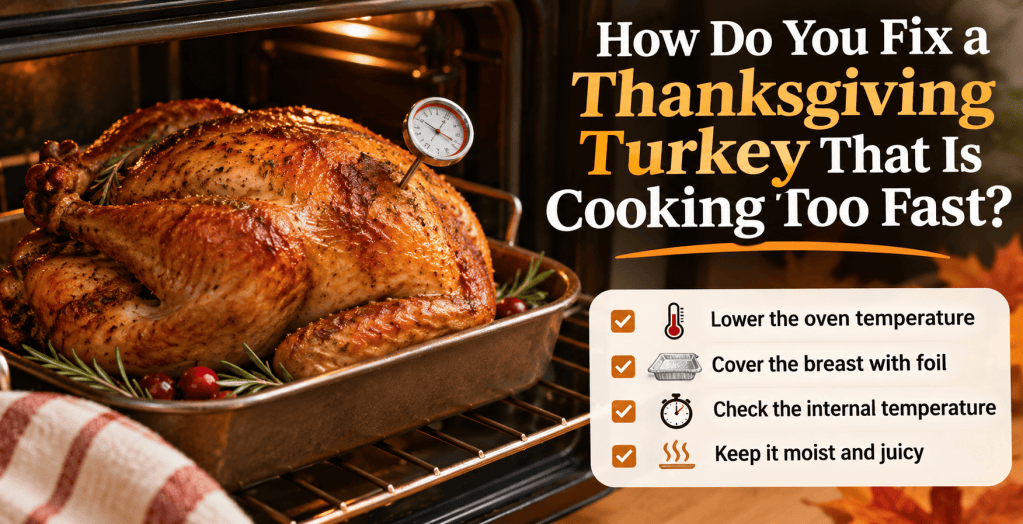
Thanksgiving turkey is often the centerpiece of the holiday meal, but cooking it perfectly can be challenging. One of the most frustrating problems is discovering that your turkey is cooking much faster than expected. You may have planned for several hours of roasting, only to find that the skin is already turning dark brown or the internal temperature is rising faster than your dinner schedule allows.
Fortunately, a Thanksgiving turkey that is cooking too fast does not necessarily mean your holiday dinner is ruined. With a few simple adjustments, you can slow down the roasting process, protect the meat from drying out, and still serve a juicy, flavorful turkey.
The key is understanding why the turkey is cooking quickly, recognizing the warning signs, and knowing when to reduce the oven temperature, cover certain areas with foil, or remove the turkey from the oven entirely.
This guide explains how to fix a Thanksgiving turkey that is cooking too fast, how to prevent overcooking, and what to do if your turkey finishes much earlier than expected.
Why Is My Thanksgiving Turkey Cooking Too Fast?
Several factors can cause a Thanksgiving turkey to cook faster than the estimated roasting time.
1. Your Oven Temperature Is Too High
One of the most common reasons a turkey cooks too quickly is an oven that runs hotter than the temperature displayed on its controls.
For example, an oven set to 325°F may actually be operating at 350°F or higher.
Even a relatively small temperature difference can affect how quickly the turkey cooks, especially during a long roasting period.
Using an oven thermometer can help you determine whether your oven is maintaining the correct temperature.
2. Your Turkey Is Smaller Than Expected
Smaller turkeys generally require less cooking time than larger birds.
A 10-pound turkey will usually finish roasting considerably sooner than a 20-pound turkey.
If you are accustomed to preparing larger Thanksgiving turkeys, you may accidentally overestimate the cooking time needed for a smaller bird.
3. Your Turkey Was Not Completely Cold
The starting temperature of the turkey can influence cooking time.
A turkey that has been sitting at room temperature for an extended period may cook somewhat faster than one transferred directly from the refrigerator.
However, raw turkey should not be left at room temperature for more than two hours, or one hour when the surrounding temperature exceeds 90°F.
4. Your Oven Uses Convection Cooking
Convection ovens circulate hot air around the turkey, allowing heat to transfer more efficiently.
This can shorten cooking times compared with conventional ovens.
If you are following a recipe written for a conventional oven while using convection settings, your turkey may finish earlier than expected.
5. Your Turkey Is Spatchcocked
A spatchcocked turkey has its backbone removed and is flattened before roasting.
Because the meat is spread out more evenly, it generally cooks much faster than a traditional whole turkey.
This cooking method is excellent for achieving crispy skin and juicy meat, but it requires different roasting expectations.
What Should You Do First If Your Turkey Is Cooking Too Fast?
The first thing you should do is check the turkey’s internal temperature using a reliable meat thermometer.
Do not rely solely on the color of the skin or the amount of time the turkey has been roasting.
A turkey can look fully cooked on the outside while remaining undercooked in the center.
Insert the thermometer into the thickest part of the breast and the innermost part of the thigh, avoiding bones. Check the innermost part of the wing as well.
The USDA recommends cooking turkey to a minimum internal temperature of 165°F in all three locations.
If the turkey has not reached a safe internal temperature, you can make adjustments to slow down the remaining cooking process.
If it has already reached 165°F throughout, remove it from the oven rather than continuing to roast it.
1. Lower the Oven Temperature
One of the easiest ways to slow down a Thanksgiving turkey that is cooking too quickly is to reduce the oven temperature.
If your turkey is roasting at 375°F or 400°F and appears to be progressing too rapidly, reduce the temperature to 325°F.
This can help slow the cooking process while allowing the inside of the turkey to continue heating.
How to Adjust the Temperature
-
Check the internal temperature of the turkey.
-
Reduce the oven setting to 325°F.
-
Keep the turkey in the oven if it is still undercooked.
-
Monitor its internal temperature regularly.
-
Remove the turkey once all required areas reach 165°F.
For a whole turkey, 325°F is a reliable roasting temperature and is the USDA’s recommended minimum oven temperature.
Avoid lowering the oven below 325°F to deliberately extend the cooking time of a whole turkey. Doing so can increase food safety risks.
2. Cover the Turkey Breast With Aluminum Foil
If the turkey breast is browning too quickly, aluminum foil can help protect it from excessive direct heat.
The breast often cooks faster than the thighs because white meat contains less connective tissue and generally requires less cooking time to become tender.
Covering the breast can help reduce additional browning while the rest of the turkey continues cooking.
How to Use Aluminum Foil
Place a loose piece of aluminum foil over the breast area.
Do not wrap the entire turkey tightly.
The foil should act as a protective shield rather than completely sealing the bird.
Continue monitoring the internal temperature.
If the skin needs additional browning toward the end of roasting, you can remove the foil briefly, provided the turkey has not already reached its safe final temperature.
Important: Aluminum foil helps control surface browning, but it does not reliably prevent the internal temperature from rising. Always use a thermometer.
3. Check Whether the Turkey Is Actually Cooking Too Fast
Sometimes a turkey appears to be cooking too quickly when it is actually following a normal roasting pattern.
Turkey cooking times are estimates rather than exact measurements.
The shape of the bird, oven performance, roasting pan, and starting temperature can all affect the cooking process.
Approximate Thanksgiving Turkey Cooking Times
The following times are general estimates for an unstuffed turkey roasted at 325°F.
| Turkey Weight | Estimated Cooking Time |
|---|---|
| 8–12 pounds | 2¾–3 hours |
| 12–14 pounds | 3–3¾ hours |
| 14–18 pounds | 3¾–4¼ hours |
| 18–20 pounds | 4¼–4½ hours |
| 20–24 pounds | 4½–5 hours |
These times are only guidelines.
Always determine doneness by checking the internal temperature rather than following the clock alone.
4. Protect the Turkey Breast From Drying Out
When a turkey cooks too quickly, one of the biggest concerns is dry breast meat.
Turkey breast contains relatively little fat, making it more vulnerable to drying out when overcooked.
Fortunately, several techniques can help preserve moisture.
Use Butter or Oil
Before roasting, brushing the turkey with melted butter or oil can help encourage even browning.
However, adding butter to an already overcooked turkey will not restore the moisture lost from the meat.
Avoid Excessive Basting
Repeatedly opening the oven to baste the turkey can cause temperature fluctuations.
Basting may add flavor to the skin, but it does not reliably keep the inside of the breast moist.
Instead, focus on maintaining a steady oven temperature and removing the turkey when it reaches the proper internal temperature.
Use a Meat Thermometer
A thermometer is the most effective tool for preventing overcooking.
Once the breast reaches 165°F, it should not continue roasting simply because the original cooking schedule has not ended.
5. What If the Turkey Breast Is Done but the Thighs Are Not?
Sometimes the turkey breast reaches 165°F before the thighs finish cooking.
This is a common challenge when roasting a whole Thanksgiving turkey.
If the breast is done but the thighs are still undercooked, continuing to roast the entire bird may dry out the breast.
One option is to carefully separate the leg quarters from the turkey and return them to the oven while the breast rests.
This allows the darker meat to finish cooking without exposing the breast to additional heat.
Use a clean cutting board and utensils, and avoid contaminating cooked meat with juices from undercooked portions.
The thighs must reach at least 165°F before serving.
For a more tender texture, many cooks prefer dark meat cooked somewhat beyond that minimum temperature.
6. What If Your Thanksgiving Turkey Is Done Too Early?
One of the most common Thanksgiving cooking problems is a turkey that finishes an hour or two before dinner.
Although this may seem inconvenient, an early turkey is generally easier to manage than one that is still raw when guests arrive.
The important thing is keeping the cooked turkey at a safe temperature.
If Dinner Is Less Than 30 Minutes Away
Allow the turkey to rest loosely covered with foil.
Resting helps the juices redistribute and makes the meat easier to carve.
A resting period of approximately 20–30 minutes is often suitable for a whole turkey.
If Dinner Is 30–60 Minutes Away
Keep the turkey covered and monitor its temperature.
If you plan to hold the turkey hot, use equipment that can maintain the meat at 140°F or higher.
Do not assume that a foil-covered turkey will remain safely hot for an hour without checking.
If Dinner Is More Than Two Hours Away
The safest approach is usually to carve the turkey and refrigerate it promptly.
Place the meat in shallow containers so it cools quickly.
When you are ready to serve dinner, reheat the turkey to 165°F.
Adding a small amount of broth or gravy during reheating can help prevent the meat from becoming excessively dry.
Cooked turkey should not remain in the temperature danger zone between 40°F and 140°F for more than two hours total.
7. Can You Turn the Oven Off and Leave the Turkey Inside?
Turning off the oven while leaving a partially cooked turkey inside is not recommended.
Although this might seem like an easy way to slow the cooking process, the oven temperature will gradually decrease.
This can leave the turkey at unsafe temperatures before it finishes cooking.
A partially cooked turkey should not be held in a cooling oven for an extended period.
Instead, maintain an oven temperature of at least 325°F until the turkey reaches the required internal temperature.
If the turkey is already fully cooked, remove it and use appropriate hot-holding or refrigeration methods.
8. Should You Add Water or Broth to the Roasting Pan?
Adding a small amount of water or broth to the roasting pan can help prevent drippings from burning.
It can also provide flavorful liquid for making Thanksgiving gravy.
However, adding liquid to the roasting pan will not significantly slow the internal cooking process.
If the turkey is cooking too fast, reducing an excessively high oven temperature and monitoring doneness are more effective solutions.
Avoid pouring cold water directly over the turkey, as this can interfere with browning and create unnecessary temperature changes.
9. How Do You Prevent the Turkey Skin From Burning?
A turkey that cooks too quickly may develop very dark skin before the meat is fully cooked.
If this happens, the best solution is to protect the skin while allowing the interior to finish roasting.
Cover the darkening areas loosely with aluminum foil.
If the oven is above 325°F, reduce it to 325°F.
Continue cooking until the required internal temperatures are reached.
If only the wing tips or drumstick ends are becoming too dark, wrap those areas individually with foil.
This allows the rest of the turkey to continue browning without exposing the smaller sections to excessive heat.
10. Can You Save a Turkey That Is Already Overcooked?
If your Thanksgiving turkey has already become dry, you cannot reverse the overcooking.
However, you can improve the flavor and texture before serving.
Slice the Turkey Thinly
Thin slices are often easier to eat than thick pieces of dry turkey breast.
Carve the meat across the grain to improve tenderness.
Add Warm Turkey Broth
Place the sliced turkey in a shallow serving dish.
Add a small amount of warm turkey or chicken broth to provide additional moisture.
Avoid completely soaking the meat, which can dilute its flavor.
Serve With Gravy
Homemade turkey gravy is one of the best ways to make slightly dry turkey more enjoyable.
The gravy adds moisture, richness, and flavor.
Use the Turkey in Other Recipes
If the turkey is too dry to serve as the main dish, it can still be used in other meals.
Leftover turkey works well in soups, casseroles, sandwiches, turkey pot pie, and turkey salad.
How Can You Prevent a Thanksgiving Turkey From Cooking Too Fast?
Preventing the problem is easier than trying to correct it during roasting.
A few simple preparations can make the cooking process more predictable.
Use an Oven Thermometer
An oven thermometer helps verify the actual temperature inside your oven.
This is particularly helpful when preparing a large Thanksgiving meal that requires several hours of cooking.
Start Checking the Turkey Early
Do not wait until the estimated finishing time to check the internal temperature.
Begin checking before the earliest expected completion time, especially when roasting a smaller turkey or using a convection oven.
Roast at a Consistent Temperature
For traditional whole-turkey roasting, 325°F is a dependable temperature.
Avoid repeatedly increasing and decreasing the heat unless necessary.
Use a Proper Roasting Pan
A sturdy roasting pan with a rack allows hot air to circulate around the turkey.
This promotes more even cooking and helps prevent the bottom of the bird from sitting directly in hot drippings.
Plan for an Early Finish
When organizing Thanksgiving dinner, allow time for the turkey to rest before carving.
Having a safe hot-holding or refrigeration plan also makes it easier to handle a turkey that finishes ahead of schedule.
Frequently Asked Questions
Why Is My Thanksgiving Turkey Cooking Faster Than the Recipe Says?
Your turkey may be smaller than the recipe’s bird, your oven may run hot, or you may be using convection settings. Turkey shape, starting temperature, and roasting equipment can also affect cooking time.
Can I Lower My Turkey Oven Temperature From 375°F to 325°F?
Yes. Reducing the oven temperature from 375°F to 325°F can help slow roasting while maintaining an appropriate temperature for cooking a whole turkey.
What Happens If My Turkey Reaches 165°F Too Early?
If the turkey reaches 165°F in the thickest breast, innermost thigh, and innermost wing, it is fully cooked and should be removed from the oven. Keep it safely hot or refrigerate it promptly if dinner is still some time away.
Will Covering a Turkey With Foil Make It Cook Slower?
Foil can reduce surface browning and protect areas from direct radiant heat, but it does not reliably slow the turkey’s internal cooking enough to solve a timing problem.
Can I Leave a Cooked Turkey in the Oven at 170°F?
A fully cooked turkey can be held in an oven set to 170°F if the meat remains at or above 140°F. However, extended holding may dry it out. Verify the actual holding temperature with a thermometer.
Should I Take My Turkey Out If the Breast Is Done but the Thighs Are Not?
Do not serve the undercooked thighs. You can separate the leg quarters and return them to the oven while protecting the cooked breast from further heating.
How Do You Keep an Early Thanksgiving Turkey Moist?
Avoid additional roasting once the turkey is fully cooked. Use safe hot holding for a short delay, or refrigerate and reheat it with a little broth for a longer delay.
Can You Put a Partially Cooked Turkey Back in the Oven Later?
Partially cooking a turkey and then cooling it to finish cooking later is not recommended. Once roasting begins, continue cooking until the turkey reaches a safe internal temperature.
Final Thoughts
A Thanksgiving turkey that is cooking too fast does not have to ruin your holiday dinner. The most important thing is recognizing the problem early and making adjustments before the meat becomes overcooked.
If the turkey is browning too quickly, loosely covering the breast with aluminum foil can help protect the skin. If the oven temperature is too high, reducing it to 325°F can slow the roasting process. Most importantly, checking the internal temperature allows you to determine exactly when the turkey is ready.
If your turkey finishes earlier than expected, proper resting, safe hot holding, or refrigeration can help preserve its quality until dinner.
Remember that a perfectly cooked Thanksgiving turkey depends more on internal temperature than roasting time.
With careful monitoring, a reliable meat thermometer, and a little flexibility in your cooking schedule, you can still serve a tender, juicy, and flavorful Thanksgiving turkey—even when it cooks faster than planned.


Leave a Reply