
Cooking the perfect Thanksgiving turkey involves more than choosing the right seasonings, roasting it at the proper temperature, and making sure the meat is fully cooked. One of the most important steps happens after the turkey comes out of the oven.
Allowing a Thanksgiving turkey to rest before carving helps preserve its natural juices, improves the texture of the meat, and makes carving easier. Cutting into the bird too soon can cause valuable moisture to escape, leaving the turkey drier than expected.
So, how long should a Thanksgiving turkey rest before carving?
Most Thanksgiving turkeys should rest for 20 to 40 minutes before carving, while particularly large birds may benefit from 45 minutes or longer. The ideal resting time depends on the turkey’s size, cooking method, and how you plan to serve it.
Understanding why resting matters and how to do it correctly can make a noticeable difference in your Thanksgiving dinner.
Why Should You Let a Thanksgiving Turkey Rest?
When a turkey roasts, heat causes its muscle fibers to contract and moisture to move throughout the meat. The juices are particularly mobile immediately after cooking.
If you carve the turkey as soon as it leaves the oven, more of those juices may flow onto the cutting board instead of remaining in the meat.
Resting gives the turkey time to cool slightly, allowing its muscle fibers to relax and helping reduce moisture loss during carving.
There are several benefits to letting your Thanksgiving turkey rest.
1. Helps Keep the Meat Juicy
One of the biggest reasons to rest a turkey is moisture retention.
During roasting, the turkey’s internal temperature rises, causing proteins to tighten and release some moisture.
As the meat rests, its temperature begins to stabilize and the muscle fibers relax somewhat.
Although resting does not completely redistribute every drop of juice, it helps reduce the amount of moisture lost when the meat is sliced.
This is especially important for turkey breast meat, which can become dry when overcooked.
2. Makes Carving Easier
A freshly roasted turkey is extremely hot, making it difficult to handle safely.
Resting allows the surface to cool enough for easier carving.
The meat also becomes slightly firmer as it cools, making it easier to cut clean slices without tearing the turkey apart.
This can be particularly helpful when preparing a large Thanksgiving turkey for a family gathering.
3. Allows Time to Finish Thanksgiving Side Dishes
Resting your turkey creates a useful window for finishing the rest of Thanksgiving dinner.
While the turkey rests, you can prepare gravy, warm dinner rolls, finish mashed potatoes, reheat casseroles, and arrange serving dishes.
Instead of rushing to carve the turkey immediately, you can use the resting period to coordinate the entire meal.
4. Helps Prevent Excessive Juice Loss
A turkey that is carved immediately after roasting may release a significant amount of liquid.
Some juice loss is unavoidable, but resting helps minimize it.
The result is turkey meat that retains more moisture and is more enjoyable to eat.
How Long Should a Thanksgiving Turkey Rest Based on Weight?
The size of your turkey can influence how long it needs to rest.
Smaller turkeys generally require less resting time than larger birds because they cool more quickly.
The following chart provides practical resting-time guidelines.
| Turkey Weight | Recommended Resting Time |
|---|---|
| 8–10 pounds | 20–25 minutes |
| 10–12 pounds | 25–30 minutes |
| 12–14 pounds | 30–35 minutes |
| 14–16 pounds | 30–40 minutes |
| 16–18 pounds | 35–45 minutes |
| 18–20 pounds | 40–45 minutes |
| 20–24 pounds | 45–60 minutes |
These times are estimates rather than strict requirements. The turkey’s temperature, cooking method, and surrounding conditions also matter.
For most Thanksgiving dinners, allowing a turkey to rest for approximately 30 minutes is a good starting point.
For food safety, keep hot turkey at 140°F or above if it will be held before serving. If the turkey cools below that temperature, do not leave it at room temperature for more than two hours total.
Should You Cover a Thanksgiving Turkey While It Rests?
One of the most common questions about resting turkey is whether it should be covered with aluminum foil.
The answer depends on how long you plan to rest the turkey and whether you want to preserve crispy skin.
Resting Turkey Without Foil
Leaving the turkey uncovered allows steam to escape naturally.
This is often the best choice if you worked hard to achieve golden, crispy turkey skin.
Covering the turkey too tightly can trap steam, which may soften the skin.
For shorter resting periods of approximately 20 to 30 minutes, leaving the turkey uncovered is usually a reasonable option.
Resting Turkey With Aluminum Foil
If your turkey is especially large or you need a longer resting period, loosely tenting it with aluminum foil can help slow heat loss.
To do this, place a large sheet of foil over the turkey without wrapping it tightly around the bird.
Leave some space for steam to escape.
Avoid pressing the foil directly against the skin whenever possible.
Which Method Is Better?
If crispy skin is your priority, rest the turkey uncovered.
If maintaining heat is more important, use a loose foil tent.
Neither method requires sealing the turkey completely.
Does a Turkey Continue Cooking While Resting?
Yes. A Thanksgiving turkey can continue cooking briefly after it comes out of the oven.
This process is known as carryover cooking.
Heat stored in the hotter outer portions of the turkey continues moving toward the cooler center.
As a result, the internal temperature may rise several degrees during the early part of the resting period.
Larger turkeys can experience more carryover cooking than smaller birds.
However, the exact temperature increase is unpredictable.
Can You Remove Turkey Before It Reaches 165°F?
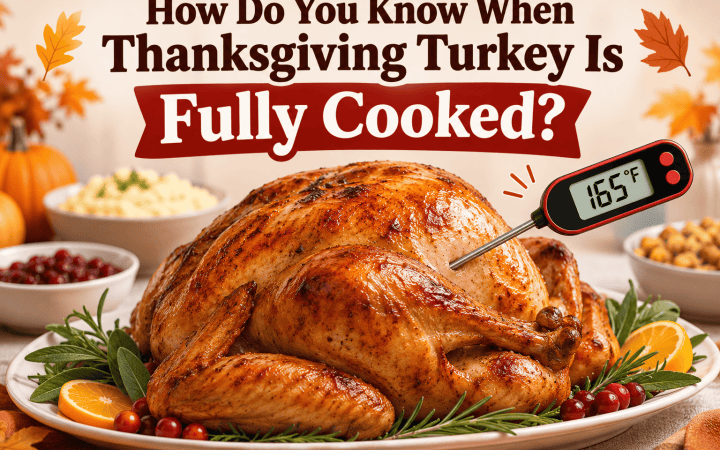
For straightforward home cooking, the safest approach is to verify that the turkey has reached an internal temperature of 165°F before removing it from the oven.
Check the thickest part of the breast, the innermost part of the thigh, and the innermost part of the wing using a food thermometer. Avoid touching bone with the thermometer probe.
If the turkey contains stuffing, the center of the stuffing must also reach 165°F.
Although some experienced cooks use carryover cooking when determining when to remove meat from heat, do not assume that resting alone will bring an undercooked turkey to a safe temperature.
What Happens If You Carve a Thanksgiving Turkey Too Soon?
Carving a turkey immediately after roasting can affect its moisture, texture, and appearance.
The most noticeable problem is excessive juice loss.
When you cut into very hot turkey meat, liquid can escape quickly from the freshly exposed surfaces.
This can leave slices of turkey breast drier than they would have been after a proper resting period.
Carving too early can also make the meat more difficult to handle.
Freshly roasted turkey is hot enough to cause burns, especially when removing the legs and separating the breast meat from the carcass.
Additionally, the meat may be more difficult to slice neatly.
While carving too early will not automatically ruin Thanksgiving dinner, waiting a little longer generally produces better results.
Can You Let a Thanksgiving Turkey Rest for an Hour?
Yes, a large Thanksgiving turkey may rest for approximately an hour, provided it is held safely.
A turkey weighing 20 pounds or more may benefit from a longer resting period, especially if it has been roasted whole.
However, the longer a turkey rests at room temperature, the more heat it loses.
If you expect to wait an hour before carving, consider loosely covering the turkey with foil and monitoring its temperature.
For extended holding, use equipment capable of keeping the turkey at or above 140°F.
Do not rely on foil or towels alone to maintain a safe temperature for a prolonged period.
The goal is to give the turkey enough time to rest without allowing it to become cold or remain at unsafe temperatures.
Can a Thanksgiving Turkey Rest Too Long?
Yes. Although resting is beneficial, leaving a cooked turkey sitting out for too long can create problems.
The first issue is temperature.
Turkey that rests for an excessive amount of time may become lukewarm or cold before serving.
The second concern is food safety.
Cooked turkey is a perishable food and should not remain at room temperature for more than two hours.
If the surrounding temperature is above 90°F, that limit decreases to one hour.
For longer delays, keep the turkey at 140°F or above or refrigerate it promptly.
A third issue is skin texture.
Covering the turkey for an extended period may trap moisture and cause crispy skin to soften.
For these reasons, it is best to coordinate your resting period with the rest of Thanksgiving dinner.
Where Should You Rest a Thanksgiving Turkey?
The best place to rest a Thanksgiving turkey is on a clean, heat-resistant surface where it can remain undisturbed.
A large cutting board with a juice groove is a convenient choice.
You can also leave the turkey on a rack inside its roasting pan.
Resting on a Cutting Board
A cutting board provides a convenient surface for carving after the resting period.
Choose a board large enough to support the entire turkey.
A juice groove around the edge can help collect any liquid released during resting.
Make sure the cutting board is stable and will not slide while you carve.
Resting in the Roasting Pan
Leaving the turkey in its roasting pan is another practical option.
This eliminates the need to transfer a very hot bird immediately after cooking.
If possible, keep the turkey elevated on a roasting rack so it does not sit directly in accumulated juices.
This can help preserve the texture of the skin on the underside of the turkey.
Should You Rest Turkey in the Oven?
A turned-off oven is not always the best resting location.
An oven that remains very hot may continue cooking the turkey, potentially drying out the breast meat.
If you need to hold the turkey for an extended period, use a controlled warming setting and verify that the turkey stays at a safe temperature.
For a normal 20- to 40-minute resting period, a cutting board or roasting pan is generally more convenient.
How Do You Keep a Thanksgiving Turkey Warm While Resting?
Keeping a turkey warm without overcooking it requires a little planning.
One option is to loosely cover the turkey with aluminum foil.
This can slow heat loss while allowing some steam to escape.
You can also place the turkey in a warm, draft-free area of the kitchen, away from cold windows or open doors.
However, a warm countertop is not a substitute for proper hot-holding equipment.
If the turkey needs to remain warm for substantially longer than its normal resting period, use a food-safe warmer that maintains a temperature of at least 140°F.
Avoid repeatedly placing the turkey back into a hot oven, as additional cooking can dry out the meat.
Should You Rest Turkey Breast and Whole Turkey for the Same Amount of Time?
No. A turkey breast generally requires less resting time than a whole turkey.
Because a turkey breast is smaller and contains less overall mass, it tends to cool more quickly.
A boneless turkey breast may need approximately 10 to 15 minutes of resting.
A bone-in turkey breast may benefit from 15 to 25 minutes.
A whole Thanksgiving turkey usually needs 20 to 40 minutes, with larger birds sometimes requiring longer.
The cooking method also influences the ideal resting period.
For example, a smoked turkey breast may benefit from a different resting time than a whole oven-roasted turkey.
Regardless of the cooking method, confirm the turkey has reached a safe internal temperature before resting.
Should You Remove the Turkey From the Roasting Pan Before Resting?
You can remove the turkey from the roasting pan before resting, but it is not required.
Transferring the turkey to a cutting board can be helpful if you need the roasting pan to make gravy.
The browned bits and drippings left in the pan can be used to prepare a flavorful Thanksgiving gravy while the turkey rests.
However, moving a large turkey requires caution.
Use sturdy utensils or appropriate lifting tools, and make sure the bird is securely supported.
If the turkey is especially heavy, leaving it in the roasting pan until it cools slightly may be easier and safer.
How Do You Know When a Thanksgiving Turkey Is Ready to Carve?
A turkey is generally ready to carve once it has rested for the recommended amount of time and is cool enough to handle safely.
You do not need to wait until the turkey reaches a specific lower internal temperature.
Instead, use the size of the bird and the elapsed resting time as your main guides.
For example, a 12-pound turkey that has rested for 30 minutes will generally be ready to carve.
A 20-pound turkey may benefit from a longer rest.
Before carving, prepare a sharp knife, a sturdy cutting board, and a serving platter.
Having everything ready makes the carving process easier.
What Is the Best Way to Carve a Thanksgiving Turkey After Resting?
Once your turkey has finished resting, proper carving helps preserve its appearance and makes serving easier.
Step 1: Remove the Legs
Place the turkey breast-side up on a stable cutting board.
Gently pull one leg away from the body and cut through the skin between the thigh and breast.
Locate the joint connecting the thigh to the body and carefully separate it.
Repeat on the opposite side.
Step 2: Separate the Thighs and Drumsticks
Place each leg section on the cutting board.
Find the joint between the thigh and drumstick.
Cut through the joint to separate the pieces.
You can serve the drumsticks whole or remove the meat from the bone.
Step 3: Remove the Wings
Pull each wing away from the turkey.
Locate the joint where the wing connects to the body and carefully cut through it.
Set the wings aside for serving.
Step 4: Remove the Breast Meat
Find the breastbone running down the center of the turkey.
Using a sharp knife, cut along one side of the breastbone.
Follow the rib cage as you carefully separate the breast meat from the carcass.
Repeat on the opposite side.
Step 5: Slice the Turkey Breast
Place each breast section on the cutting board.
Slice the meat across the grain into even pieces.
Cutting across the grain shortens the muscle fibers and helps make each bite more tender.
Arrange the slices on a serving platter.
Step 6: Serve Immediately
Once the turkey is carved, serve it while it is still warm.
You can spoon a little warm turkey broth or reserved cooking juice over the slices to help keep them moist.
Serve with gravy and your favorite Thanksgiving side dishes.
Common Mistakes to Avoid When Resting Thanksgiving Turkey
Even experienced home cooks can make mistakes during the resting process.
Here are some of the most common problems to avoid.
Carving Immediately After Roasting
Cutting into the turkey too soon can cause unnecessary moisture loss.
Allow at least 20 minutes for most whole turkeys.
Wrapping the Turkey Too Tightly
Tightly wrapping the turkey in foil traps steam.
This can soften the skin and reduce the crispy texture developed during roasting.
Use a loose tent instead.
Letting the Turkey Sit Out Too Long
Resting should not become an extended period of unsafe room-temperature storage.
Keep track of the time and use safe hot-holding equipment if dinner is delayed.
Forgetting About Carryover Cooking
A turkey can continue cooking after it leaves the oven.
This is one reason accurate temperature monitoring is important.
Not Planning the Resting Period
If you wait until the turkey is finished cooking to start preparing side dishes, Thanksgiving dinner may become unnecessarily stressful.
Build the resting period into your meal schedule.
Frequently Asked Questions
Is 20 Minutes Enough for a Thanksgiving Turkey to Rest?
Yes. Twenty minutes can be sufficient for a smaller whole turkey, particularly one weighing around 8 to 10 pounds. Larger turkeys generally benefit from a longer resting period.
Should You Rest Turkey for 30 Minutes or 60 Minutes?
For most average-sized Thanksgiving turkeys, 30 minutes is a practical resting time. Very large turkeys may benefit from 45 to 60 minutes, provided they are kept at safe temperatures.
Does Resting Turkey Make It More Tender?
Resting can improve the eating experience by reducing moisture loss during carving. It does not significantly break down connective tissue or reverse overcooking, but it can help the meat seem juicier and more tender.
Should You Cover Turkey With a Towel While Resting?
A towel is not necessary for a normal resting period. A loose foil tent is generally easier to manage. Towels and foil do not guarantee safe hot holding, so use temperature-controlled equipment for extended delays.
Can You Rest Turkey After Deep Frying?
Yes. Deep-fried turkey also benefits from resting. Many whole deep-fried turkeys can rest for approximately 20 to 30 minutes before carving, depending on their size.
Should You Remove the Stuffing Before Resting the Turkey?
If you cooked stuffing inside the turkey, first verify that the center of the stuffing has reached 165°F. Remove the stuffing carefully and transfer it to a separate serving dish or a container that can keep it safely hot. Do not leave stuffing inside a cooling turkey for an extended period.
Will Turkey Get Cold While Resting?
A turkey gradually loses heat while resting, but a large whole turkey often retains substantial warmth during a normal 20- to 40-minute resting period. For longer waits, monitor the temperature and use safe hot-holding methods.
Can You Reheat Turkey After It Has Rested?
Yes. If the turkey has cooled and been refrigerated safely, you can reheat it later. Reheat leftovers to an internal temperature of 165°F. Adding a small amount of broth and covering the meat while reheating can help prevent dryness.
Final Thoughts: How Long Should a Thanksgiving Turkey Rest Before Carving?
Resting your Thanksgiving turkey is one of the simplest ways to improve the final meal.
After spending hours seasoning, preparing, and roasting the bird, allowing a little extra time before carving helps preserve moisture and makes serving easier.
For most Thanksgiving turkeys, 20 to 40 minutes of resting is ideal, while particularly large birds may benefit from 45 to 60 minutes.
Keep the turkey uncovered if crispy skin is your priority, or loosely tent it with aluminum foil if you want to slow heat loss.
Most importantly, make sure the turkey has reached a safe internal temperature before removing it from the oven, and avoid leaving it at room temperature for an extended period.
A properly rested Thanksgiving turkey is easier to carve, retains more of its natural juices, and provides tender, flavorful slices for everyone around the table.
Sometimes, the secret to a better Thanksgiving dinner is simply knowing when to wait.



Leave a Reply